


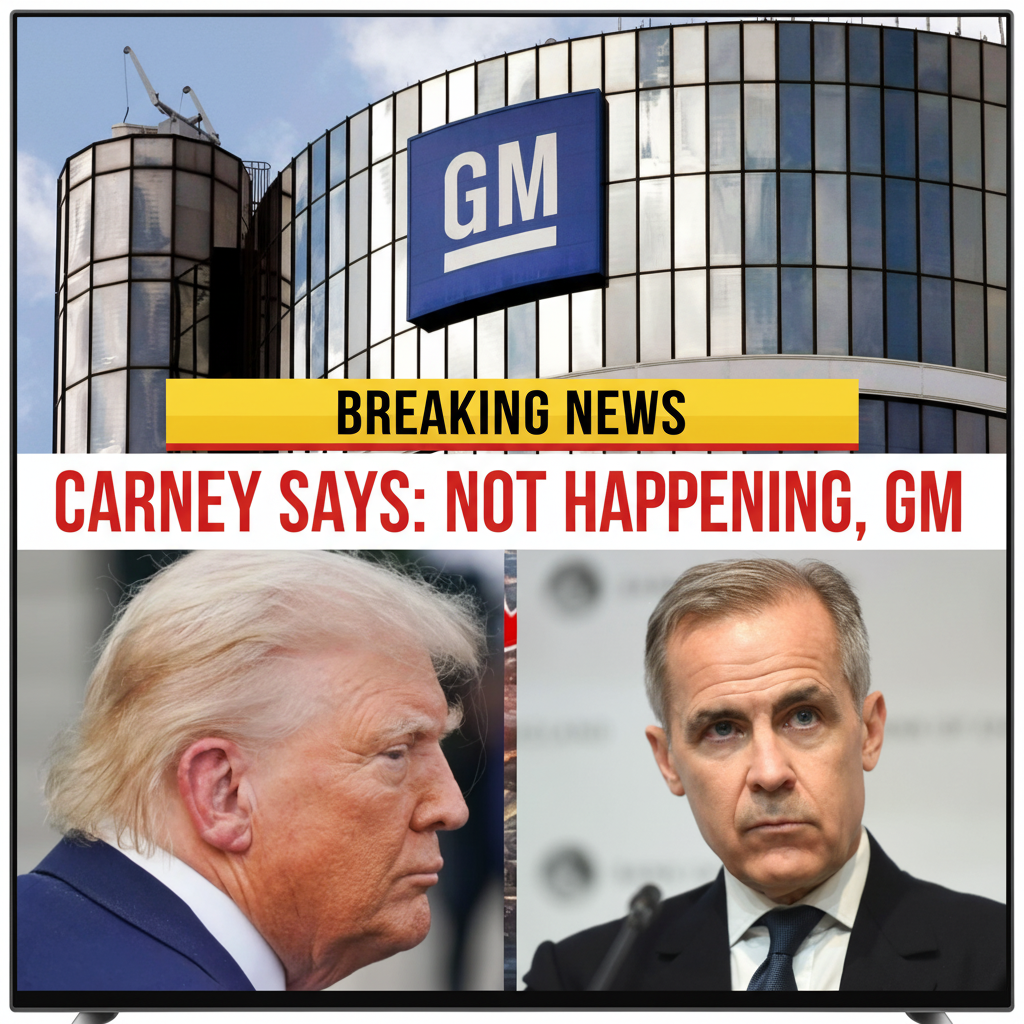
When General Motors quietly shut down its BrightDrop electric delivery van plant in Ingersoll, Ontario, it expected backlash from workers and local politicians. What it didn’t expect was a systemic response from Ottawa—one designed not to negotiate, but to punish. Within days, Canada activated a new legal framework aimed at holding multinational corporations accountable for broken commitments. The result: steep tariffs, shattered assumptions, and a clear signal that Canada is no longer willing to absorb corporate exits without consequences. What began as a factory closure has quickly escalated into a defining test of power between the Canadian state and global automakers.
The announcement came without warning.
In a brief corporate statement, General Motors confirmed it was shutting down production at its BrightDrop electric delivery van facility in Ingersoll, Ontario—an operation that had been widely touted as a cornerstone of Canada’s electric vehicle future. More than 1,200 workers were suddenly left in limbo, and a community built around decades of automotive manufacturing faced an uncertain future.
For many employees, the decision felt less like a business adjustment and more like a betrayal. GM had previously positioned Ingersoll as a flagship EV hub, benefiting from public incentives, political goodwill, and a workforce that had weathered multiple industry downturns. The closure raised an uncomfortable question: what happens when corporate promises collide with shareholder priorities?
Ottawa’s answer arrived swiftly—and quietly.

Three days after GM’s announcement, Industry Minister Mélanie Joly and Finance Minister François-Philippe Champagne released a carefully worded statement noting that GM, along with Stellantis, had violated commitments made to Canadian workers and the federal government. To casual observers, the language appeared restrained. To insiders, it was unmistakable: the government was triggering a new enforcement mechanism that had been designed precisely for moments like this.
That mechanism—the auto remission framework—represents a fundamental shift in Canada’s approach to corporate accountability. Unlike past disputes, which often devolved into prolonged negotiations or political standoffs, the framework operates automatically. Break a commitment, and penalties follow.

For GM, the consequences are severe. Under the framework, the company faces a 25% reduction in its duty-free vehicle import quota into Canada. Vehicles imported from the United States will now be subject to steep tariffs, sharply increasing their retail prices. Analysts estimate that a U.S.-built GM vehicle costing $45,000 could jump by more than $10,000 once tariffs are applied—an increase likely to erode market share almost overnight.
Stellantis, which has shifted production away from Canada in recent years, has also been hit. Its tariff-free allowance has been cut by 50%, putting pressure on its Canadian operations and sending a clear message to other automakers watching closely.
What makes the response extraordinary is not just its scale, but its structure. There is no backroom bargaining, no political theater. The penalties are rule-based, immediate, and difficult to reverse. In effect, Canada has rewritten the terms of engagement with multinational manufacturers.
The broader implications are impossible to ignore.
For decades, Canada was often seen as the quieter partner in North American manufacturing—reliable, accommodating, and cautious about asserting leverage. That posture is changing. The BrightDrop closure has accelerated a shift toward a more assertive industrial strategy, one that prioritizes domestic jobs and long-term commitments over corporate flexibility.
This transformation is unfolding against a volatile backdrop. Trade relations across North America remain fragile following years of tariff battles and policy unpredictability under former U.S. President Donald Trump. With Washington increasingly viewed as an unreliable partner, Canada has begun diversifying its economic and diplomatic options.
That pivot was underscored recently when Prime Minister Mark Carney held talks with Chinese President Xi Jinping, signaling a cautious thaw in relations and a willingness to explore alternative markets and supply chains. While politically sensitive, the outreach reflects a broader urgency: Canada can no longer afford overdependence on a single economic partner or a handful of global corporations.
Meanwhile, the clock is ticking for GM.
Ottawa has given the company 15 days to present a credible plan for the future of the Ingersoll plant. Failure to do so could cement the tariffs permanently, reshaping GM’s position in the Canadian market and setting a precedent with global consequences.
For workers, the outcome will determine livelihoods. For corporations, it signals a new risk calculus. And for Canada, it marks a decisive moment.
What began as a factory shutdown has evolved into something far larger—a test of whether a G7 nation can enforce economic sovereignty in an era dominated by multinational power. Ottawa has made its move. Now, the world is watching how GM responds—and whether other corporations take note.