


Canada just landed a clean-tech prize that cuts straight into the most sensitive battlefield of the decade: the EV supply chain.
While Washington braces for yet another round of tariff chaos, court fights, and corporate whiplash under Donald Trump’s second-term trade machine, one European company quietly delivered a verdict with its wallet: invest where the rules don’t change overnight.
In 2025, that place is Canada.
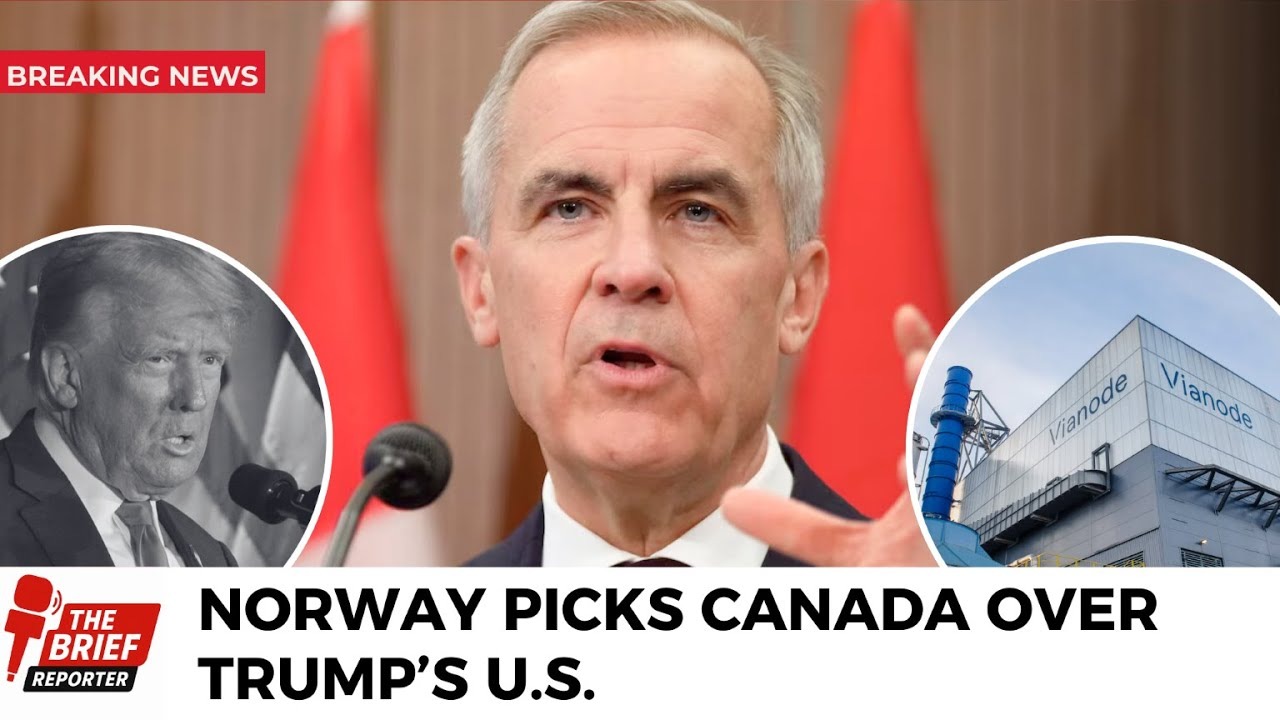
Norway’s Vianode has chosen Ontario for a $3.2 billion synthetic graphite plant—described as North America’s largest facility of its kind—set for St. Thomas, Ontario (at the Yarmouth Yard site). On paper, it’s an industrial announcement. In reality, it’s a geopolitical signal flare.
Because synthetic graphite isn’t “just another material.” It’s the backbone of lithium-ion batteries—the single heaviest component by weight in an EV battery. It’s even listed as a NATO critical mineral.
And right now, the West has an uncomfortable dependency: roughly 95% of global synthetic graphite supply still runs through Chinese producers. Every government in the G7 talks about “de-risking” from China. Vianode just showed what acting on it looks like.
Vianode’s CEO boiled the decision down to one word: predictability. Canada offers a stable political environment—exactly what a company needs when it’s about to lock billions into concrete, power contracts, and long-term supply obligations.

And the numbers are designed to make competitors sweat. The plant is expected to start with 300 jobs and scale to about 1,000 at full capacity. Output is projected at 150,000 tons of synthetic graphite per year—enough material for roughly 2 million electric vehicles. That’s not a “pilot project.” That’s a supply-chain anchor.
Ontario is backing the project with a $670 million loan. Ottawa, through Export Development Canada, is signaling support worth up to $500 million. The Canada Infrastructure Bank is assessing further financing.
Translation: Canada isn’t begging for investment and hoping for the best—it’s placing strategic bets and building industrial gravity.
What makes this hit harder is the contrast playing out across Ontario at the same time. While headlines swirl about job losses and production shifts—like Stellantis moving Jeep Compass production out of Brampton to Illinois and GM pausing EV van output in Ingersoll—Vianode is doing the opposite. It’s moving toward Canada, not away from it.

And it’s happening as the United States looks… unstable.
Trump’s tariff waves—autos, metals, threats of 100% duties on China—have rattled markets and pushed major players into legal battles. Automakers and clean-tech builders don’t just fear tariffs; they fear the deeper disease: uncertainty.
Even the future of CUSMA/USMCA, with a major review looming in 2026, is being treated like a risk event companies must price into their plans.
Canada, meanwhile, is broadcasting something investors crave: clarity. Prime Minister Mark Carney is expanding partnerships across Asia, signing minerals and defense-aligned agreements with allies, and positioning Canada as a dependable hub for clean-tech manufacturing.
Vianode’s decision also exposes the factor that makes Canada uniquely dangerous in this race: electricity. Synthetic graphite production is power-hungry. Most countries can’t offer large-scale electricity that is simultaneously clean, affordable, and reliable.
Canada can. The transcript points out that Canada’s grid is dominated by hydro and nuclear—and over 80% of national electricity already comes from emissions-free sources.
That clean grid isn’t a “nice to have.” It’s the entire business case.
Vianode says its technology can cut emissions by more than 90% compared with traditional Chinese methods—but that claim only works if the plant is plugged into clean power. In Canada, it is. Without hydro and nuclear, the math collapses.
This is why mega-projects keep landing in Ontario and Quebec—like Volkswagen’s $7 billion PowerCo battery gigafactory and other EV-linked investments.
The pattern is becoming impossible to ignore: companies want green electrons, stable policy, and governments willing to move fast. Canada is offering all three.
Then comes the bigger punchline: this isn’t just about jobs. It’s about leverage.
Countries that control processing capacity—not just raw minerals—get to shape the next industrial map. Vianode’s plant means Canada is moving up the value chain, creating non-Chinese supply for EVs, batteries, energy storage, and even defense-adjacent sectors across the G7.
In a world where the U.S. is increasingly seen as politically volatile, Canada is becoming the stable anchor. Norway just confirmed it with $3.2 billion.
And the question now isn’t whether Canada can compete.
It’s: if Vianode made this move… who’s next?