


As the busiest travel season of the year arrived, U.S. border cities were bracing for crowds, full hotels, and packed restaurants. What they got instead was silence.
No license plates from Ontario.
No Quebec ski buses.
No Canadian snowbirds crossing south.
Canada’s New Year boycott didn’t just make a statement—it emptied American border towns almost overnight, delivering a shock that local businesses say they have never seen before.
For generations, cross-border travel between Canada and the United States was treated as automatic. Canadians crossed south to shop, vacation, ski, dine, and celebrate holidays.
Entire local economies—from Maine to Montana—were built around that assumption. In late 2025, that assumption collapsed.
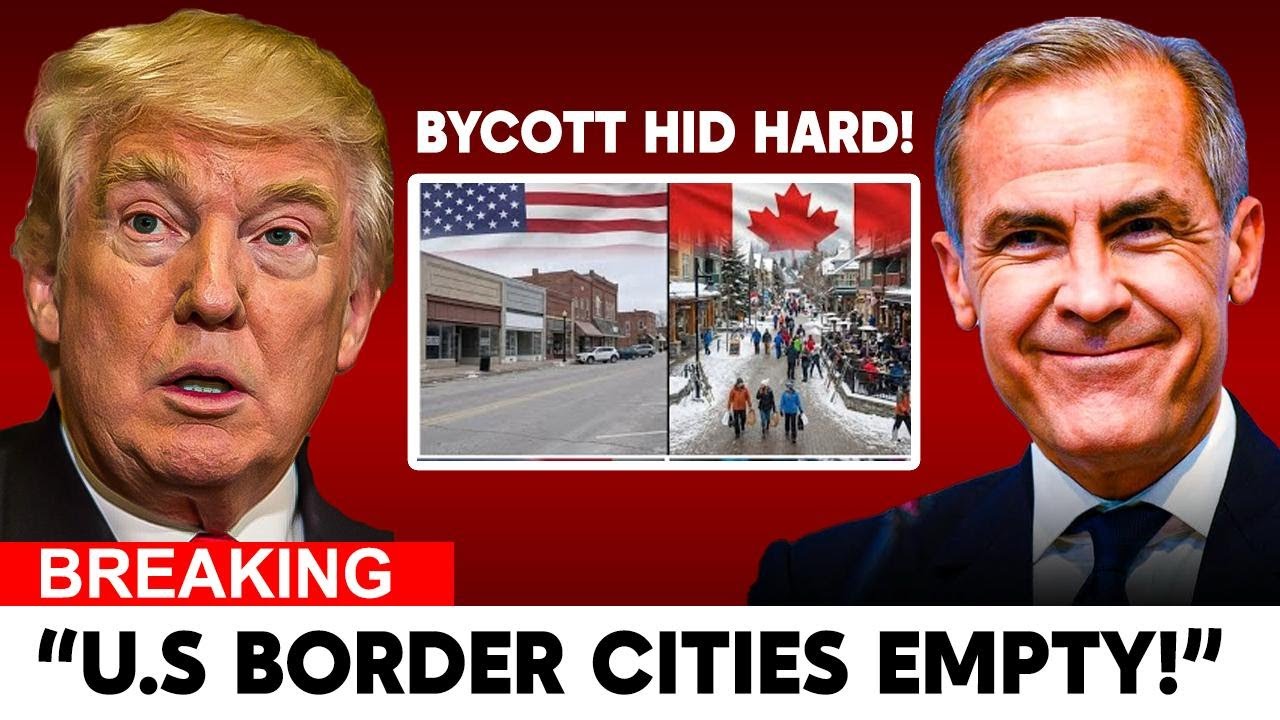
Business owners are now admitting what officials avoided saying publicly: Canadians aren’t coming back—at least not yet.
The numbers tell a brutal story. During the first 10 months of 2025, Canadian travel to the U.S. dropped 19% nationwide. In raw terms, that means 4.5 million fewer land crossings compared to the year before. But national averages hide the real pain.
The damage is concentrated almost entirely in border communities where Canadian visitors aren’t optional—they’re essential.
Vermont saw crossings fall 28%.
Washington State dropped 24%.
Montana fell 19%.
New Hampshire suffered a staggering 30% decline.
Those aren’t statistics. They’re lost paychecks.
In Montana, where nearly 80% of international visitors are Canadian, the impact was immediate. Businesses reported a 44% drop in Canadian credit card spending. One hotel alone lost $38,000 after a Canadian sports team canceled 70 rooms and a 200-person dinner.
That single cancellation rippled outward—caterers, suppliers, servers, cleaners, and nearby shops all took the hit.

New Hampshire’s data was even more alarming. State-run campground reservations plunged 71% in the first five months of 2025. In North Conway, a hotel owner said 30% of rooms sat empty on summer weekends that normally sell out effortlessly.
Washington State felt the collapse at the border itself. Spokane reported a 33% drop in visitors, while a duty-free shop near the crossing saw business fall over 80%. Staffing was slashed from about 20 employees to just three or four working limited hours.
These aren’t seasonal dips. They’re structural shocks.
At the national level, the U.S. Travel Association now projects a $5.7 billion loss in international tourism spending for 2025, with Canadian travelers responsible for a large share.
Historically, Canadians make up about 25% of all foreign visitors to the U.S. In 2024 alone, they spent $20.5 billion south of the border.
Every 1% drop in Canadian travel equals roughly $200 million in lost economic activity. A 10% decline threatens $2.1 billion and 140,000 jobs. With the current drop sitting at nearly 19%, the damage is already far beyond early projections.

So why are Canadians staying away?
It started with emotion—but evolved into habit.
President Trump’s repeated comments about Canada becoming the “51st state,” combined with tariff threats and abrupt trade walkouts, fundamentally changed how Canadians view the U.S. as a destination.
When tariffs on Canadian goods rose as high as 35%, and border enforcement became slower, more intrusive, and unpredictable, many Canadians decided the trip simply wasn’t worth it.
The January 2025 executive order tightening entry rules added another layer of friction. Snowbirds who once spent months in Florida—supporting entire rental, dining, healthcare, and retail ecosystems—stayed home instead.
And once Canadians discovered alternatives, they didn’t look back.
Canadians are still traveling. They’re just spending their money elsewhere. Japan, Europe, Australia, the Caribbean, and Mexico are all seeing surging Canadian bookings.

Domestic tourism inside Canada has also jumped sharply, supported by provincial campaigns encouraging people to keep their money at home.
Polling reveals the deeper shift: 91% of Canadians now want their country to rely less on the United States.
This isn’t a passing protest. It’s a strategic recalibration. Nearly 90% of Canadians say they are closely following trade and border policy developments—the highest sustained engagement since the early COVID years.
That level of attention signals something serious: this boycott has staying power.
For U.S. border cities, the New Year collapse wasn’t an anomaly. It was a preview. Even if politics change, habits formed during this period won’t vanish overnight. Businesses are closing. Workers are leaving. Tax bases are shrinking.
What was once the most dependable tourism relationship in North America has fractured—and New Year’s Eve proved just how fragile it has become.