


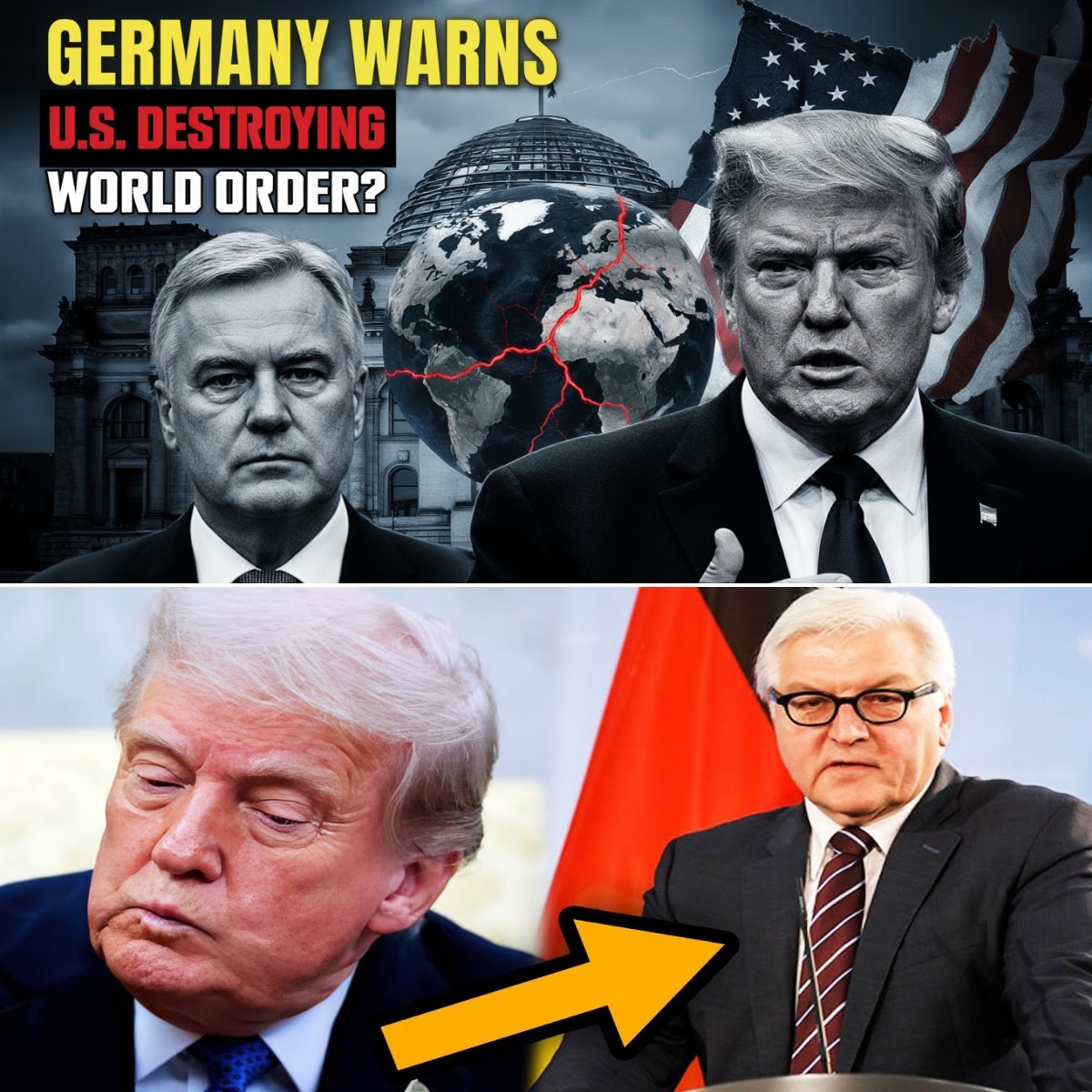
Germany’s President Issues Stark Warning as U.S. Credibility Erodes Under Trump
Berlin — In unusually blunt remarks that have reverberated across European capitals, Germany’s president, Frank-Walter Steinmeier, warned that the United States under Donald Trump is actively dismantling the global order it once helped build — a charge that underscores how sharply Washington’s standing abroad has deteriorated since Trump’s return to power.
Speaking with language rarely used by a German head of state, Steinmeier said the world is sliding toward what he described as a “den of robbers,” a system in which powerful countries seize what they want, borders lose meaning and international rules apply only to the weak. Coming from a largely ceremonial president known for restraint, the warning carried unusual weight.
Germany’s presidency is not an office prone to rhetorical escalation. Precisely because Steinmeier is not responsible for day-to-day policymaking, diplomats say his words reflect a broader, deeply rooted anxiety within Europe’s political establishment — one that has been growing steadily as Trump’s foreign policy has become more openly transactional, coercive and dismissive of democratic norms.
“This is not about a policy disagreement or a tactical mistake,” Steinmeier suggested. “It is about the destruction of the world order itself.”
A Second Historic Rupture
Steinmeier framed current American behavior as a “second historic rupture” in global norms, placing it alongside Russia’s invasion of Ukraine — a striking comparison that has been widely discussed across American media outlets, including CNN, MSNBC and Foreign Policy.
European officials have watched with alarm as Trump has pushed for a negotiated settlement in Ukraine that would allow Russia to retain territory seized by force, a position that many in Europe see as legitimizing territorial conquest. But Steinmeier made clear that his concern extends far beyond Ukraine.
At issue, he argued, is a broader erosion of the principle that power should be constrained by rules — a foundation of the post–World War II system that the United States once championed.
“The danger,” as one European diplomat put it in a recent interview with The Atlantic, “is not that America is stepping back, but that it is actively teaching others that rules no longer matter.”
Venezuela and the Logic of Power
Steinmeier’s remarks also pointed to U.S. actions in Latin America, particularly Venezuela, where Trump has openly supported efforts to remove President Nicolás Maduro and has endorsed extraterritorial measures that critics describe as coercive and destabilizing.
While Washington has long justified interventionist policies as necessary to promote democracy, European leaders increasingly see a contradiction between that rhetoric and Trump’s willingness to bypass international law, ignore multilateral institutions and determine — unilaterally — who should govern weaker states.
“If a smaller country attempted this kind of interference,” a former U.S. diplomat noted on MSNBC, “the Trump administration would denounce it as unacceptable. When Washington does it, it’s framed as strength.”
That asymmetry, Steinmeier suggested, is at the heart of what many Europeans now view as American hypocrisy.
Trust at Historic Lows
The political impact of these perceptions is measurable. A new German public opinion poll has found that 76 percent of Germans now believe the United States is no longer a reliable partner, while only 15 percent say the U.S. can be trusted — the lowest level of confidence ever recorded since polling began.
By contrast, roughly three-quarters of Germans say they trust France and the United Kingdom.
The symbolism is difficult to ignore. Germany, long one of Washington’s closest allies and a cornerstone of NATO, now expresses greater confidence in its European neighbors than in the United States.
This erosion of trust has been a recurring theme across American commentary, including in viral segments on MSNBC and widely shared opinion threads on X (formerly Twitter), where analysts argue that Trump’s claim of restoring global “respect” conflates fear with legitimacy.
“Fear is not respect,” one former NATO official wrote recently. “It’s the absence of trust.”
NATO and the Question of Security
Concerns about European security have intensified. Nearly 70 percent of Germans surveyed said they are worried about the continent’s defense, and a similar number expressed doubts that NATO can rely on the United States to honor its collective defense commitments.
Those doubts are rooted in Trump’s own statements. He has repeatedly suggested that the United States might not defend NATO allies that fail to meet defense spending targets, a position that European leaders view as a direct challenge to Article 5 — the alliance’s core guarantee.
For decades, American credibility rested less on rhetoric than on predictability. Under Trump, that predictability has frayed.
“Deterrence works because it’s boring,” a defense analyst told CNN. “Trump has made it exciting. That’s the problem.”
Isolation, Not Strength
Trump has long argued that his confrontational approach makes America stronger. But many foreign policy experts — including conservatives — say the opposite is happening.
Rather than forcing allies into line, they argue, Trump has accelerated efforts in Europe to reduce reliance on Washington, deepen regional defense cooperation and prepare for a future in which American leadership can no longer be assumed.
“The United States is not being respected,” wrote one prominent political scientist on Substack. “It is being hedged against.”
Steinmeier’s warning reflects that shift. For the first time since 1945, a German president is openly cautioning the world against American behavior — a reversal that would have been unthinkable just a decade ago.
A Broader Alarm
The concern is not limited to diplomats. Scholars who study authoritarianism and democratic backsliding — many of whom have become influential voices on American social media — increasingly describe Trump’s worldview as aligned with strongman politics rather than liberal internationalism.
Some have chosen to leave the United States altogether, citing fears about the long-term trajectory of American democracy. Their departures have become a recurring topic in U.S. political podcasts and digital media spaces, fueling a sense that the country is experiencing a reputational decline as well as an internal reckoning.
An Unmistakable Signal
Steinmeier’s message was ultimately less about Germany than about the system the United States once led.
When the architect of postwar reconciliation in Europe warns that America is turning the world into a free-for-all dominated by bullies, it signals a profound shift in how U.S. power is perceived.
Whether Trump acknowledges it or not, the world is responding — recalibrating alliances, questioning assumptions and preparing for a global order in which American leadership is no longer a stabilizing force, but an unpredictable one.
The postwar era was defined by rules, institutions and trust. The fear now, as Steinmeier made clear, is that those foundations are being dismantled — not by America’s adversaries, but by America itself.