


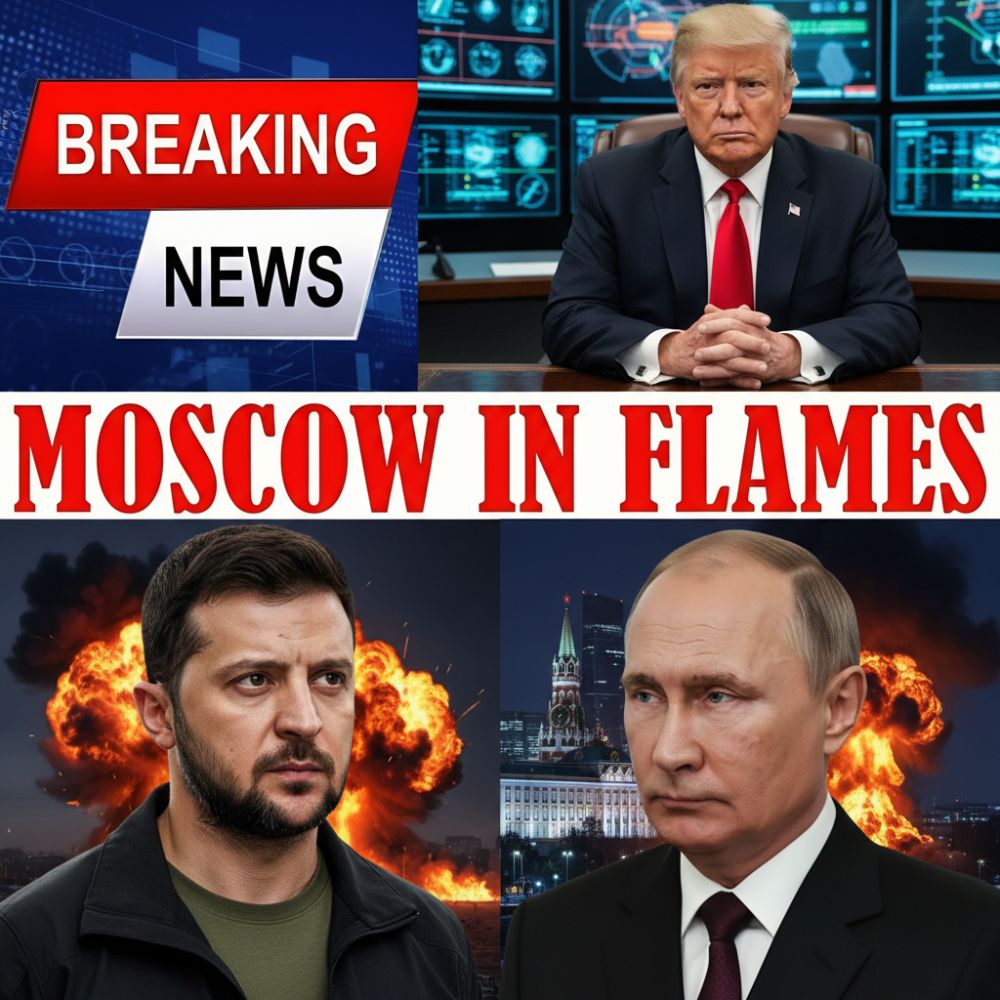
Ukraine’s Strike Near the Kremlin Signals a Dangerous New Phase of the War
In the early hours of Wednesday morning, residents of central Moscow awoke to something that had long been considered unthinkable: explosions echoing within miles of the Kremlin.
Videos posted to Russian social media platforms shortly after 3 a.m. showed fires burning in neighborhoods near the capital’s historic core. Sirens wailed. Air defenses appeared to activate. For several hours, Russia’s tightly controlled state media offered little explanation, an unusual silence that fueled speculation among analysts and foreign intelligence officials monitoring events in real time.
While the full scope and targets of the strikes remain difficult to independently verify, Western intelligence officials and open-source analysts say the attack bore the hallmarks of a highly coordinated Ukrainian operation — one that may mark the most audacious escalation of the war since Russia’s full-scale invasion began nearly three years ago.
If confirmed, the strikes would represent the clearest demonstration yet that Ukraine is willing and able to bring the conflict directly to the Russian capital, shattering Moscow’s long-standing assumption that the seat of political power would remain a sanctuary.
A Shift in Ukraine’s Targeting Doctrine
Since early 2023, Ukraine has steadily expanded its campaign of long-range strikes inside Russia, using domestically produced drones and Western-supplied intelligence. Those attacks have largely followed a predictable pattern: oil refineries, ammunition depots, air bases and logistics hubs — all carefully chosen to degrade Russia’s war effort while avoiding targets that could be interpreted as symbolic or politically destabilizing.
That pattern appears to have changed.
According to multiple analysts who track Ukrainian military operations, unusual indicators emerged in the days leading up to Wednesday’s strike. Satellite imagery reviewed by independent researchers showed increased reconnaissance activity over western Russia. Ukrainian special operations units known to Western intelligence agencies appeared to “go dark,” ceasing routine communications. Testing of long-range systems near Ukraine’s borders was detected but not publicly acknowledged.
“When Ukrainian elite units disappear from the intelligence picture, that usually means something sensitive is coming,” said a former U.S. intelligence official who spoke on the condition of anonymity. “It’s a classic preparation phase.”
What Was Hit — and Why It Matters
Videos geolocated by open-source investigators suggest explosions occurred within two kilometers of Red Square. Western officials say at least three targets were struck, including what they believe to be a military coordination facility operating under civilian cover — a tactic Russia has frequently used throughout the war.
Ukrainian officials have not publicly detailed the operation, but Ukraine’s military intelligence agency later confirmed that the strikes were “planned over many months” and designed to exploit weaknesses in Russian air defense coverage around Moscow.
The significance, analysts say, is less about physical damage than psychological impact.
“For three years, Moscow has lived with the illusion that the war happens somewhere else,” said Michael Kofman, a senior fellow at the Carnegie Endowment for International Peace. “Breaking that illusion changes the domestic political equation for the Kremlin.”
An Uncharacteristically Subdued Kremlin Response
Perhaps the most striking development came hours later, when President Vladimir V. Putin appeared in a brief televised address. Gone was the familiar rhetoric of defiance and nuclear warning. Instead, Mr. Putin described the attack as “provocative” and “escalatory” — and then acknowledged that Russia had suffered losses.
The word stood out.
Since February 2022, the Kremlin has gone to extraordinary lengths to minimize or deny Russian casualties and setbacks. Acknowledgment of losses, even in vague terms, is rare and politically risky.
“This suggests internal pressure,” said Tatiana Stanovaya, a senior fellow at the Carnegie Russia Eurasia Center. “When the capital itself is affected, denial becomes harder to sustain.”
Russian authorities placed air defense systems around Moscow on their highest alert level and activated emergency security protocols across the city. State television, typically quick to frame attacks as isolated terrorist incidents, delayed coverage for several hours — another unusual departure.
NATO and the Question of Escalation
NATO officials responded cautiously, emphasizing Ukraine’s right to strike legitimate military targets while warning against disproportionate retaliation.
In a statement, alliance officials noted that the reported targets appeared to be military facilities rather than civilian infrastructure — a distinction that carries legal weight under international humanitarian law and underscores Ukraine’s effort to contrast its conduct with Russia’s widespread attacks on civilian areas.
Privately, Western diplomats say the concern now is not whether Ukraine crossed a line, but how Russia will respond.
“When leaders feel humiliated at home, the risk of overreaction rises,” said a senior European official. “That’s the danger zone.”
Kyiv’s Message: No Safe Zones
President Volodymyr Zelensky addressed Ukrainians later in the day, framing the operation as both a military necessity and a moral statement.
“Russia believed its capital was beyond reach,” he said. “Tonight, that illusion ended.”
He emphasized that Ukraine was targeting only facilities directly supporting Russia’s occupation of Ukrainian territory and warned that distance would no longer confer immunity.
“These are not reckless words,” said a former NATO commander. “They are carefully calibrated — and meant to be heard in Moscow.”
A New Phase of the War
The Kremlin-area strike coincided with Ukrainian attacks in occupied Crimea and reported cyber operations that disrupted Russian command-and-control networks for brief periods. Analysts say the synchronization suggests a deliberate transition to multi-domain operations aimed at overwhelming Russian defenses and decision-making systems.
What comes next is uncertain. Russia could intensify strikes on Ukrainian civilian infrastructure. Security services may launch sweeping internal investigations for intelligence leaks. Or Mr. Putin, facing mounting pressure from military commanders, oligarchs and a suddenly unsettled public, could choose a more dangerous path.
What is clear, analysts say, is that the psychological balance of the war has shifted.
“The myth of Moscow’s invulnerability has been punctured,” said a former Russian diplomat now in exile. “And once that myth is gone, it cannot be restored.”
As more evidence emerges and independent verification continues, the world will be watching not just for confirmation of what was hit, but for how Russia responds to a reality it long insisted could never exist.
For the first time in this war, the conflict no longer feels distant in Moscow. And that may change everything.