


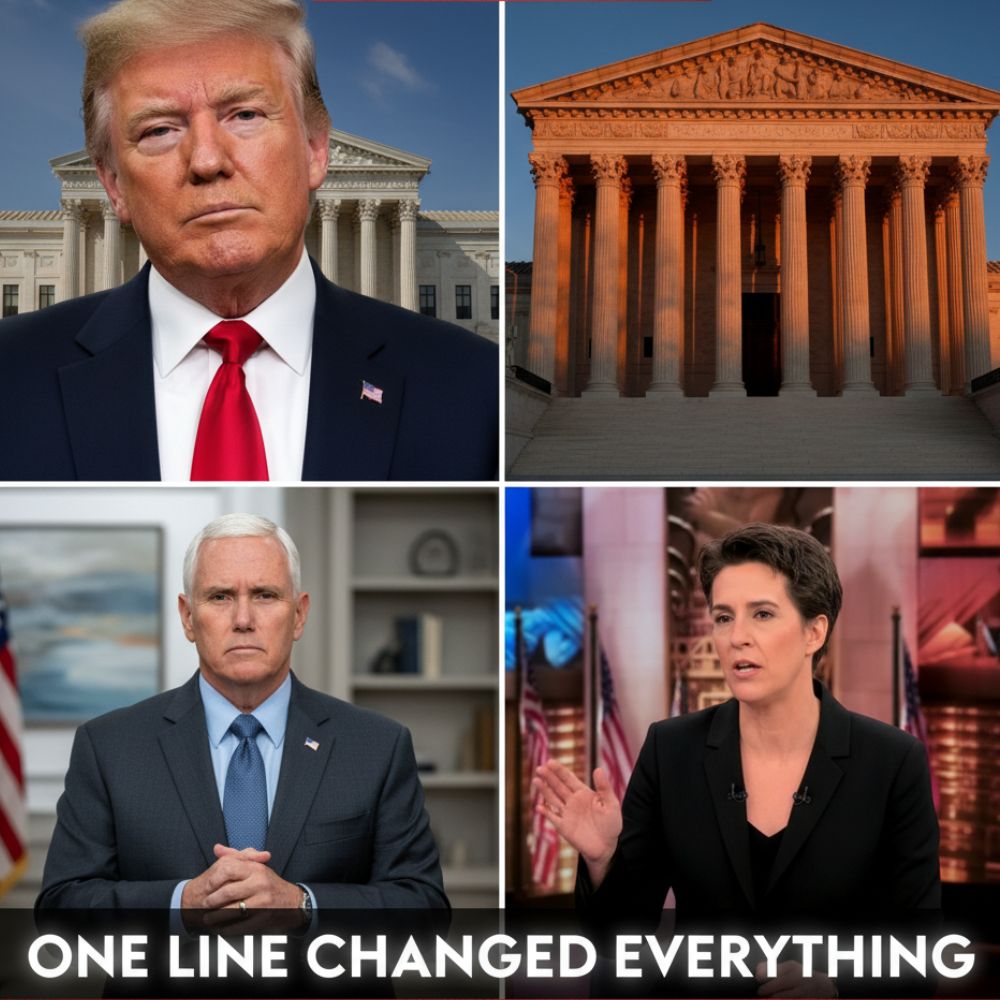
When the U.S. Supreme Court released its decision in Trump v. United States on July 1, 2024, the headline seemed technical: presidential immunity, remanded proceedings, unresolved distinctions between official and unofficial acts. The language was careful. Clinical. Almost calm.
That calm may have been the most consequential detail of all.
On MS Now , Rachel Maddow didn’t react the way audiences might expect after a landmark ruling. There was no immediate outrage, no sharp punchline. Instead, she slowed down. She read. She paused. And then she focused on what the Court had granted—not loudly, but almost incidentally.
The ruling, authored by Chief Justice John Roberts, established absolute immunity for a president’s “core constitutional acts,” including pardons and appointments. For other official actions, it introduced a presumption of immunity—one that prosecutors must overcome before a case can even proceed. Most strikingly, the Court ruled that evidence of official acts cannot be used to prove unofficial wrongdoing.
It was that last point that Maddow lingered on.
“This is a ruling,” she said, carefully, “that says as long as you can construe it as an official or quasi-official act, you can do absolutely anything.” Her voice rose only at the end. Not for drama—but for clarity.
The decision immediately delayed Donald Trump’s federal election interference case, pushing it past the 2024 election and forcing lower courts to disentangle actions that may now be legally insulated. Trump’s alleged pressure campaign on Mike Pence, once central to the indictment, now sits in a gray zone the Court itself declined to define.
What unsettled Maddow wasn’t just the delay. It was the expansion.
Lower courts had previously dismissed Trump’s immunity claims as extreme, even mocking the idea that a president could order criminal acts without consequence. Yet the Supreme Court went further than Trump’s legal team requested, creating new constitutional protections without clear historical precedent.
In dissent, Justice Sonia Sotomayor didn’t mince words. She warned that the ruling effectively places the president “above the law,” invoking imagery of unchecked authority the Constitution’s framers explicitly rejected. Her hypothetical—that a president could order lethal force under official pretext without facing prosecution—was stark, but it followed the logic of the majority opinion to its edge.
Maddow’s analysis traced that edge carefully.
She reminded viewers that the framers designed the presidency in opposition to monarchy, shaped by English history where kings were immune by definition. Post-Watergate reforms reinforced that no president was meant to be untouchable after leaving office. Accountability, delayed but inevitable, was part of the system.
This ruling disrupted that understanding.
Civil liberties groups, including the ACLU, echoed the concern, noting that even corrupt official acts now receive constitutional shielding. The Court did not define the limits of “official,” leaving future cases—and future presidents—to test them.
What made Maddow’s segment resonate wasn’t hyperbole. It was restraint. She used on-screen graphics, highlighted specific passages, and let the implications emerge slowly. The danger wasn’t announced. It revealed itself.
“The practical impact,” she said, “is to give Trump immunity that even he and his counsel did not ask for.”
That sentence hung there.
The ruling applies not just to Trump, but to every future president—regardless of party. It redraws the boundary between power and consequence without clearly marking where accountability resumes, if at all.
And perhaps that’s why the reaction was delayed. No explosion. No immediate crisis. Just a quiet shift.
The kind that only becomes obvious once it’s already in place.
If the highest court has elevated the presidency this far above reproach, the question lingers—unanswered, unresolved, and uncomfortably open:
What, exactly, still stops a president once the line is blurred?