


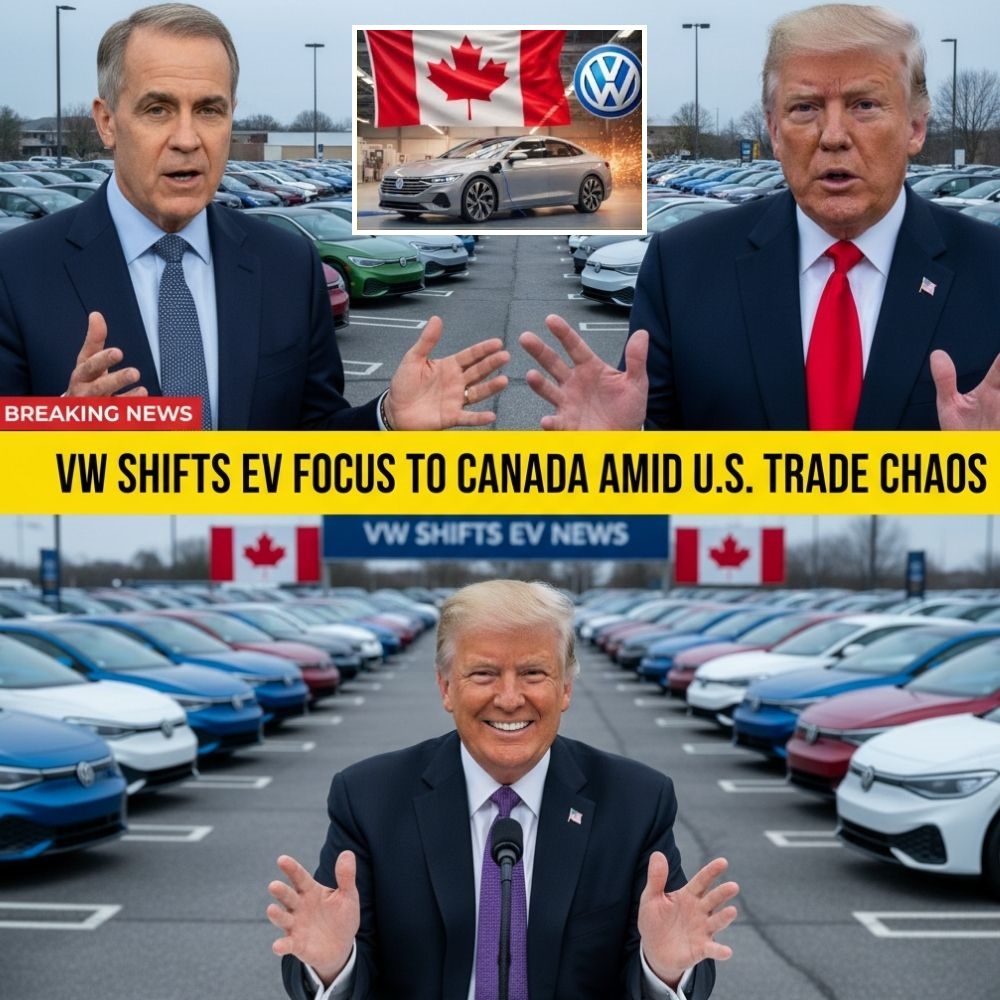
A major shift is underway in North America’s electric vehicle future, and Volkswagen has just made it impossible to ignore. As political turbulence and tariff uncertainty rattle the U.S. auto sector, Canada is emerging as the unexpected winner—and Volkswagen’s massive PowerCo battery plant in St. Thomas, Ontario, is the clearest proof yet.
This week, Volkswagen confirmed that its PowerCo battery facility—Canada’s largest EV battery investment to date—is accelerating hiring and construction plans. Initially announced in 2023 with expectations of around 3,000 direct jobs, the company now says employment will reach “thousands,” with several thousand more spin-off jobs rippling through construction, logistics, raw materials, and advanced manufacturing.
More than 200 workers are already on payroll. A dedicated jobs portal is launching. A custom-built training center is nearly complete. And with site infrastructure almost finished, steel construction for Phase One is set to begin within weeks. If timelines hold, production is expected to begin in 2027—possibly earlier.
What makes this announcement so significant isn’t just the scale. It’s the timing.
Volkswagen executives openly acknowledged that instability in U.S. trade policy is influencing how and where the company deploys long-term capital. Without naming names, the message was unmistakable: unpredictable tariffs, shifting rules, and policy whiplash out of Washington are complicating investment planning across the American auto sector.
Since returning to office, President Donald Trump has revived a tariff-first agenda, reintroducing threats and duties on vehicles, metals, and components. According to extensive reporting throughout 2025, U.S. automakers and suppliers have repeatedly warned the White House that this volatility is raising costs, freezing contracts, and making long-term forecasts nearly impossible.

For industries like EV batteries—where investments run into the billions and payoffs stretch across decades—uncertainty isn’t just inconvenient. It’s fatal.
And that’s where Canada comes in.
While the U.S. wrestles with trade shocks, Canada is positioning itself as the stable anchor of North America’s EV supply chain. Under Prime Minister Mark Carney, Ottawa has emphasized predictable industrial policy, long-term clean-tech incentives, streamlined permitting, and deeper partnerships with Europe and Asia. Volkswagen’s decision to push full speed ahead in St. Thomas suggests those signals are being heard loud and clear in global boardrooms.
Company executives have praised Ontario’s skilled workforce, even noting they were surprised by the depth of technical talent available. The fact that Volkswagen built a training facility before the factory itself sends a powerful signal: this isn’t a short-term hedge. It’s a multi-decade commitment.
The contrast with the U.S. could hardly be sharper. South of the border, EV projects have been delayed, downsized, or canceled altogether as subsidy disputes and tariff threats multiply. In Michigan—the historic heart of American auto manufacturing—suppliers warn that continued trade volatility could pose existential risks.
Meanwhile, in a mid-sized Canadian city once written off as part of the Rust Belt’s decline, cranes are rising for a battery plant that could define the next era of automotive power.
This shift carries serious geopolitical weight. Batteries are the heart of electric vehicles, and control over battery supply chains increasingly means control over the auto industry itself. As more of that ecosystem consolidates in Canada—from critical minerals to cathode materials to final assembly—U.S. leverage weakens.
The implications extend into the looming 2026 CUSMA (USMCA) review. A more self-sufficient Canadian EV sector reduces America’s ability to dictate terms and forces U.S. automakers to rely on a neighbor that is becoming increasingly independent.
The irony is hard to miss. Trump’s tariff strategy was designed to force manufacturing back into the United States. Instead, it’s pushing capital toward the one thing global companies crave most: stability.
Volkswagen’s hiring ramp-up isn’t just about jobs. It’s a signal flare. Industrial power doesn’t shift through speeches or slogans—it shifts when global companies decide where they feel safe investing billions.
Right now, that place is Canada.
If this momentum holds, the St. Thomas PowerCo plant may be remembered not just as a factory, but as the moment North America’s EV center of gravity quietly tilted north—not because Canada shouted louder, but because it planned smarter.