


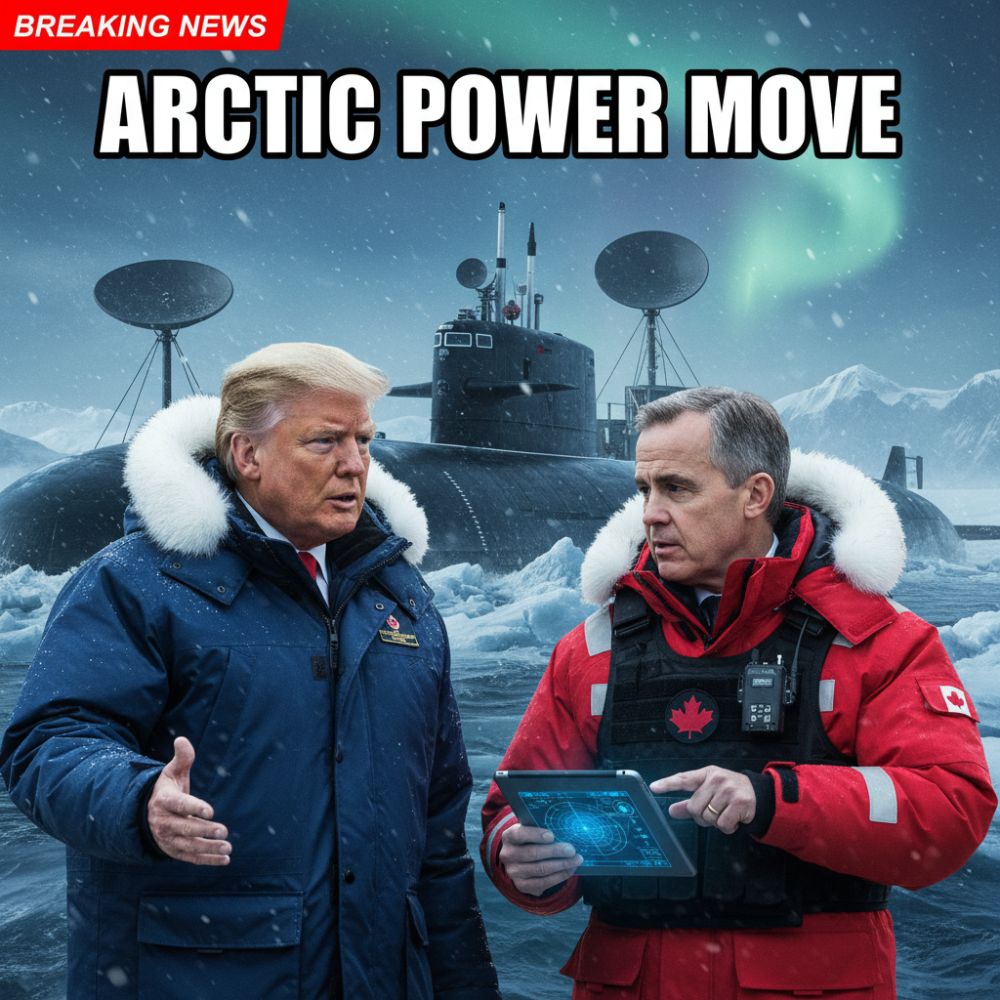
Canada has just crossed a strategic line it cannot uncross—and the shockwaves are being felt far beyond the ice.
In a moment that defense experts are calling historic, Prime Minister Mark Carney has unveiled the most decisive Arctic security push in Canadian history: a new generation of under-ice submarines and a long-range radar shield designed to operate without U.S. permission, technology, or oversight. Far from symbolic, this is a hard-power response to a rapidly changing geopolitical reality—one accelerated, not slowed, by Donald Trump.
Canada’s Arctic story has always been written by geography. With the longest coastline on Earth, much of it frozen, remote, and sparsely populated, sovereignty has traditionally relied on law, diplomacy, and assumption rather than constant presence. That era is now over.
The turning point came in November 2025, when Donald Trump released a national security strategy that bluntly reframed the Western Hemisphere as an arena of enforced American dominance. The Arctic—and the Northwest Passage in particular—was named outright as a strategic priority. For Ottawa, the message was unmistakable: if Washington decided access was “essential,” Canadian objections would no longer be treated as binding.
For decades, the sovereignty dispute over the Northwest Passage had been carefully managed. The 1988 Arctic Cooperation Agreement allowed U.S. icebreakers to transit the passage with Canada’s consent, preserving legal ambiguity while avoiding confrontation. Trump’s doctrine effectively erased that compromise. In plain language, it signaled that treaties and goodwill would no longer constrain American military planning.
For Canada, this was not a rhetorical shift. It was an operational threat.
Carney’s response has been swift and calculated. Ottawa announced two finalists for what will become the largest submarine program in Canadian history—a fleet of up to 12 conventionally powered submarines specifically designed for Arctic warfare. These are not coastal patrol vessels. They are built to operate beneath thick ice for weeks, travel 3,500 nautical miles, and remain fully covert for 21-day patrols.
The contenders—Germany’s ThyssenKrupp Marine Systems and South Korea’s Hanwha Ocean—represent proven submarine powers. Hanwha has proposed a delivery timeline beginning in 2032, with four submarines operational by 2035 and the full fleet completed by the early 2040s, at an estimated cost of $20–24 billion. ThyssenKrupp brings unmatched NATO experience, having supplied roughly 70% of alliance conventional submarines.
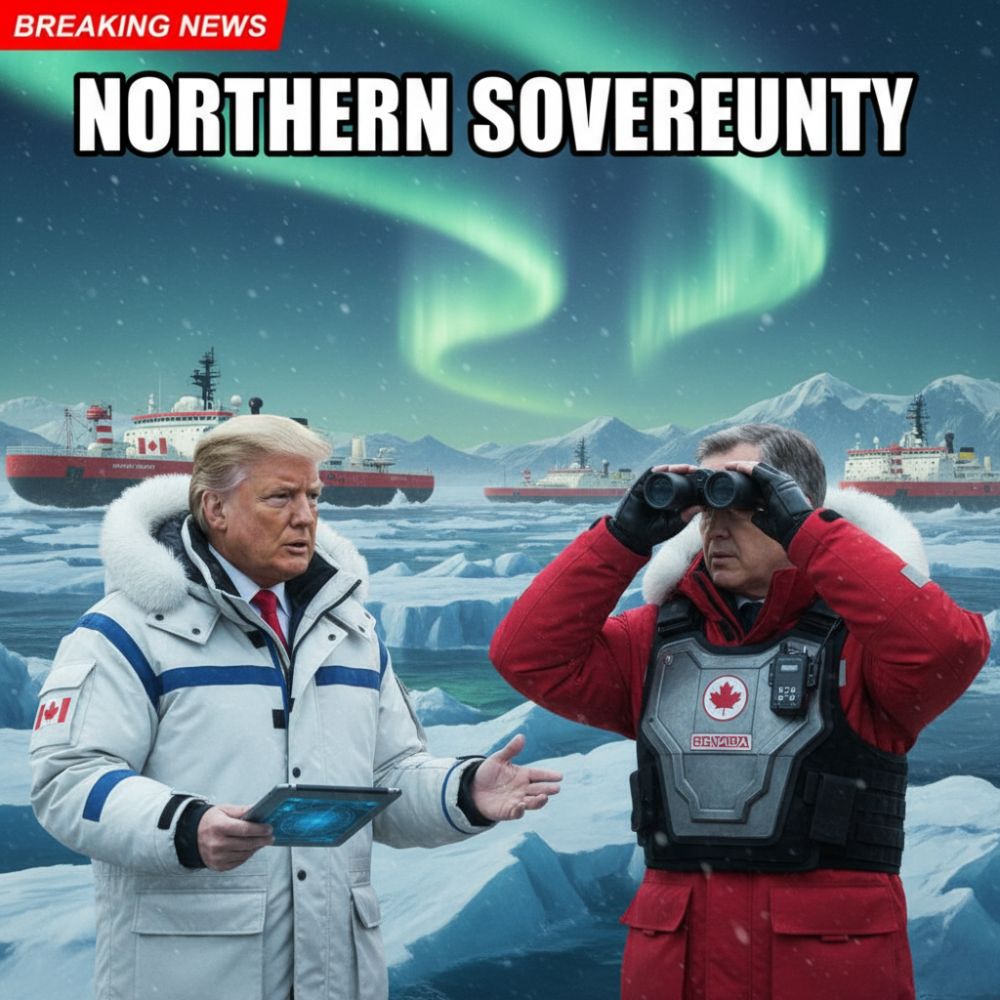
Whichever bid wins, the outcome is transformational: Canada gains an Arctic-optimized submarine force that does not rely on U.S. combat systems, logistics chains, or command structures.
This alone would mark a turning point. But Ottawa didn’t stop there.
Alongside submarines, Canada is moving forward with an over-the-horizon radar system, scheduled to begin deployment in 2026. Using adapted Australian technology—proven in similarly vast and remote conditions—the radar will be able to detect threats up to 3,000 kilometers away, including aircraft and cruise missiles approaching from the Arctic.
Critically, this system will be entirely Canadian-owned and operated. Built on Canadian soil. Run by Canadian personnel. Controlled by Canadian command.
This choice was deliberate. Rather than defaulting to American systems, Ottawa opted for strategic independence—while remaining interoperable with allies. The radar network will consist of four major sites, with full operational capability expected in the early 2030s. Once built, it becomes permanent infrastructure, locking in sovereignty for generations.
Trump’s pressure produced the opposite of its intended effect. Instead of compliance, it created political unity inside Canada. Provinces that once resisted major defense spending fell into alignment. Public opinion hardened. Polling now shows roughly 80% of Canadians believe Arctic sovereignty must be actively enforced or risk being lost.
That consensus unlocked massive investment: $38.6 billion for NORAD modernization, up to $60 billion for submarines, and billions more for Arctic ports, airfields, satellite communications, and logistics hubs. Polar communication satellites will close long-standing gaps above 70° north latitude, enabling continuous command and control in the high Arctic.
This is not a short-term posture. Submarines delivered in the 2030s will patrol into the 2070s and beyond. Radar stations, once built, become fixtures of national defense. Doctrine, training, and experience will accumulate year after year.
The deeper message is impossible to miss. Canada is no longer assuming that allies will always align—or that sovereignty can survive on paper alone. Capability is now the currency of control.
In trying to assert dominance over the Arctic, Trump may have triggered the very outcome Washington least expected: a Canada prepared to secure its north independently, permanently, and without asking permission.
The ice hasn’t moved—but the balance of power beneath it just did.