


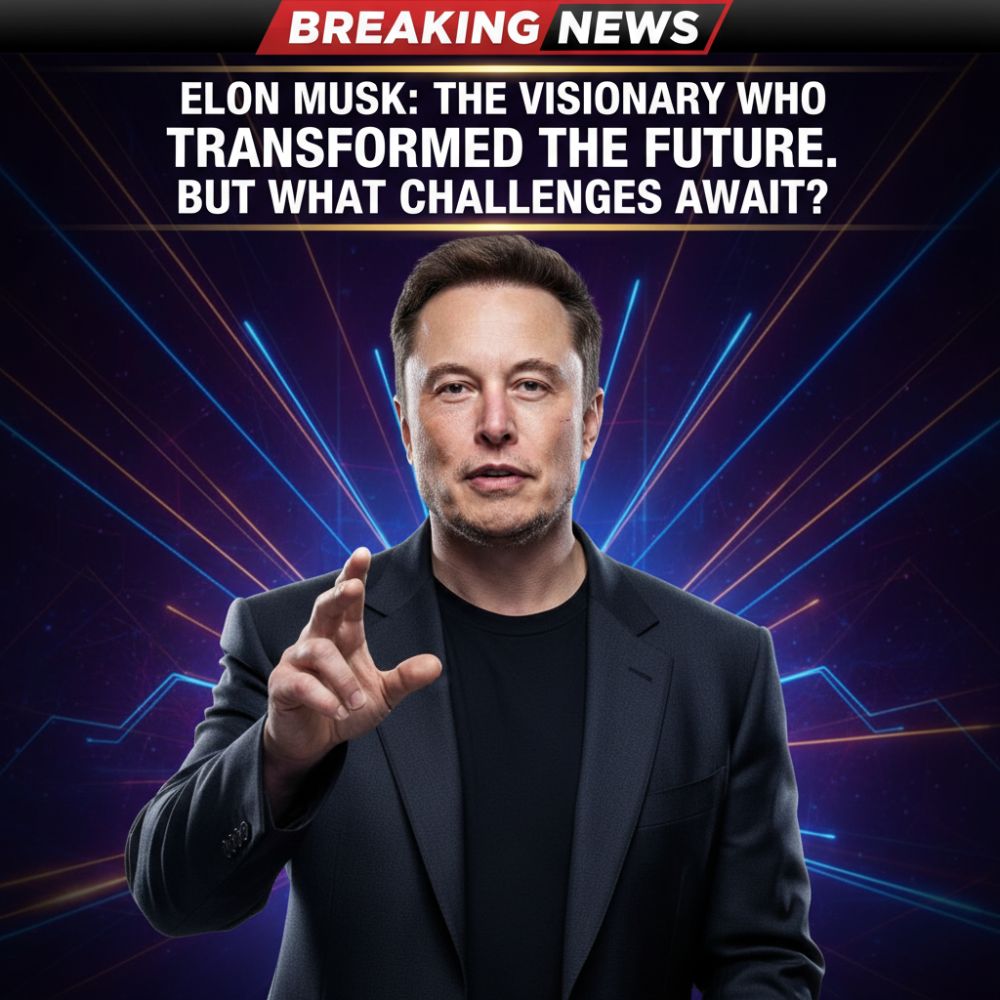
For more than two decades, one name has hovered over the most disruptive breakthroughs of the modern era like a gravitational force: Elon Musk. To admirers, he is the architect of humanity’s future. To critics, a risk-taker pushing civilization faster than it can safely adapt. Either way, few deny this truth—Musk stands at the center of an interconnected technology ecosystem unlike anything the world has ever seen.
Electric vehicles, reusable rockets, satellite internet, artificial intelligence, brain–computer interfaces—each of these fields alone could define a generation. Under Musk’s influence, they are no longer separate revolutions. They are converging.
And that convergence is exactly what has begun to unsettle the world.
One Vision, Many Revolutions
Tesla did more than popularize electric cars. It forced the global auto industry to abandon complacency. SpaceX didn’t just reduce the cost of spaceflight; it rewrote the economics of orbit itself. Starlink is not merely an internet service—it is a planetary-scale infrastructure project, quietly wrapping Earth in a digital shell.
Then there is Neuralink, probing the boundary between mind and machine, and xAI, Musk’s answer to the accelerating arms race in artificial intelligence.
Each company is staffed by elite engineers, scientists, and innovators. But critics argue that the real innovation lies not in any single product—it lies in how all of them connect.
The Ecosystem Effect
What makes Musk’s empire unprecedented is not scale alone, but integration. Satellites guide autonomous vehicles. AI models optimize rocket launches. Brain–computer research informs artificial intelligence development. Data, power, and decision-making flow across platforms.
Supporters describe this as elegant synergy—a master plan where progress compounds upon itself. Skeptics see something else entirely: a concentration of influence that no individual has ever wielded across so many foundational technologies.
In the past, railroads, oil, electricity, and the internet each reshaped society. Musk’s ecosystem touches all of them at once.
Admiration Turning to Unease
Public sentiment has shifted. Where once there was unfiltered awe, there is now a quieter, sharper question emerging in boardrooms, universities, and governments:
What happens when one ecosystem becomes too essential to fail?
Starlink already plays a role in global communications, emergency response, and geopolitical conflicts. Tesla’s software updates can change the behavior of millions of vehicles overnight. SpaceX launches payloads critical to national security. AI models increasingly shape information flows.
The systems work independently—but they also reinforce each other.
That realization has triggered admiration and fear in equal measure.
Engineers as the New Power Brokers
At the heart of Musk’s empire is a culture that celebrates engineers as the primary drivers of civilization. Decisions once made by policymakers are now embedded in code. Ethics debates are replaced by deployment timelines. Innovation moves faster than regulation can follow.
This is not inherently malicious. Many engineers involved genuinely believe they are solving humanity’s biggest problems: climate change, isolation, inefficiency, extinction-level risks.
Yet history offers a warning. Every technological leap has consequences its creators failed to anticipate.
The Fear of Acceleration
One recurring concern is speed.
Musk’s companies move at a pace that leaves little room for social adaptation. Autonomous systems evolve faster than legal frameworks. AI capabilities leap ahead of consensus on safety. Neural interfaces probe human identity itself.
Critics warn that society is being dragged forward by momentum rather than choice.
What happens when technology reshapes labor before economies adjust? When AI-generated reality blurs truth faster than institutions can respond? When connectivity becomes so essential that opting out is no longer possible?
Control Without a Crown
Musk holds no elected office. Yet his influence rivals that of governments. His decisions can alter markets, shift military logistics, and redefine communication access across continents.
This has sparked an uncomfortable debate: power without formal accountability.
Supporters argue that innovation thrives precisely because it is free from bureaucracy. Opponents counter that systems shaping humanity’s future should not depend on the vision—or temperament—of one individual, no matter how brilliant.
The Man at the Center
Elon Musk himself remains a paradox. He openly warns about the dangers of AI while accelerating its development. He champions free speech while shaping platforms that influence global narratives. He speaks of safeguarding humanity while pushing technologies that could redefine what it means to be human.
Is this contradiction—or strategic realism?
Those closest to the ecosystem describe a man obsessed not with dominance, but with survival. Mars colonization, AI alignment, neural integration—each framed as insurance against extinction.
But fear remains: survival for whom, and under whose rules?
The Question the World Is Asking
As Musk’s interconnected ecosystem grows, the world finds itself at a crossroads. The technologies are dazzling. The engineers are brilliant. The progress is undeniable.
Yet beneath the admiration lies a shared anxiety:
Have we created systems so powerful that we no longer control the direction they are pulling us?
History rarely pauses to ask permission. It advances through bold individuals and unforeseen consequences. Elon Musk may be the most visible architect of that advance in our lifetime.
Whether he is remembered as the savior who accelerated humanity into a resilient future—or the catalyst who moved too fast for wisdom to keep up—remains unwritten.
But one thing is certain.
The ecosystem is already here.
The momentum is already moving.
And the fears are no longer hypothetical.
They are beginning.