


Late-Night, Power and the Politics of the Punch Line
On a recent episode of Jimmy Kimmel Live, comedy yielded to something closer to a performance of accountability. The segment, framed as satire but staged with the visual language of an inquiry, arrived amid renewed claims that the Trump White House once pressured Disney, the parent company of ABC, over the show’s relentless mockery of the former president.
Kimmel addressed those claims directly at the top of the broadcast. In 2018, he said, President Donald J. Trump had been so angered by jokes at his expense that he urged aides to explore retaliation against networks whose coverage he deemed hostile. Trump himself has publicly floated the idea that broadcast licenses should be revoked if programming is “almost 100 percent negative” toward him.
The episode that followed did not unfold like a conventional monologue. There was no band cue, no laugh-heavy warm-up. Instead, Kimmel adopted the posture of a presenter, not a performer, guiding viewers through what he described as an archival narrative about Trump’s long-standing claims of intellectual superiority.
For decades, Trump has pointed to his education at the New York Military Academy and the Wharton School as shorthand for brilliance, often daring critics to compare IQ scores. Kimmel did not dispute that biography outright. Instead, he satirized the claim by dramatizing what he described as a hypothetical archival discovery — a document said to originate from a mid-1960s standardized aptitude assessment.
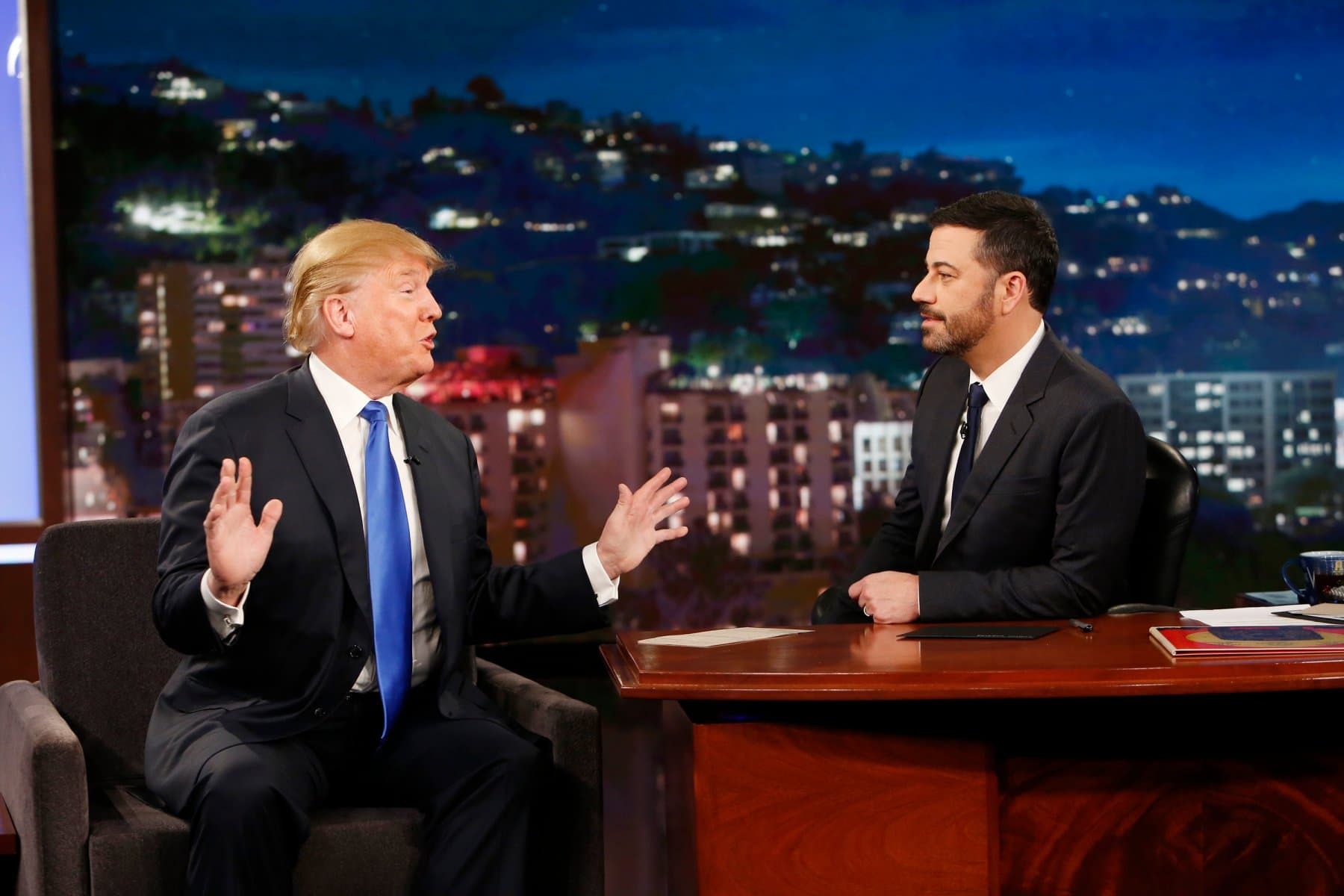
The document’s authenticity was not independently verified, and Kimmel did not present it as such. The staging mattered more than the proof. The lights were cooler, the audience subdued, the language procedural. Kimmel spoke not in jokes but in descriptions, using a pointer to highlight columns and numbers as if guiding a jury through exhibits.
This was comedy borrowing the grammar of bureaucracy. The power of the moment rested not in what was shown, but in how it was shown: slowly, visually, with pauses designed to let numbers linger. The joke was not a punchline but the premise itself — the idea that Trump’s self-mythology could be interrogated through paperwork rather than rhetoric.
At one point, Kimmel juxtaposed the fictionalized test results with Trump’s often-cited self-reported golf handicap, letting the comparison sit without commentary. The audience laughed, but not easily. The humor depended on recognition of a broader truth: Trump’s public persona has long relied on assertion over evidence, confidence over corroboration.
The segment then escalated into theatrical confrontation. Trump appeared via satellite, visibly irritated, rejecting the premise and attacking the framing as fraudulent and biased. The exchange followed a familiar pattern. Trump sought to overwhelm the moment with counterclaims and insults, while Kimmel maintained a measured tone, returning repeatedly to the visual on screen.
The most striking moment arrived with the appearance of Barack Obama, introduced not as a foil but as an adjudicator. Obama did not mock or rebut. He held up an index card and asked Trump to read a short, plain sentence — a symbolic test of ease with the written word. Trump deflected, complained about technical issues and refused to comply. The studio fell quiet.
Whether scripted or spontaneous, the scene landed not as ridicule but as exposure of discomfort. The power lay in restraint. No one needed to say what the moment suggested.
None of this should be mistaken for journalism. The segment made no claim to verified fact, nor did it pretend to. It was political satire performed with the aesthetics of an audit, a genre Trump has struggled with because it denies him his usual tools. Paper does not argue. Numbers do not heckle back.
The larger story was not about intelligence or test scores. It was about control. Trump’s repeated threats against media institutions reflect a belief that ridicule is not merely offensive but destabilizing. Late-night comedy, in that view, is not entertainment but insubordination.
What Jimmy Kimmel Live demonstrated is how satire can adapt. Rather than trading insults, it mimicked the forms Trump fears most: records, lists, quiet pauses, unanswered questions. In an age of constant outrage, the episode’s most effective weapon was stillness.
If power depends on dominating the frame, then the refusal to rush, shout or explain can feel threatening. The episode did not end with a punchline. It ended with silence — and in that silence, a reminder that sometimes the sharpest critique is simply letting the record sit where everyone can see it.