


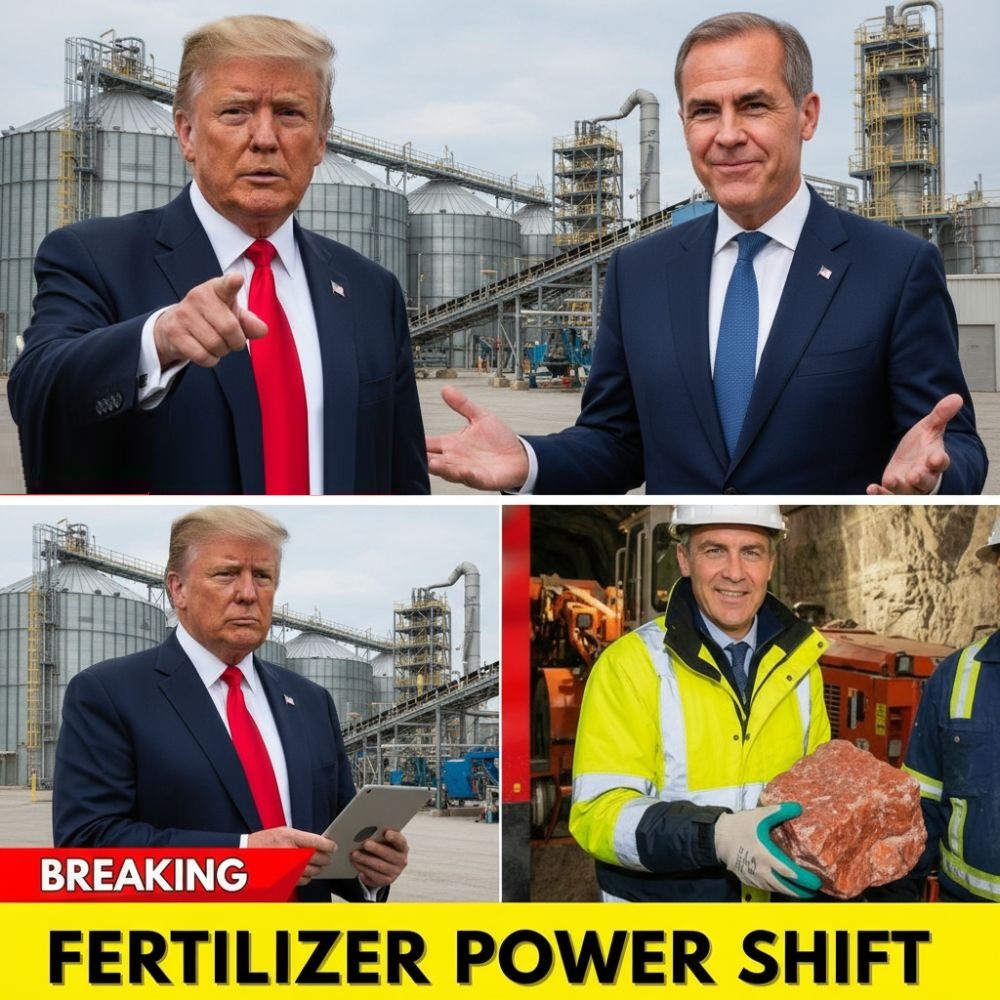
How Trump’s Tariff Threats Turned Canadian Potash into Permanent Leverage
Donald Trump once threatened Canada with “very severe tariffs” on fertilizer. Almost simultaneously, his administration handed American farmers $12 billion in bailout money to offset the damage caused by its own trade war.
Mark Carney did not negotiate. He did not retaliate.
He diversified.
While Washington escalated threats, Canada quietly redirected its most critical agricultural export—potash—away from the United States and toward Brazil, China, India, and the fastest-growing food markets in Asia. The outcome was not dramatic. It was structural.
American farmers paid more.
Canadian producers found new customers.
And U.S. leverage quietly disappeared.
An Unavoidable Dependency
American agriculture runs on Canadian potash.
Nearly 90% of U.S. potash consumption is imported, and roughly 80% of those imports come from Canada. Saskatchewan alone holds 1.1 billion tons of recoverable reserves—more than five times the estimated reserves in the United States.
American farms consume about 5.3 million tons per year.
Canada produces 22.9 million tons annually.
This is not a trade imbalance that tariffs can fix.
It is geology.
Potash deposits take millions of years to form. They cannot be created by policy, reshoring incentives, or presidential threats. No tariff can conjure fertilizer out of bedrock.
Yet Trump threatened tariffs on the one agricultural input American farmers cannot replace—then expressed confusion as food prices kept rising.
The Bailout That Couldn’t Solve the Problem
Trump’s trade war with China crushed soybean exports and pushed U.S. farmers into a third consecutive year of losses. Fertilizer costs rose by 11%. Crop prices fell. The American Soybean Association projected $15 billion in losses, averaging $150 per acre nationwide.
The White House responded with a $12 billion “bridge assistance” bailout.
The math never worked.
Losses exceeded aid. Subsidies softened the blow but did nothing to restore competitiveness. Even with government checks, many farmers continued operating at a loss.
Then, at the very event announcing the bailout, Trump threatened Canadian fertilizer tariffs—raising costs for the same farmers the aid was meant to protect.
Washington was paying farmers with one hand while taxing their inputs with the other.
Maximum Pressure, Minimum Understanding
Trump argued tariffs would force domestic fertilizer production. “You’ll be making your own fertilizer,” he told farmers.
At the same time, the Department of Justice launched investigations accusing Canadian producers—most notably Saskatchewan-based Nutrien—of price manipulation.
The contradiction was glaring.
If Canadian companies truly had monopolistic power, tariffs would not weaken them—they would increase prices further. And if the goal was to replace Canadian supply, the United States lacked the reserves, mines, and timelines to do so.
Building a potash mine takes 10 to 15 years, billions in capital, and geology that simply does not exist in sufficient scale south of the border.
Trump treated potash like steel or aluminum—industries that can be expanded with investment. Potash is different. It is location-bound. And Canada controls it.
Canada’s Quiet Pivot
Ottawa understood something Washington did not: dependence cuts both ways only until alternatives exist.
Rather than fight tariffs head-on, Canada accelerated diversification that had already begun. Shipments expanded to Brazil, now the world’s fastest-growing fertilizer importer. Sales to India and China increased. Asian demand surged as diets shifted and crop intensity rose.
None of these markets cared about Trump’s tariffs.
As Canadian volumes redirected abroad, U.S. buyers lost priority access. Contracts tightened. Spot prices climbed. American farmers absorbed the cost.
Once those supply chains moved, they did not snap back.
From Tactical Threat to Structural Loss
This is the critical mistake Washington made.
Tariffs work only when the target has nowhere else to go. By threatening Canada’s most irreplaceable export, Trump forced Canadian producers to do what commodity exporters always do when pressured: lock in alternative buyers.
Long-term contracts replaced short-term exposure. Infrastructure investments followed. Trade routes shifted. Over time, Canada’s reliance on the U.S. market shrank—not because of ideology, but because of risk management.
Potash exports became more diversified, more global, and less politically vulnerable.
What began as a tactical threat turned into a permanent loss of leverage.
The Farmer Pays Last
American farmers were left in an impossible position.
They could not switch suppliers.
They could not reduce fertilizer use without sacrificing yields.
They could not wait out geological reality.
They paid higher input costs, received partial government compensation, and watched as their most critical supplier grew less dependent on them each year.
By the time Washington softened its tone, the damage was done.
A Lesson Written in Bedrock
Trade wars assume symmetry. Potash exposes asymmetry.
Canada does not need American farmers as much as American farmers need Canadian fertilizer. That imbalance cannot be legislated away.
Trump believed pressure would force compliance. Instead, it forced diversification. And diversification, once achieved, does not reverse.
Canada didn’t win by fighting back.
It won by making itself harder to pressure.
Potash is no longer a bargaining chip. It is leverage—and now, it is permanent.