


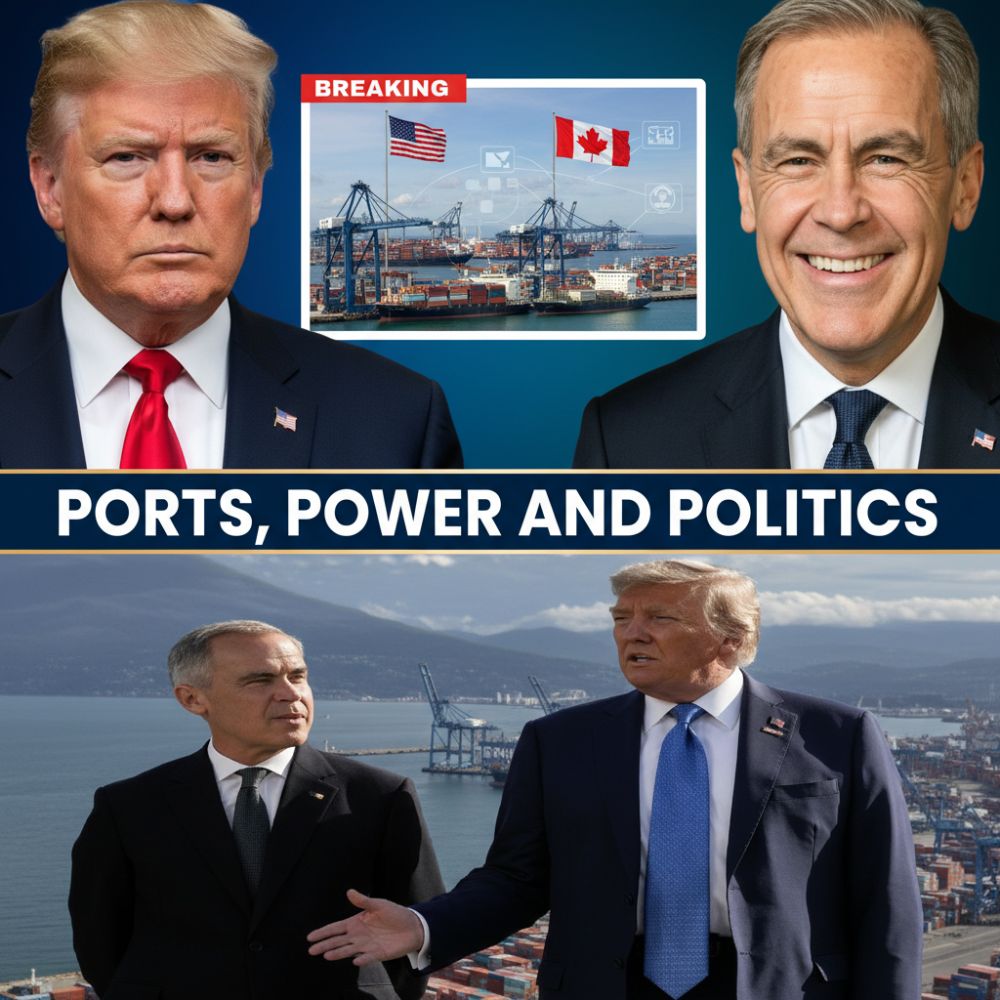
⚓ Trump Pushes for Strategic Access to Canadian Waterways — Carney Draws a Hard Line
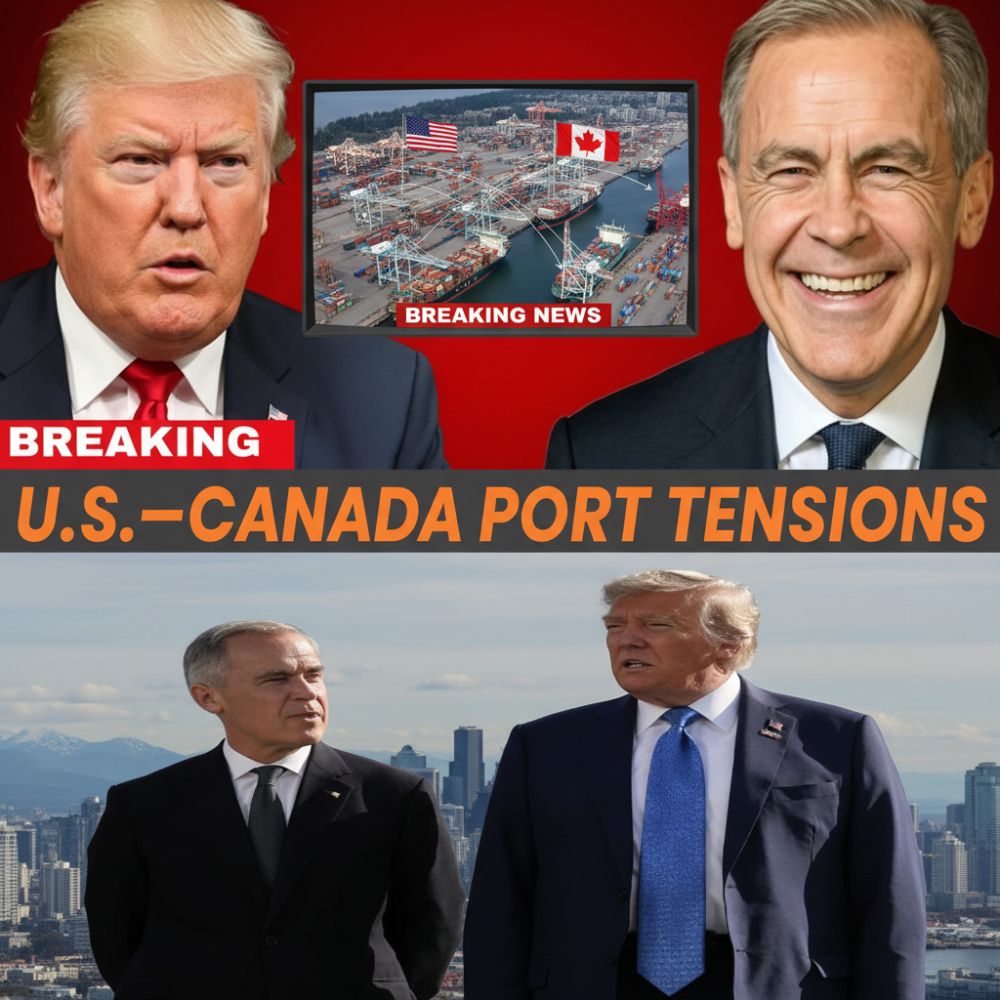
Tensions between Washington and Ottawa have entered a new and unusually sensitive arena: water.
Amid intensifying drought conditions across the American West, President Donald Trump has reportedly pressed for expanded U.S. access to Canadian-managed waterways and port infrastructure — moves framed by his allies as resource security measures, but viewed in Ottawa as an unprecedented challenge to Canadian sovereignty.
Prime Minister Mark Carney’s response was swift and unambiguous: Canada’s freshwater resources and port authorities are not bargaining chips.
The clash marks a sharp escalation in an already strained U.S.–Canada relationship.
From Trade War to Water Politics
What began as tariffs and supply chain disputes has evolved into something more strategic.
Over the past year, North American trade has been rattled by shifting tariff policies and retaliatory measures. At the same time, U.S. container traffic has faced volatility, while certain Canadian ports — particularly Arctic and Atlantic gateways — have gained new strategic attention as global shipping routes adapt to climate change.
Now, drought conditions across California, Arizona, and Nevada have intensified political pressure in Washington to secure long-term water stability.
That urgency appears to have spilled into diplomacy.
The Columbia River Treaty Under Strain
At the center of the controversy is the Columbia River Treaty, a 1961 agreement governing flood control and hydropower coordination between the two countries.
Modernization talks have been ongoing for years, aimed at updating provisions to reflect environmental concerns, Indigenous rights, and shifting climate realities.
However, recent rhetoric suggesting that Canadian water resources could serve as relief for drought-stricken U.S. regions has complicated negotiations. Canadian officials argue that water-sharing frameworks must remain treaty-based, cooperative, and sovereign — not politically transactional.
Ottawa’s message: modernization, yes. Control, no.
Carney’s Calculated Refusal
Mark Carney, better known internationally for financial diplomacy than populist politics, took a rare forceful tone.
Canadian water, he emphasized, is a sovereign resource governed by domestic law, Indigenous agreements, and international treaties. It cannot be redirected or reallocated under political pressure.
The firm stance quickly unified political parties, provincial leaders, Indigenous coalitions, and environmental groups across Canada.
In effect, Washington’s pressure consolidated Canadian consensus.
The Economic Stakes
Water security is not abstract.
California’s Central Valley supplies a significant share of U.S. fruits and vegetables.
Arizona’s semiconductor facilities require stable, high-volume water supplies.
Hydropower coordination in the Pacific Northwest underpins regional energy grids.
Any disruption or politicization of shared river systems introduces risk into agriculture, technology manufacturing, and energy markets.
Investors have already shown sensitivity to resource volatility. Agricultural futures, energy stocks, and infrastructure investments tend to react sharply when supply certainty weakens.
Sovereignty in a Climate-Stressed Era
The deeper issue is not just water allocation — it is how climate stress reshapes geopolitical leverage.
Canada possesses roughly 20% of the world’s freshwater resources. As drought intensifies globally, freshwater is increasingly viewed as a strategic asset rather than merely an environmental one.
That reality elevates Canada’s geopolitical profile — but it also heightens sensitivity to any suggestion of external control.
For Ottawa, defending water sovereignty is not symbolic. It is foundational.
Continental Interdependence
Despite heated rhetoric, the U.S. and Canada remain deeply integrated:
Shared electricity grids
Coordinated hydropower management
Cross-border manufacturing supply chains
Interdependent agricultural markets
Attempts to use water as leverage risk destabilizing systems that benefit both sides.
In highly integrated economies, coercion rarely operates cleanly. Pressure on one side tends to generate economic and political costs on the other.
A Strategic Inflection Point
This dispute signals something larger than a treaty disagreement.
It reflects a broader shift in global geopolitics, where natural resources — water, critical minerals, energy corridors — are becoming central to national security strategy.
The era when access to neighboring resources was assumed may be ending. Future access may depend increasingly on structured agreements, mutual incentives, and climate adaptation cooperation.
What Happens Next?
The coming months will test whether diplomacy prevails over escalation.
Modernizing the Columbia River Treaty and reinforcing Great Lakes cooperation mechanisms could stabilize tensions.
Escalatory rhetoric, however, risks transforming a manageable negotiation into a long-term fracture in North American cooperation.
The Larger Lesson
Military power and economic size do not automatically translate into resource control.
In a warming world, sovereignty over water may prove as strategically significant as control over oil was in the 20th century.
Canada’s refusal underscores a simple principle:
Freshwater is not a tariff line item.
It is a national asset.
And in the geopolitics of climate change, whoever governs water governs leverage.
Whether this moment becomes a diplomatic reset or a lasting rupture will depend on how both capitals navigate the reality that interdependence is not weakness — but it does have limits.