


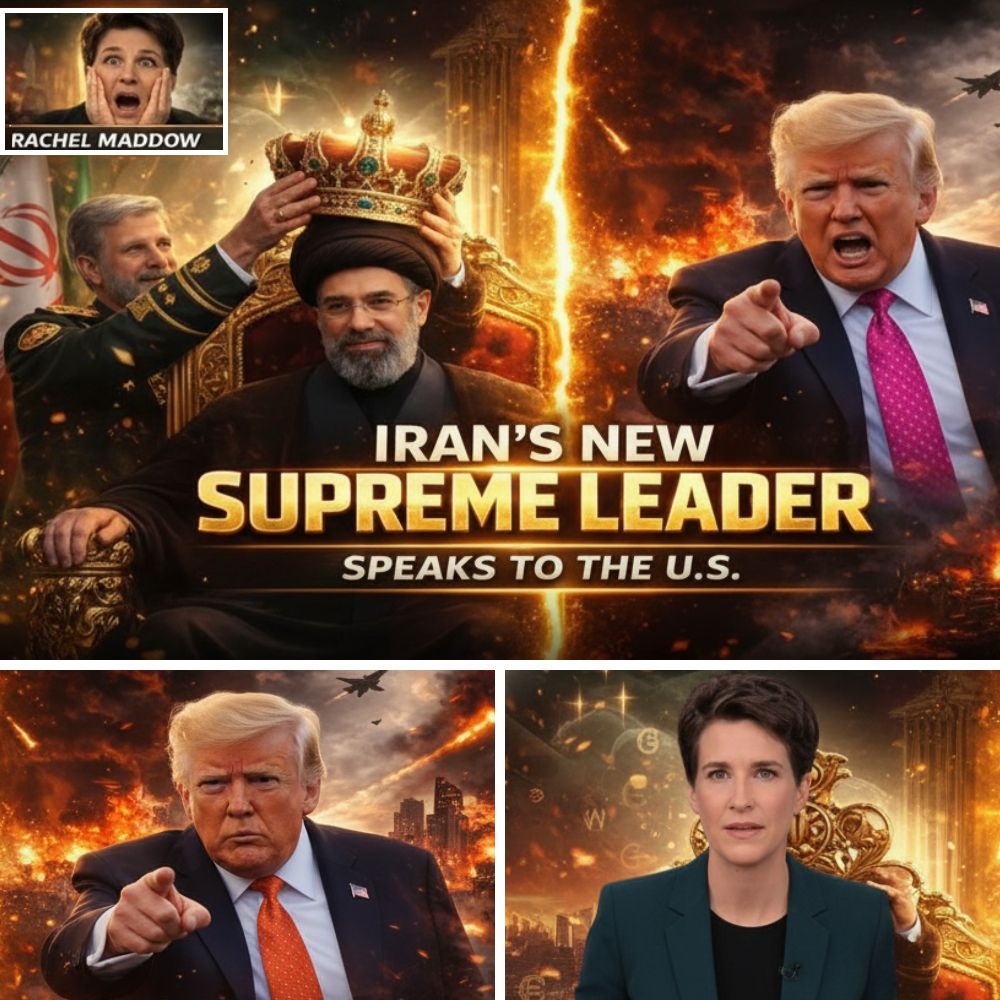
Iran’s New Supreme Leader Issues First Message to the U.S. Rachel Maddow
The Ghost Emerges: Mojtaba Khamenei and the Consolidation of an IRGC Dictatorship
At 2:17 a.m. Eastern time, the world as we knew it shifted. Iranian state television ceased its regular programming to announce a succession that intelligence agencies had long feared but hoped to avoid. Mojtaba Khamenei, the 56-year-old “shadow son” of the leader killed just ten days ago by American and Israeli strikes, has officially ascended to the seat of Supreme Leader.
This is not a mere continuation of his father’s legacy; it is a hardline pivot toward a military-industrial dictatorship. Mojtaba is a man who spent decades in the shadows, controlling the IRGC’s intelligence wings and overseeing the brutal suppression of the 2009 Green Movement. He is not a man of the cloth, despite the robes; he is a man of the barracks. His first act was not a call for mourning or a plea for a ceasefire. Instead, he delivered a chilling promise of a “slap to America’s face that history will remember.”
The mainstream networks are giving you the headline, but they aren’t connecting the dots of the constitutional crisis unfolding in Tehran. By law, the Supreme Leader must be a high-ranking cleric—an Ayatollah. Mojtaba is not. His appointment is a blatant violation of the Islamic Republic’s own constitutional framework, which tells you everything you need to know about who is truly in charge: the Islamic Revolutionary Guard Corps (IRGC). This is a military coup dressed in religious succession, and the “regime change” Washington hoped for has instead resulted in a regime that has shed its last pretenses of civilian or religious oversight.
The Ten-Day Descent into Chaos
To understand the gravity of Mojtaba’s first message, we have to look at the wreckage of the last ten days. Operation Epic Fury was sold to the American public as a surgical strike to “decapitate” a regime and end a nuclear threat. Instead, it has ignited a regional firestorm that shows no sign of abating.
February 28: The strike on Tehran kills Ali Khamenei.
March 1–4: Iran retaliates, killing six American service members. Oil prices leap past $100.
March 8: Donald Trump declares he will not “approve” of the next Iranian leader.
Today: Iran ignores the warning, appoints the most radical option available, and confirms the seventh American death.
The “unconditional surrender” the White House demanded has been met with unconditional defiance. Mojtaba didn’t just reject negotiations; he framed the killing of American soldiers and the disruption of global oil as “victories.” His war aim is no longer just survival; it is the total expulsion of American forces from the Middle East.
The Energy War: The 20% Threat
If you think this is just a Middle Eastern story, look at your gas station’s marquee. The IRGC has issued an explicit “energy war” warning. In the dialect of the Persian Gulf, that is a direct threat to the Strait of Hormuz.
The Strait is the world’s most important oil artery. If the IRGC, now fully empowered by their hand-picked Supreme Leader, decides to close that waterway, the economic consequences will be catastrophic. Every serious economist is modeling the same nightmare: Brent crude hitting $180 a barrel and American gas prices reaching $9 per gallon. This isn’t speculation; it is the documented cost of a Hormuz disruption. The “victory” Mojtaba speaks of isn’t just on the battlefield; it’s the systematic destruction of the Western economy.
The Geopolitical Pivot: Moscow and Beijing
Perhaps the most significant detail missed by the major networks is Mojtaba’s first diplomatic move. Before he spoke to his people, and certainly before he spoke to the UN, he sent private communications to China and Russia.
Iran is no longer playing by the rules of Western diplomacy. They are framing this conflict not as a nuclear dispute, but as an American “land grab” for oil and territory—a narrative that resonates perfectly in Beijing and Moscow. By activating this international architecture, Mojtaba is signaling that Iran believes it has the backing of the world’s other major powers.
The Illusion of the Off-Ramp
There are still those in Washington and at the Atlantic Council who argue this transition creates a “diplomatic slate.” They suggest that because Mojtaba has no public record, he can negotiate without losing face. This is dangerous wishful thinking.
When a leader’s inaugural address declares military casualties as “victories” and demands the total withdrawal of your forces, he isn’t looking for an off-ramp; he’s looking for a surrender. The IRGC has consolidated power precisely because they want to fight, not because they want to talk. They have watched American “maximum pressure” for years and concluded that the only language Washington respects is escalation.
The regime didn’t fragment. It didn’t collapse. It adapted. It grew armor. And now, the man who was supposed to “not last long” is sitting in a soundproof bunker, coordinating with Moscow, and watching the global inflation clock tick.