


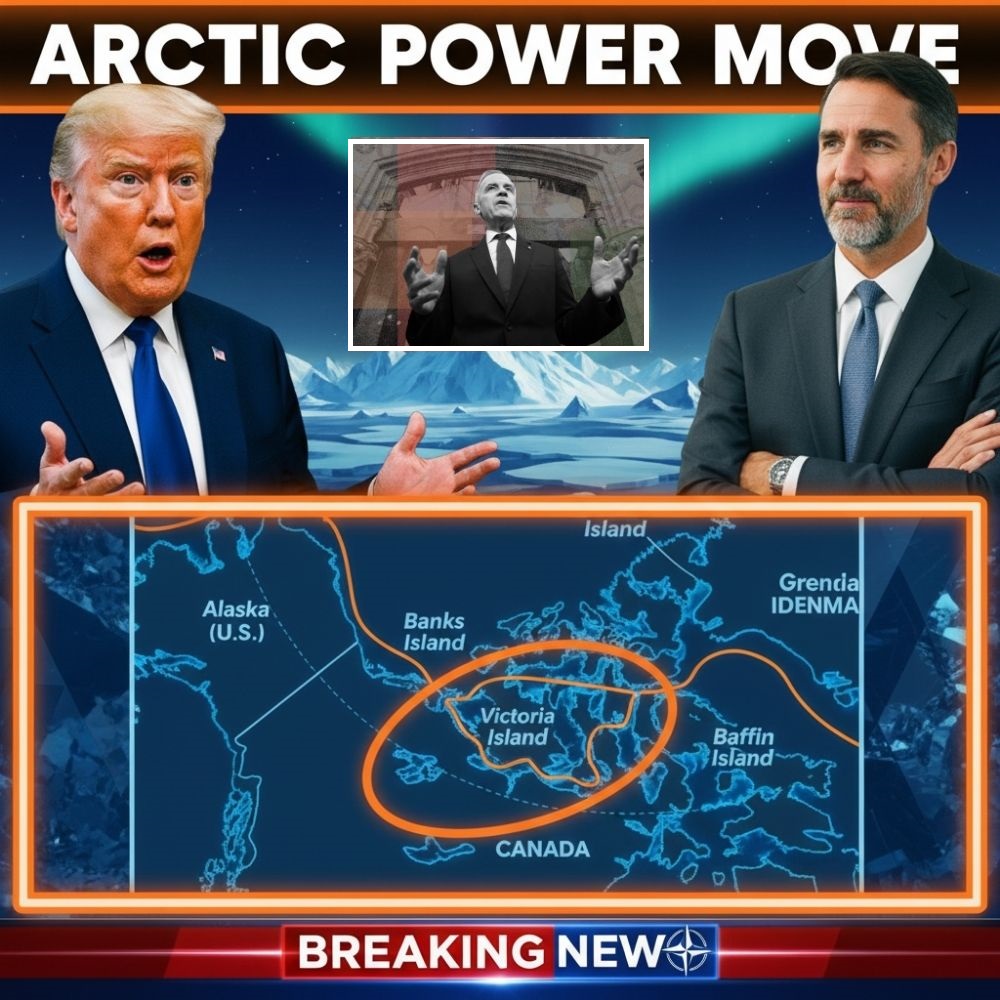
The $900 Billion Frontier: How Canada’s Arctic Push Is Redefining Sovereignty—and Challenging the United States

“This is really a catalytic moment for Canada and for our government,” the minister said, leaning forward. “We’ve got a prime minister who has brought the importance of the Arctic and sovereignty—sovereignty that is not recognized by countries like Russia and our friends, the United States.”
The message landed without diplomatic cushioning. For decades, Canada’s objections to American vessels moving through the Northwest Passage carried little weight. U.S. submarines surfaced at the North Pole and called it international space. American ships transited for nearly 70 years without asking permission. Ottawa protested, but without infrastructure or enforcement, those protests were theoretical.
That era is ending.
Prime Minister Mark Carney’s government has committed $7 billion to new Arctic icebreakers, port infrastructure, and surveillance systems—a down payment on a vision that turns sovereignty from a line on a map into something enforceable. The timing is not accidental. It comes as melting ice opens a shipping corridor valued at an estimated $900 billion over the next three decades, slicing 7,000 kilometers off the route between Asia and Europe.
And it comes as pressure from Washington—Donald Trump’s tariffs and talk of economic annexation—has reshaped Canadian politics, pushing Carney into power with a mandate to push back.
The Geography of Control
The Northwest Passage is not a single channel carved neatly across the top of the continent. It is a complicated web of narrow straits, bays, and sea lanes winding through Canada’s Arctic archipelago, linking the Atlantic and Pacific oceans in a way that looks clean on a map but brutal in reality.
For centuries, this route was sealed by ice so thick and unpredictable that entire expeditions vanished trying to cross it. Wooden ships were crushed. Steel hulls were trapped for years. Even modern vessels treated the passage as a gamble with no margin for error. It carried enormous theoretical value—it shortened global trade routes—yet for most of history, it remained useless in practice. Nature enforced the rules, and nature did not care about economics or geopolitics.
That balance began to collapse as the Arctic warmed faster than almost anywhere else on Earth. Ice that once locked the passage for 10 months a year now retreats earlier and returns later, opening navigable windows that keep expanding. Climate models and shipping forecasts point in the same direction. By the mid-2030s, many experts expect the Northwest Passage to be largely ice-free during summer months. By mid-century, with icebreaker support, year-round navigation becomes plausible rather than speculative.
This shift changes the math for global trade in a way that is difficult to overstate. A container ship sailing from Shanghai to New York through the Northwest Passage cuts more than 6,000 kilometers compared to the Panama Canal route. That distance translates into days saved at sea, lower fuel consumption, reduced crew costs, and faster delivery for high-value and time-sensitive cargo.
Projections already estimate that by 2050, between 2 and 5% of global maritime shipping could pass through the Northwest Passage. On its face, that number may sound modest until it is placed next to the scale of global trade itself. Maritime commerce moves roughly $20 trillion in goods every year. Two percent of that equals $400 billion. Five percent pushes the figure toward a trillion.
The Resources Beneath the Ice
And shipping tolls alone are not the full story. The real value lies beneath the water and across the frozen land surrounding it.
Canada’s Arctic contains vast deposits of critical minerals: rare earth elements, nickel, copper, lithium, zinc, gold, and other materials essential for electric vehicles, advanced weapon systems, and renewable energy technology. For decades, these resources sat beyond reach, not because they were unknown, but because moving them to market was prohibitively expensive. There were no roads, no rail connections, and no ports capable of handling large-scale exports. Flying materials out was the only option, which limited viable mining to the most valuable commodities like diamonds and gold.
The opening of the Northwest Passage transforms that equation. Ports, icebreaker support, and reliable shipping lanes turn once-isolated mineral deposits into commercially viable assets. Suddenly, Canada is not only a shipping corridor but a gateway to resources that the global economy increasingly depends on. Control over access to the passage becomes control over the flow of those materials.
That is where the $900 billion figure comes from. It reflects the combined value of trade, extraction, infrastructure, and strategic leverage projected over the next three decades.
The Legal Dispute That Wouldn’t Die
And that value sits at the heart of a sovereignty dispute that has simmered for nearly 80 years.
Canada has claimed the Northwest Passage as internal waters since 1946. The legal reasoning is straightforward under Canadian law: the waterways run through Canadian territory, weaving between islands that are unquestionably Canadian. Under this view, vessels crossing the passage should require Canadian permission, in the same way ships entering the St. Lawrence River or navigating the Great Lakes do.
The United States has rejected that position consistently. Washington argues that the Northwest Passage qualifies as an international strait under maritime law, granting all vessels the right of transit passage without seeking permission. Canada may set environmental and safety standards, but it cannot deny access.
This disagreement remained manageable for decades because the passage itself had limited practical value. As long as ice made transit rare, the legal debate stayed mostly academic.
The Enforcement Gap
The deeper problem for Canada was not legal theory but enforcement. Sovereignty means little without the ability to exercise it.
For decades, Canada lacked the infrastructure and military presence needed to control the Arctic in any meaningful way. The Canadian Armed Forces conducted limited annual exercises in the region. A small number of Rangers patrolled vast distances with minimal support. Coast Guard vessels operated only during short summer seasons. There were no deep-water ports capable of servicing large ships, no permanent military bases, and no comprehensive surveillance network to track traffic moving through the passage. Monitoring vessels was difficult. Stopping them was nearly impossible.
In that environment, other powers acted accordingly. The United States treated the passage as open water. Russia invested heavily in Arctic infrastructure, building a fleet of around 50 icebreakers and establishing military bases along its northern coast. China began calling itself a “near-Arctic state” and sent research vessels through the region.
Canada objected diplomatically and watched those objections fade into the background.
Building Facts on the Water
The $7 billion icebreaker commitment changes that dynamic at a fundamental level. These are not symbolic additions. They are polar-class vessels designed to break through three meters of ice and operate in temperatures reaching minus 50 degrees Celsius. Their purpose is to establish a permanent Canadian presence in Arctic waters regardless of season or conditions.
The timeline reflects urgency rather than caution. The first icebreaker is scheduled for delivery by 2030, the second by 2032. Port upgrades at Churchill began immediately. Infrastructure for critical mineral exports is expected to be operational within five years. The broader Arctic Infrastructure Fund targets northern airports, all-weather roads linking remote communities and mining sites, expanded Coast Guard operations, new radar and surveillance systems, and military facilities capable of supporting year-round deployments.
This pace signals a fundamental shift. Infrastructure creates facts on the ground—or in this case, on the water.
For decades, the United States treated the Northwest Passage as international waters because Canada lacked the capacity to manage it. No ports meant no leverage over shipping. No icebreakers meant limited monitoring. No sustained military presence meant regulations were unenforceable. As those conditions change, the legal debate loses relevance.
Continuous icebreaker patrols allow Canada to require ships to report in, accept Canadian pilots, and comply with environmental rules. Functioning ports give vessels practical incentives to cooperate, from refueling and repairs to emergency support. Control exercised daily outweighs arguments made in courtrooms.
The Irony of American Pressure
This shift carries consequences far beyond Canada and the United States. China and Russia are watching closely.
If Washington maintains its position that the Northwest Passage is an international strait, that logic applies to all nations equally. Chinese and Russian vessels gain the same rights of transit passage claimed by American ships. That outcome undermines North American security at its foundation. NORAD exists to defend the continent from threats approaching over the Arctic. Unrestricted access to Arctic waters near North America weakens that defensive perimeter.
Some American strategists have begun to acknowledge this contradiction privately, questioning whether supporting Canadian sovereignty might better serve long-term U.S. security interests. Such a shift would require admitting decades of error and accepting that Canada controls access to a corridor valued at $900 billion. That recalibration has not occurred, and time is not on Washington’s side.
The greatest irony lies in how American pressure reshaped the strategic landscape. Russia has spent decades preparing for an Arctic future, building icebreakers, bases, and shipping routes designed to move up to 100 million tons of cargo annually through its Northern Sea Route by 2030. China, despite its distance from the Arctic Circle, has invested heavily in icebreaker technology, scientific research missions, seabed mapping, and diplomatic ties with Arctic nations.
For years, Canada and the United States worked together to counter that expansion. Trade conflicts fractured that unity. As Canada diversified its partnerships, options once considered politically unthinkable became discussable. While direct cooperation with Russia remains unlikely due to broader geopolitical tensions, Chinese investment in Canadian Arctic projects has moved from impossible to plausible—if the Northwest Passage is treated as international waters.
What Comes Next
“I think it’s about time the Canadian government focused on what is beneficial for Canada,” the minister continued. “This Arctic—this one particular project—is the one that could be shovel-ready in 2026. Control is the difference between a line on a map and real power.”
That idea sat at the center of Carney’s message. If Canada is building the ships, servicing the ports, and enforcing the rules, then Canada decides what happens in those waters. For decades, that was not the case. American assumptions filled the vacuum left by Canadian inaction.
Those assumptions are now being tested. The ice is melting. The resources are accessible. The infrastructure is coming. And the question that once seemed academic—who controls the Northwest Passage?—is becoming urgent.
Can the Northwest Passage become the line where American assumptions end? And what happens when sovereignty stops being theoretical and starts being enforced? Geography explains why this fight exists at all, but geography alone never decides who wins it.