


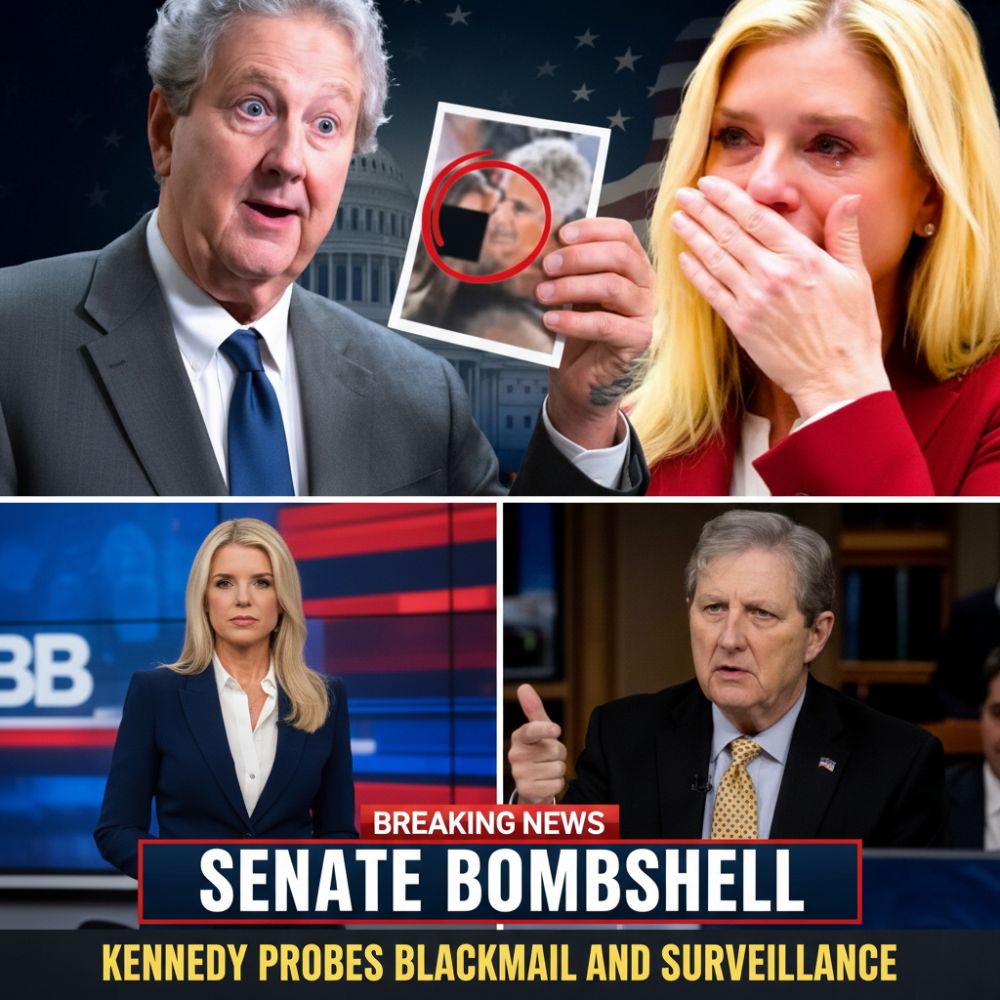
The Great Blackmail Theory: John Kennedy, Pam Bondi, and the Subpoena of Eight Senators
In the theater of political oversight, Senator John Kennedy of Louisiana is often the man who brings the technicality into the spotlight with the folksy charm of a country lawyer. But on Tuesday afternoon, during a Senate Judiciary Committee hearing, the charm was stripped away to reveal a series of questions that shook the room’s foundation.
What began as a discussion about judicial procedures quickly morphed into a two-pronged interrogation: the alleged blackmail empire of Jeffrey Epstein and the reported seizure of phone records belonging to eight sitting United States senators.
As Attorney General Pam Bondi sat across from him, the room witnessed a masterclass in the “Kennedy Method”—a methodical stacking of facts that created an image of a government shielding its own secrets while invading the privacy of its representatives.
1. The “Greatest Blackmailer” and the Next-Door Neighbor
The hearing took an explosive turn when Kennedy brought up a recent interview given by Commerce Secretary Howard Lutnick. Lutnick, who once lived next door to Jeffrey Epstein in Manhattan (reportedly sharing a common wall), described the disgraced financier as “the greatest blackmailer ever.”
Lutnick’s claim was chillingly specific: Epstein’s “MO” was to invite prominent men into private massage rooms equipped with hidden cameras. The goal wasn’t just exploitation; it was leverage.
Kennedy: “Do you know if the DOJ has interviewed Secretary Lutnick about these claims?”
Bondi: “No, Senator.”
The Implication: If a sitting cabinet member publicly states that the most notorious criminal of the decade ran a blackmail operation against the global elite, why hasn’t the FBI knocked on his door?
Kennedy’s insistence highlighted a “Strategic Void”: If blackmail was the engine of Epstein’s wealth and influence, then every document still under seal might be a record of that influence.
2. The Case of the Eight Senators: Subpoenas in the Dark
While the Epstein discussion was the hook, the second half of the exchange was the hammer. Kennedy transitioned into a “hypothetical” that felt remarkably like a leak. He described a scenario where federal investigators issued administrative subpoenas to telecommunications companies (like AT&T) to obtain the phone records of eight sitting U.S. senators.
Kennedy’s forensic walk-through of the law was devastating for the Department’s optics:
Civil Liability: If a phone company’s general counsel receives a subpoena for a Senator’s records and doesn’t file a Motion to Quash, they could be civilly liable for invading privacy.
Lack of Notification: Kennedy asked if Attorney General Merrick Garland or FBI Director Christopher Wray were ever told that their subordinates were targeting members of the Senate.
The “Aneurysm” Test: “This is as serious as an aneurysm,” Kennedy noted. “This is a sitting United States senator.”
Bondi’s refusal to confirm or deny the existence of these subpoenas citing “pending investigations” only intensified the tension. If the records were seized without a judge’s signature or notification to the targets, it represents a massive breach of the separation of powers.
The “Kennedy Audit” of Secrecy:

3. The “Testicle” Metaphor: Corporate and Bureaucratic Failure
In a moment that will undoubtedly go viral, Kennedy criticized the telecommunications companies for their passivity. He suggested that instead of simply saying “Sure” to federal investigators, these companies should have “gone to Amazon and bought some testicles online” to challenge the invasion of their customers’ privacy.
The humor masked a serious point: If the general counsel of a Fortune 500 company won’t protect the records of a Senator, what hope does an ordinary citizen have?
Conclusion: Pieces of the Story Still Missing
As the 12 minutes of questioning ended, the “Greatest Blackmailer” theory remained hanging in the air alongside the “Eight Senator” subpoenas. The hearing proved that while the Epstein case is technically “closed” regarding the man, it is wide open regarding the network.
Whether it is the “truckloads of evidence” Bondi previously mentioned or the “40-minute correction” of Les Wexner’s name, the pattern is consistent: the public is only seeing what it forces the government to show.
Do you believe the FBI should aggressively interview Howard Lutnick about his blackmail claims, or is the “Eight Senator” subpoena scandal a more immediate threat to American democracy? Let us know in the comments.