


The hearing began like hundreds of others in Washington, slow, procedural, and almost painfully predictable for anyone who has watched congressional oversight sessions over the years.
Cameras were rolling, lawmakers shuffled notes, and the usual rhythm of questions and rehearsed answers seemed destined to carry the afternoon without any dramatic moment.
Then Congressman Dan Goldman began speaking.
Within minutes, the hearing room transformed from routine oversight into one of the most uncomfortable political confrontations in recent memory.
Goldman did not arrive empty-handed.
He came carrying documents he said members of Congress had been allowed to review but that the public had never fully seen.
Across the table sat Attorney General Pam Bondi, watching carefully as Goldman laid the papers down and began to explain what he claimed to have discovered.
At first, his tone sounded calm and almost technical.
He explained that he had recently visited the Department of Justice to review files connected to the Jeffrey Epstein investigation.
According to Goldman, the archive contained millions of documents, far more than anyone could realistically analyze in a single visit.
But even during a brief review, he said he noticed something troubling.
Key documents appeared to remain heavily redacted, even when viewed by members of Congress themselves.
One example he mentioned was an eighty-six page prosecution memo prepared by the Southern District of New York.
Another was described as a draft indictment targeting alleged co-conspirators connected to Epstein.
Goldman told the committee that both documents appeared to contain large sections blacked out.
He leaned forward and asked Bondi a simple question.
Would she commit during the hearing to releasing those documents without the redactions.
The question sounded straightforward.
The response was not.
Bondi suggested that the materials could be protected by legal privilege.
Goldman immediately challenged that explanation.
He argued that the claim of privilege did not apply in the context he was describing.
The room began to grow noticeably tense.
But the exchange was only beginning.
Goldman then revealed that he had discovered something else while reviewing the files.
He said he had located an email exchange between Jeffrey Epstein and his longtime associate Ghislaine Maxwell.
According to Goldman, the email included notes referring to statements Donald Trump allegedly made about his past relationship with Epstein.
Goldman insisted there was no legal reason for the email to remain hidden.
He pointed out that the message had been sent between Epstein and Maxwell, not between a lawyer and a client.
In his view, attorney-client privilege could not possibly apply.
Bondi maintained that the material was privileged.
Goldman pressed again.
Voices in the room grew sharper, though still controlled within the formal boundaries of congressional procedure.
Staff members whispered to each other behind the rows of lawmakers.
Observers in the gallery leaned forward.
The hearing was no longer routine.
It was becoming a political spectacle.
Then Goldman shifted to a second issue that stunned many watching.
He accused the Department of Justice of handling redactions in a way that protected powerful individuals while failing to protect alleged victims.
To illustrate the claim, he described a document titled “Epstein victim list.”
According to Goldman, the document contained thirty-two names.
But only one of those names had been redacted.
Thirty-one remained visible.
If accurate, that meant most of the alleged victims listed in that document had not been shielded from public identification.
Goldman argued that such an outcome could not simply be an accidental oversight.
Someone, he said, must have reviewed the document and decided which names to conceal and which to leave exposed.
Bondi rejected the accusation.
She insisted that reviewing millions of pages of records under tight deadlines inevitably produced occasional errors.
According to her, the department’s overall error rate remained extremely low.
But Goldman was not finished.
He turned toward the gallery behind the attorney general.
Seated there were individuals identified as survivors connected to the Epstein case.
Goldman asked them a question directly.
How many of them had been contacted by the Department of Justice to provide testimony or evidence.
No hands were raised.
He asked a second question.
How many had reached out themselves to offer testimony or information.
Several hands reportedly went up.
Goldman followed with a third question.
How many had attempted to cooperate but had been ignored or turned away.
According to Goldman, every person in the group indicated they had reached out without success.
The room fell quiet.
For a few seconds the tension was almost visible.
The image of survivors standing silently behind the nation’s top law enforcement official created a powerful moment.
But the calm lasted only briefly.
Bondi responded by pivoting the discussion in a completely different direction.
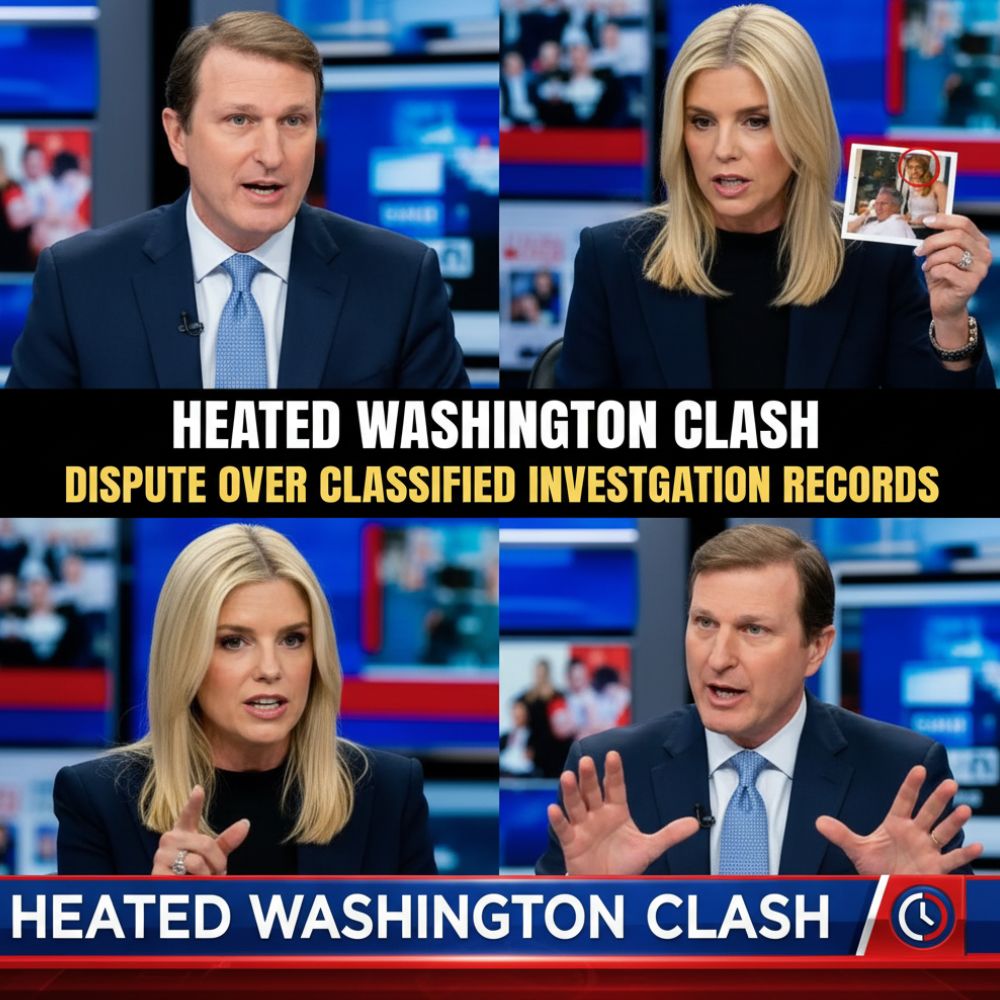
Instead of continuing the debate about Epstein documents, she began speaking about crimes committed by undocumented immigrants.
She held up photographs of individuals convicted of violent offenses.
Her argument was that Goldman and other lawmakers were ignoring crimes affecting their own communities.
The sudden change in topic surprised many observers.
Some lawmakers interrupted.
The committee chair attempted to restore order.
At one point the clock had to be stopped to regain control of the hearing.
Viewers watching the exchange interpreted the moment in very different ways.
Critics argued the immigration discussion looked like a deflection away from Goldman’s questions about the Epstein records.
Supporters of Bondi said she was highlighting serious public safety concerns that lawmakers often overlook.
Regardless of interpretation, the hearing had clearly veered far from its original agenda.
But another mystery soon resurfaced.
Goldman brought up a statement Bondi had made nearly a year earlier.
During a television interview, she had suggested that a list of Epstein associates existed and that she had been reviewing it.
The remark had sparked enormous speculation online.
Many people believed a hidden roster of powerful individuals connected to Epstein might eventually be revealed.
Yet Goldman told the committee that after reviewing the files, he had not found the list Bondi once described.
That raised an obvious question.
If such a list existed at one point, where was it now.
There are several possible explanations.
The phrase “client list” may have been misunderstood or used loosely during the earlier interview.
Some documents might remain sealed for legal reasons connected to ongoing investigations.
It is also possible that the records exist but cannot be publicly disclosed under current law.
For now, the exact answer remains unclear.
But uncertainty itself has fueled months of speculation across the internet.
And the clash between Goldman and Bondi added even more fuel to that debate.
Supporters of Goldman say he exposed serious transparency issues within the Justice Department.
They argue that the public deserves to see the full unredacted record of the Epstein investigation.
Supporters of Bondi see the situation very differently.
They say legal protections exist to safeguard victims and prevent sensitive information from being misused.
In their view, releasing certain documents could cause harm or interfere with legal proceedings.
Both sides insist they are defending the truth.
But many of the most important details remain locked inside files the public has not yet seen.
That is why the Epstein case continues to generate intense interest years after Epstein’s death.
The investigation touches powerful names, international networks, and unresolved questions about how such crimes went undetected for so long.
Every new document released sparks another wave of speculation.
Every unanswered question creates another controversy.
The hearing between Goldman and Bondi became the latest chapter in that ongoing story.
And it demonstrated something about modern politics that has become impossible to ignore.
Congressional hearings are no longer just policy discussions.
They are moments designed for cameras, for viral clips, and for public reaction across social media.
A single confrontation can overshadow hours of testimony.
And in this case, the confrontation left one question echoing long after the hearing ended.
If the full truth about Epstein’s network is buried somewhere in those files, who will finally bring it into the open.