


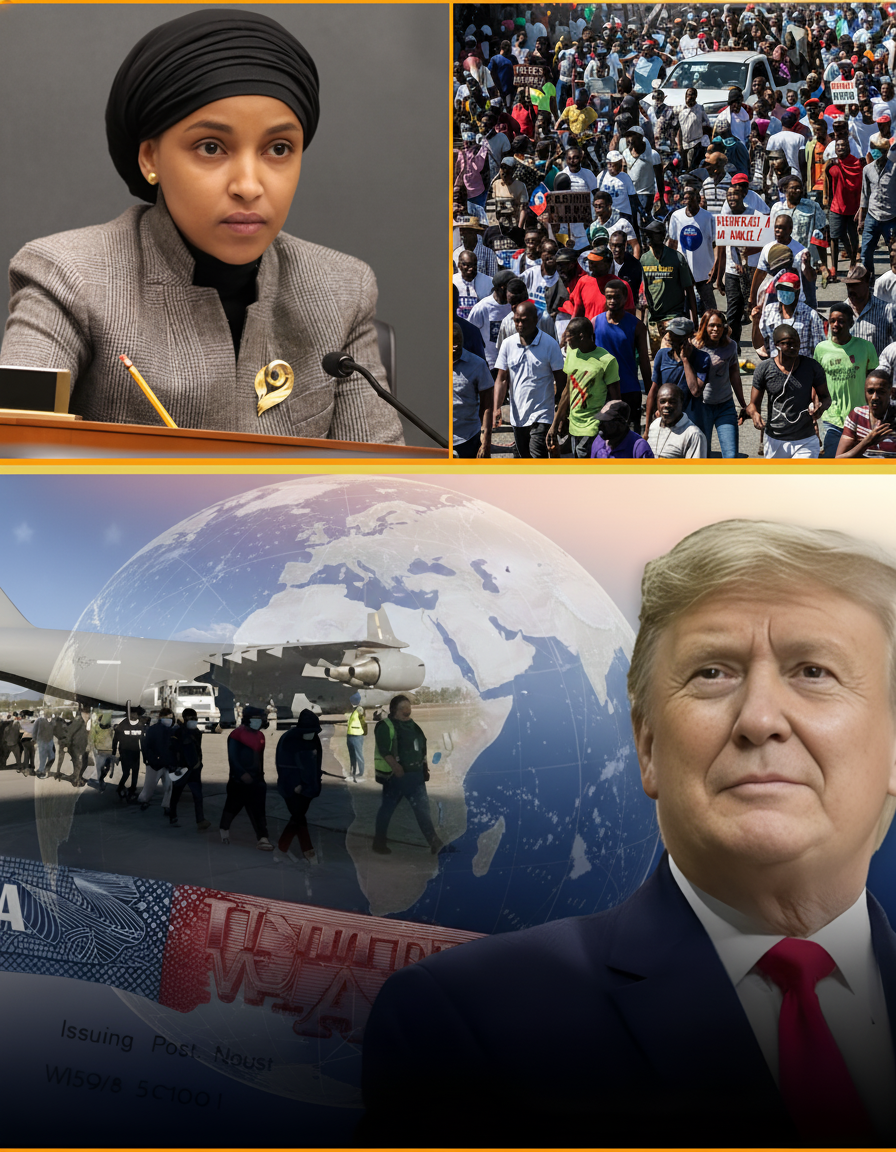
THE SHADOW OF EXILE: FEAR, RHETORIC, AND THE FRACTURE OF AMERICA’S HEARTLAND
It began with a sentence — a blast of words hurled into a roaring crowd, amplified through megaphones, echoing across social media feeds before settling like ash over Minnesota’s frozen streets. In the aftermath, panic spread with the velocity of a wildfire struck by lightning. Families whispered urgently through thin apartment walls. Community leaders scrambled into late-night meetings. Mothers dialed their children. Men checked the locks on doors that had never been locked before.
A fear — raw, unfiltered, and electric — surged through Minnesota’s Somali community.
A fear that as many as one-third of them could face deportation.
Not because a policy had been announced.
Not because a law had been passed.
But because rhetoric had ignited imagination, and imagination had ignited dread.
Above all, it was the tone of the remarks — sharp, dismissive, punctuated by a word that cut deeper than most political insults: “garbage.” A dismissal not just of arguments, but of existence. A dismissal that many interpreted as a signal, a warning, or even a precursor to something more devastating.
Into this vortex walked Rep. Ilhan Omar — a woman who has long stood at the intersection of America’s political storms, and whose very identity embodies the complexities of belonging, loyalty, fear, and resilience.
As threats against her surged, as rumors intensified, as communities trembled, America found itself once again confronting the fractures running through its heart.
This is the story of that fracture — how it formed, why it deepened, and what it reveals about the future of a nation caught between truth and terror, rhetoric and reality, fear and defiance.
I. The Spark That Lit the Powder Keg
Political rhetoric has power — not merely to persuade, but to transform.
Sometimes into inspiration.
Sometimes into fury.
Sometimes into fear so profound that it rearranges the emotional architecture of a community.
The remarks at the center of the Minnesota firestorm were not new in sentiment, but new in timing. Delivered at a moment when immigration enforcement debates were already fraught, they reverberated with alarming resonance. Across the state, Somali Americans interpreted the comments as a direct threat — not because deportations had been announced, but because history had taught them that political winds change quickly, and communities on the margins feel the blast first.
In Minneapolis’s Cedar-Riverside neighborhood, sometimes called “Little Mogadishu,” the reaction was immediate. Cafés fell silent as conversations shifted from daily life to survival strategy. Phones buzzed with messages urging caution, preparation, vigilance.
Some families packed emergency bags.
Some called lawyers.
Some prayed.
Fear, once sparked, does not wait for confirmation.
It simply spreads.
II. The Anatomy of Fear: Why 1/3 Became the Symbol
The number — one-third — appeared not as a statistic but as a fear. It represented scale, severity, and the possibility of a community-changing shock. The idea that such a significant portion of Minnesota’s Somali population could face removal created a psychological earthquake.
Why did the community latch onto that figure?
1. Historical Memory
Many in Minnesota’s Somali community carry memories of displacement, war, and forced migration. They have lived through governments collapsing overnight. They know how rapidly life can change because they have lived it.
2. Politicized Identity
Somali Americans have been repeatedly invoked in national debates — about immigration, assimilation, security, and identity. Being named in political rhetoric heightens vulnerability.
3. The Weight of a Single Word
When rhetoric labels a community as “garbage,” it signals exclusion. It implies disposability. Words can be perceived as precursors.
4. Lack of Clarity from Authorities
In the vacuum of official reassurance, rumors metastasize. Community fears expand into imagined worst-case scenarios.
Thus, “one-third” did not represent a census breakdown.
It represented a psychological threshold:
A number large enough to devastate.
III. Minneapolis: A City of Refuge, Now a City of Uncertainty
Minnesota has long been the largest Somali diaspora community in the United States — a place of refuge, rebuilding, and resilience. Over decades, Somali Americans have woven themselves into the state’s cultural, political, and economic fabric. They have created businesses, schools, mosques, community centers, and even political representation.
But safety is fragile.
In the days after the controversial remarks, Minneapolis felt transformed. Snow muffled the city, but tension vibrated beneath the hush.
Mosques hosted emergency meetings.
Nonprofits organized legal clinics.
Parents debated whether to send children to school.
College students avoided dorm common areas.
Elders whispered warnings: “Prepare. Be ready. We don’t know what comes next.”
What frightened the community was not just enforcement itself, but the unknown — the absence of clarity, the unpredictability of political escalation, the vulnerability of being visible and misunderstood.
IV. Ilhan Omar: In the Crosshairs and at the Crossroads
For Rep. Ilhan Omar, the moment was not merely political — it was existential.
Her office reported increased threats.
Her team issued statements urging calm.
Her supporters rallied, arguing that inflammatory rhetoric endangers not only policies but lives.
Omar’s identity — Somali-born, Muslim, refugee, woman, progressive, outspoken — places her at a unique intersection where America’s cultural and political anxieties collide. To some, she is a symbol of representation. To others, a figure of controversy. To many in the Somali community, she is their voice — their defender, their connection to power.
To her critics, her prominence makes her a target.
And when rhetoric escalates, targets become more vulnerable.
Throughout the unfolding storm, Omar remained defiant. Her speeches emphasized belonging, dignity, and resistance. She warned against demonization. She rejected narratives framing entire communities as threats.
Her message was clear:
“We belong here. We are not going anywhere.”
But belonging is not something one declares — it is something one must continually defend in a nation divided against itself.
V. The Threat Matrix: How Words Become Warfare
Threats to public officials are not new, but their frequency has surged in the era of hyperpolarization. For Omar, whose identity and politics already place her at heightened risk, moments like these become crucibles.
When rhetoric casts a community as suspicious or undesirable, extremists interpret it as permission.
When rhetoric lumps complex identities into single derogatory labels, individuals within those communities become potential targets.
Political scientists call this “stochastic harm” — violence that is indirectly incited through rhetoric and probability, not explicit instruction.
Even without intent, words can become weapons.
VI. The Legal Landscape: What Could Actually Happen?
Fear does not always align with law — but fear does not need legal grounding to be real.
In reality:
- Deporting one-third of a single community would require unprecedented resources.
- No such policy had been formally proposed.
- Immigration enforcement is subject to legal and constitutional constraints.
- Large-scale mass removal would trigger national and international backlash.
Yet uncertainty persists because:
- Federal immigration powers are broad.
- Courts can shift.
- Political will can shape enforcement priorities.
- Precedents exist for rapid expansion of removals under executive authority.
So while a mass deportation of that scale is improbable, communities that have experienced instability understand that improbable does not mean impossible.
VII. The Emotional Fallout: Trauma Rekindled
Many in Minnesota’s Somali community arrived as refugees or children of refugees. They fled warlords, famine, terrorism, and chaos. They rebuilt lives in America based on a belief in stability.
But rhetoric that evokes removal, threat, or exclusion tears open old wounds.
Psychologists note that refugee communities are uniquely susceptible to re-traumatization when faced with the prospect of displacement. Statements suggesting that protections could be revoked rekindle survival instincts.
Fight.
Flight.
Hide.
Prepare.
The brain responds to fear, not legal nuance.
VIII. America’s Fracture: How Political Rhetoric Becomes Social Earthquake
The Minnesota firestorm is not just about one community or one congresswoman. It reflects a larger unraveling within the American experiment — a deepening fissure between narratives of inclusion and exclusion.
1. Identity Politics on All Sides
The right invokes nationalism and purity.
The left invokes diversity and protection.
The center collapses beneath the weight of polarization.
2. Social Media: The Accelerant
Fear spreads faster than facts.
Outrage spreads faster than nuance.
Rumors spread faster than reassurance.
3. The Vacuum of Trust
Government statements are doubted.
Media coverage is disputed.
Communities rely on internal whisper networks.
When trust erodes, fear governs.
IX. What the Minnesota Crisis Reveals About America’s Future
This moment, though born from rhetoric, exposes pivotal truths:
1. Vulnerable communities live in perpetual uncertainty
Legal status does not guarantee emotional security.
2. Words from powerful figures carry disproportionate impact
Whether intended or not, rhetoric shapes outcomes.
3. America’s multicultural fabric is under strain
Conflicts around identity, belonging, and immigration are intensifying.
4. Political adversaries exploit fear
Fear becomes currency — traded, amplified, weaponized.
5. Solidarity is fragile but possible
Under threat, communities unite.
But unity can collapse under sustained pressure.
X. Conclusion: Standing in the Snowstorm
As Minneapolis endures another winter, its Somali community stands at a crossroads — caught between fear of what might come and resolve to defend their place in the nation they call home.
Rep. Ilhan Omar stands in the center of that storm — defiant, vulnerable, symbolic, embattled.
And America, too, stands at a crossroads:
Will rhetoric continue to redefine reality?
Will fear dictate policy?
Will communities fracture or fortify?
Will the heartland unite or shatter?
The answers are not yet written.
But the snow-covered streets of Minnesota whisper a truth older than politics:
A nation is measured not by how loudly it declares freedom, but by how fiercely it protects the people who fear losing it.