


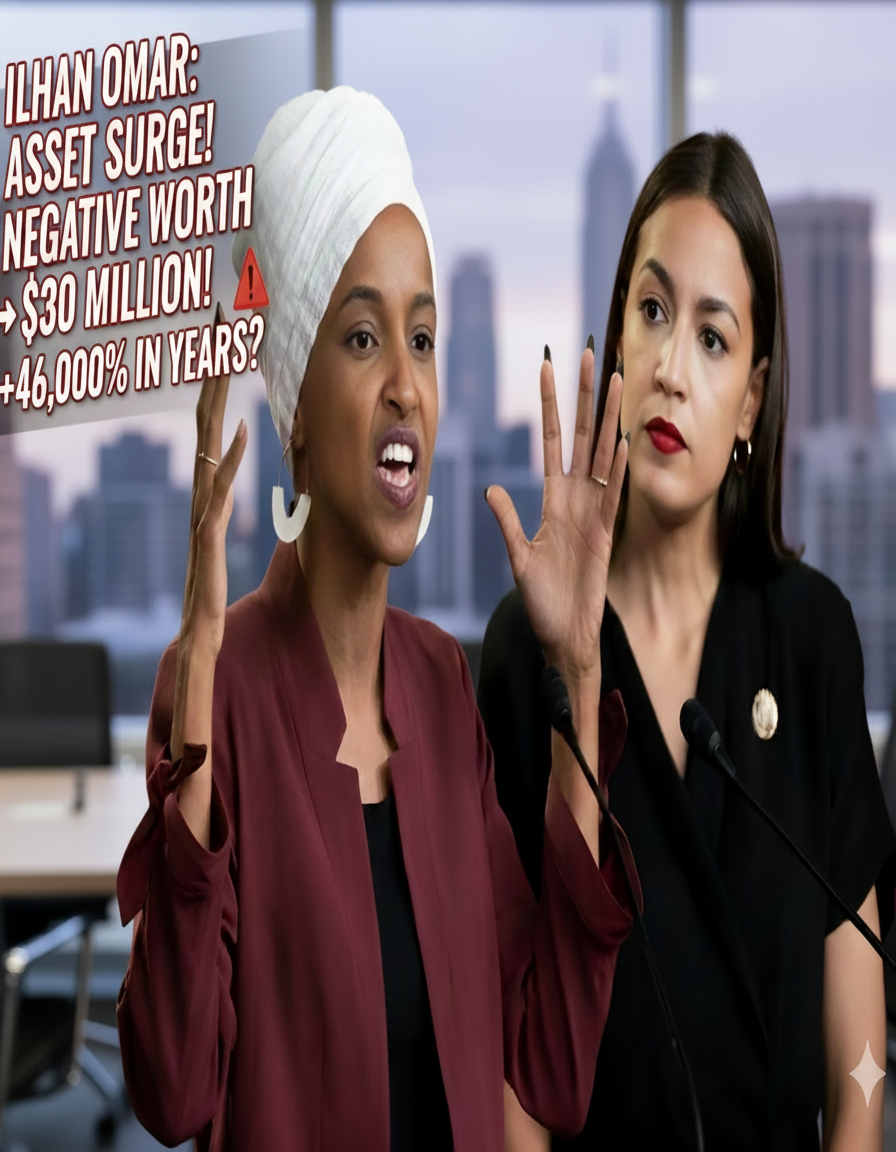
THE 46,000% QUESTION: HOW A SINGLE VIRAL CLAIM ABOUT ILHAN OMAR’S NET WORTH IGNITED A NATIONAL FIRESTORM OVER TRANSPARENCY, SUSPICION, AND POLITICAL NARRATIVES
In modern American politics, nothing spreads faster than a number.
It doesn’t matter if the number is verified, unverified, exaggerated, or completely misunderstood.
If it’s shocking — it will detonate.
And that is exactly what happened when a viral claim began circulating online, alleging that Rep. Ilhan Omar’s household net worth had skyrocketed by more than 46,000% since entering Congress, jumping from negative territory to supposed multimillion-dollar levels within a few short years.
No congressional hearing.
No investigative report.
No policy failure.
Just one number — and suddenly the internet was an inferno.
This is not a story about whether the claim is true.
It is a story about why America was ready to believe it, how political narratives weaponize financial suspicion, and what this says about transparency, distrust, and the fragile ecosystem of modern democracy.
I. The Spark: How One Viral Post Fractured the Online Landscape
The claim did not come from a major newspaper, a leaked financial document, or an official watchdog group.
Like most digital wildfires, it emerged from:
- a social media post
- a jaw-dropping percentage
- an emotionally loaded name
The formula was perfect.
Ilhan Omar — one of the most polarizing figures in Congress — sits at the intersection of nearly every cultural and political tension point: immigration, religion, race, foreign policy, and ideological identity.
When a shocking financial figure is attached to a high-profile figure like her, it hits a psychological trigger:
“If true, this is outrageous.”
“If false, this is manipulation.”
Both reactions fuel engagement.
Engagement fuels spread.
Spread fuels belief.
Within hours, the claim migrated from X to TikTok, to Reddit, to YouTube, each platform mutating the numbers just enough to keep the outrage alive.
“46,000%” became:
- “a 400-fold increase”
- “from debt to $30 million”
- “overnight wealth spike”
Facts no longer mattered.
Only emotion did.
II. The Perfect Storm: Why Financial Claims Hit Harder in Modern Politics
There are three topics that Americans react to viscerally:
- money
- power
- fairness
When those three converge in a single narrative, the reaction is explosive.
Over the last decade, public confidence in political institutions has eroded sharply. Poll after poll shows Americans increasingly believe:
- politicians become wealthy after taking office
- lobbyists influence personal fortunes
- public service has blurred into private gain
- transparency rules are performative, not substantive
So when a viral number appears — even without evidence — it fits into a pre-existing national suspicion.
The claim becomes a Rorschach test, not a data point.
Some see corruption.
Some see propaganda.
Some see proof of systemic failure.
Some see a targeted smear.
In this environment, truth is no longer the driver — perception is.
III. The Anatomy of a Viral Financial Scandal (Even When It’s Unverified)
Political analysts describe the Ilhan Omar net-worth firestorm as a textbook example of how digital misinformation or unverified claims evolve.
It follows a familiar sequence:
1. Shock
The number is extreme.
Extreme numbers cause emotional paralysis — and emotional paralysis spreads.
2. Simplification
A complex financial life is reduced to:
- “before Congress”
- “after Congress”
- “big jump”
Nuance disappears.
Outrage remains.
3. Polarization
The left calls it a smear.
The right calls it corruption.
The center calls it suspicious.
Conflict = virality.
4. Narrative Capture
Influencers, commentators, and anonymous accounts reshape the story to match their agenda.
Suddenly:
- it’s about ethics
- it’s about immigration
- it’s about identity
- it’s about political double standards
The original claim is no longer the story.
The discourse it generated becomes the story.
IV. Why Ilhan Omar Became the Perfect Target for a Financial Controversy
Ilhan Omar’s political presence has always triggered strong reactions.
She is:
- outspoken
- ideologically distinct
- symbolically potent
- a lightning rod for cultural conflict
Her identity amplifies public suspicion — whether justified or not.
A financial claim involving her triggers more intensity than the same claim about a less polarizing figure.
Not because of evidence.
Because of psychology.
Political consultants privately admit:
“An unverified claim about Omar spreads ten times faster than a verified claim about an establishment politician.”
She is both a political figure and a cultural symbol — and symbols attract narratives far beyond the facts.
V. The Real Issue: America Has a Transparency Problem — Regardless of the Claim
The online uproar is not really about Ilhan Omar.
It is about trust, or rather, the absence of it.
The outrage reveals a deeper truth:
People no longer trust financial disclosures.
Members of Congress file them, but they are vague, broad-range, and difficult for the public to interpret.
People believe politics enables financial advantage.
Democrats and Republicans alike face accusations of portfolio gains, book deals, speaking fees, consulting ties, family wealth, or asset restructuring.
People suspect wealth accumulation in office.
Whether true or not in any individual case, the belief is widespread — and growing.
The firestorm around Omar’s viral net-worth claim is a symptom of a national wound:
Americans think the system is rigged.
Unverified numbers succeed where verified reports fail because they speak to the public’s emotional truth, not the factual truth.
VI. The Media Response: A Crisis of Verification
Traditional media struggled to respond.
If outlets ignored the claim, they looked complicit.
If they covered it, they risked amplifying misinformation.
This is a modern dilemma:
- respond = spread
- ignore = mistrust
Truth becomes trapped between two bad options.
Analysts observed that mainstream outlets took 48–72 hours to address the narrative at all — an eternity in digital time — by which point the public had already formed emotional conclusions.
This is how misinformation thrives:
speed > accuracy
emotion > evidence
And it’s not going away.
VII. What Happens Next: Three Possible National Outcomes
The Ilhan Omar net-worth firestorm may evolve into:
1. A demand for stronger transparency laws
Expect calls for:
- real-time financial disclosures
- stricter reporting standards
- bans on certain investments
- independent audit teams
2. A political weapon for future elections
Candidates will use this episode as:
- proof of corruption
- proof of targeted smears
- proof of bias
- proof of systemic failure
Everyone will seize it.
3. A cultural shift
Americans may become even more cynical about:
- money in politics
- media credibility
- public accountability
- institutional honesty
Whether or not the claim is true, the damage is already done.
The narrative has become bigger than the number.
Conclusion: The Viral Claim Was Never About the Math — It Was About the Moment
The Ilhan Omar net-worth controversy is not fundamentally a financial story.
It is a mirror.
A mirror reflecting:
- the country’s distrust of its institutions
- the public’s desperation for honesty
- the political ecosystem’s hunger for scandal
- the vulnerability of democracy to viral information
- the fragility of truth in a hyper-connected age
The number sparked the fire.
The distrust fueled it.
The country carried it.
And whether the claim is true, false, exaggerated, or misunderstood will matter far less than what it exposed:
America no longer agrees on what truth looks like — only on how quickly it spreads.