

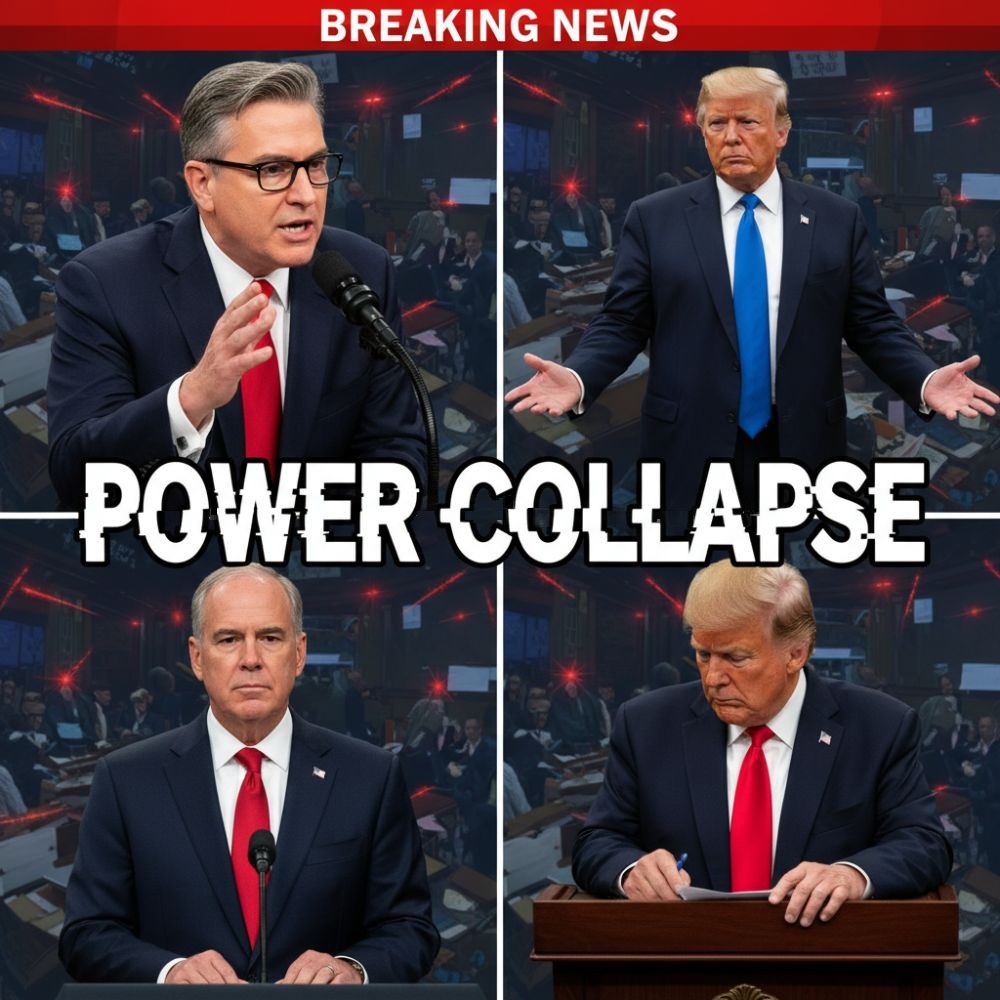
A Fracturing Republican Party: As Donald Trump and Mike Johnson Lose Control of the House
Washington — In a rare but consequential moment, the U.S. House of Representatives has become the clearest stage yet for exposing the simultaneous weakening of President Donald Trump and House Speaker Mike Johnson. The passage of legislation extending subsidies under the Affordable Care Act (ACA) — despite opposition from Republican leadership — was not merely a legislative setback, but a sign that the already fragile power structure of the Trump administration is beginning to crack from within.
For months, the relationship between Mr. Trump and Mr. Johnson has been viewed as a political “puppet and puppet master” dynamic: a president who dominates his party through personality and pressure, and a House speaker struggling to maintain internal discipline within an increasingly fractured coalition. The latest developments on the House floor, however, suggest that this grip on power is no longer sufficient to keep Republican lawmakers unified.
A Public Revolt
The House vote — in which more than 20 Republicans joined Democrats to pass the ACA subsidy extension — unfolded in full view of party leadership. The 230–196 result marked not only a victory for supporters of preserving health care assistance, but also a serious warning for Mr. Johnson, who now presides over the slimmest majority in modern House history.
Political observers note that this vote reflects a growing unwillingness among moderate and swing-district Republicans to sacrifice constituent interests in defense of an unclear and underdeveloped policy agenda coming from the White House.
“Everything eventually comes back to policy,” said a former Republican House adviser. “And that’s where both Trump and Johnson are coming up empty.”
A Crisis That Extends Beyond Mike Johnson
Mr. Johnson, once seen as a compromise figure after a series of leadership crises in the House last year, now faces a threat to his speakership comparable to those confronted by his predecessors. With proxy voting prohibited and the Republican conference shrinking due to illness, accidents, and resignations, Mr. Johnson is governing a House in which only a handful of defections can paralyze the legislative process.
Yet the deeper problem is that Mr. Johnson can no longer rely on the so-called “Trump shield” — the force that once suppressed nearly all internal dissent. As President Trump increasingly appears without a concrete policy plan, particularly on health care, Republican lawmakers are left without a defensible narrative to bring back to their voters.
“Interested in Health Care” — Without a Plan

Mr. Trump’s recent statement that he is “interested” in health care quickly became fodder for ridicule across political television and social media platforms in the United States. Analysts point out that for nearly a decade, Mr. Trump has repeatedly promised a “beautiful” or “phenomenal” health care plan to replace Obamacare — without ever delivering a comprehensive proposal.
Minnesota Governor Tim Walz, in remarks that circulated widely online, called such claims a fundamental misunderstanding of how the American health care system works. Comments like these have only increased pressure on Republican lawmakers, particularly those representing competitive districts where voters depend heavily on federal health care subsidies.
The Erosion of MAGA’s “Glue”
For years, personal loyalty to Donald Trump functioned as the binding force of the MAGA movement. But according to political analysts, as Trump’s second term enters a more turbulent phase, that loyalty is no longer enough to maintain party discipline.
Lawmakers such as Mike Lawler of New York, Don Bacon of Nebraska, and Thomas Massie of Kentucky — despite their ideological differences — share a common motivation: political survival. For them, openly challenging party leadership can sometimes be the only viable path to holding onto their seats.
“This is no longer about loyalty or betrayal,” one political strategist said. “It’s about who can still convince voters that they’re actually doing something meaningful.”
Long-Term Consequences for Trump’s Presidency
The House setback not only weakens Mike Johnson’s standing, but also signals a volatile period ahead for the remainder of President Trump’s term. As control of the House becomes increasingly tenuous, the likelihood of passing major reforms — on taxes, immigration, or health care — diminishes sharply.
At the same time, internal Republican divisions risk creating opportunities for Democrats to reshape the policy debate, particularly as American voters grow more focused on kitchen-table issues such as cost of living and access to health care.
A Moment That May Define the Future
The recent vote may not rank among the most dramatic episodes in House history, but it may well be remembered as the moment when the political authority of Donald Trump and Mike Johnson visibly began to erode. As personal loyalty proves insufficient to mask a widening policy vacuum, American politics enters a new phase — one in which the question of who truly controls the House is harder to answer than ever before.