

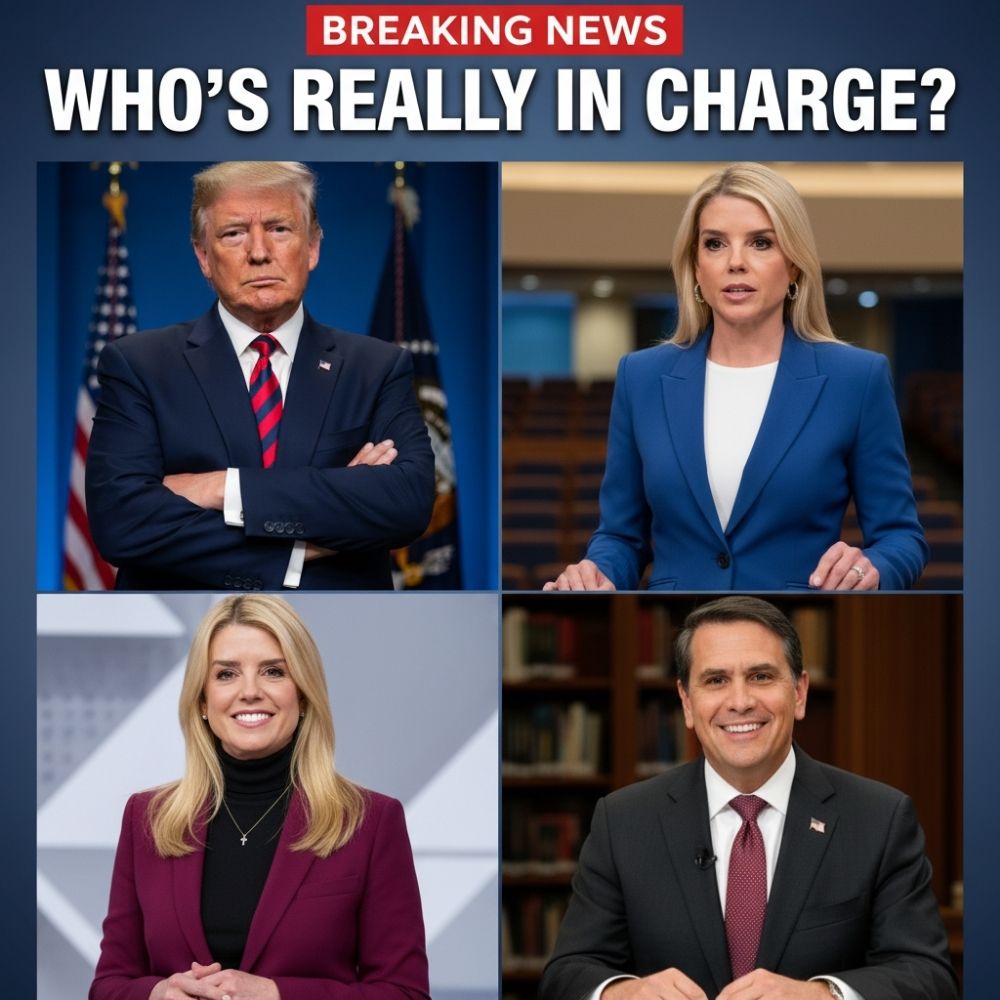
Justice Department Turmoil Raises Questions About Leadership, Independence, and Power
Washington — The Department of Justice, long regarded as one of the federal government’s most insulated institutions, is facing renewed scrutiny as senior officials fall silent, internal leadership shifts accelerate, and politically charged investigations converge under a small circle of presidential allies.
At the center of the current controversy is Attorney General Pam Bondi, whose public absence in recent weeks has prompted intense speculation across political media and legal circles about her standing inside the administration. Once a visible spokesperson for the department, Bondi has not addressed several of the most consequential matters now confronting federal law enforcement, including renewed attention to the Jeffrey Epstein files, a U.S. law-enforcement operation linked to Venezuela, and the killing of Renee Good, a case that has sparked civil-rights concerns.
Her silence has coincided with growing reporting and commentary suggesting that President Donald Trump, now in his second term, has lost confidence in her leadership. While the White House has not confirmed any change, the speculation reflects a broader perception that power within the Justice Department is shifting away from its nominal head.
A Vacuum at the Top
Former Justice Department officials say prolonged silence from an attorney general during moments of national controversy is unusual.
“Even when attorneys general choose not to comment on ongoing investigations, they typically delegate or appear to reaffirm institutional processes,” said one former senior DOJ official, speaking on condition of anonymity. “Total disappearance creates uncertainty — internally and externally.”
That uncertainty has been amplified by the increasing visibility of Todd Blanche, the department’s deputy attorney general and formerly one of Mr. Trump’s criminal defense lawyers. Blanche has taken a leading role in public messaging and legal strategy on multiple fronts, according to filings, media appearances, and internal communications cited by political commentators.
He has been associated with decisions related to the Epstein document review, the legal defense of Jonathan Ross, an ICE agent under investigation, and coordination surrounding the Venezuela operation — areas where Bondi herself has remained publicly absent.
The result, critics argue, is the appearance of a Justice Department increasingly run by personal loyalty rather than institutional hierarchy.
The Epstein Files and the Southern District of New York
Few issues illustrate the tension more clearly than the handling of the Epstein materials. According to multiple media reports and commentary from legal analysts on social platforms, much of the Southern District of New York — traditionally the department’s most powerful prosecutorial office — has been redirected to work almost exclusively on Epstein-related matters.
Current and former prosecutors have expressed concern that such an all-hands focus could sideline other major federal cases, including those involving narcotics trafficking, financial crime, and national security.
“This office built its reputation on independence and breadth,” said a former SDNY prosecutor. “If it’s effectively taken offline for a single politically sensitive matter, that’s a structural change, not a tactical one.”
The Justice Department has not confirmed the scope of the reassignment.
A Prosecutor Removed — and a Message Sent
The sense of institutional instability deepened with reports that Robert McBride, the acting head of the U.S. Attorney’s Office for the Eastern District of Virginia, was removed from his post. McBride, a veteran prosecutor brought in late in his career, had reportedly sought to stabilize the office amid pressure to pursue politically sensitive indictments.
According to legal commentators and journalists citing internal sources, McBride resisted leading a prosecution against former FBI Director James Comey while simultaneously running the office — a stance that may have placed him at odds with senior department leadership.
His removal followed meetings with federal judges in the district, where he reportedly attempted to reassure the bench that prosecutorial decisions would remain grounded in law rather than politics.
The Justice Department declined to comment on personnel matters.
Civil Rights Concerns in the Renee Good Case
Perhaps the most consequential controversy involves the killing of Renee Good, which has drawn comparisons in media commentary to prior civil-rights prosecutions led by the department, including the federal case against former Minneapolis police officer Derek Chauvin.
In that case, the Justice Department’s Civil Rights Division played a central role. In the Good investigation, however, the division has reportedly declined to take a lead prosecutorial role, prompting criticism from civil-rights advocates and legal analysts.
Those critics point to public statements by administration figures, including Vice President JD Vance, characterizing the killing as self-defense before the investigation has concluded — remarks that, they argue, undermine claims of independence.
The Civil Rights Division, now led by Harmeet Dhillon, has undergone significant restructuring under the Trump administration. Supporters say the changes have restored balance; critics contend the division has been hollowed out and politicized.
Loyalty Versus Law
Taken together, these developments have fueled a broader narrative — advanced most prominently on legal podcasts, independent political networks, and social-media platforms — that the Justice Department is undergoing a quiet but profound transformation.
In this view, traditional guardrails are giving way to a model in which legal authority flows upward through personal trust rather than institutional norms. Blanche, widely viewed as a trusted confidant of the president, is often cited as emblematic of this shift.
White House allies reject that characterization, arguing that the department is merely correcting years of politicization by prior administrations.
What Comes Next
No official announcement has been made regarding Bondi’s future. But in Washington, absence often speaks as loudly as action. Should a change occur, it would mark yet another instance of rapid turnover at the top of an institution designed to outlast any single presidency.
For now, federal judges, career prosecutors, and civil-rights advocates are watching closely — not only for who occupies the offices of power, but for whether the Justice Department can still credibly claim independence at a moment when public trust is already strained.
As one former DOJ official put it, “The department doesn’t collapse all at once. It erodes — quietly, incrementally — until one day people realize it no longer looks like the institution they thought they knew.”