

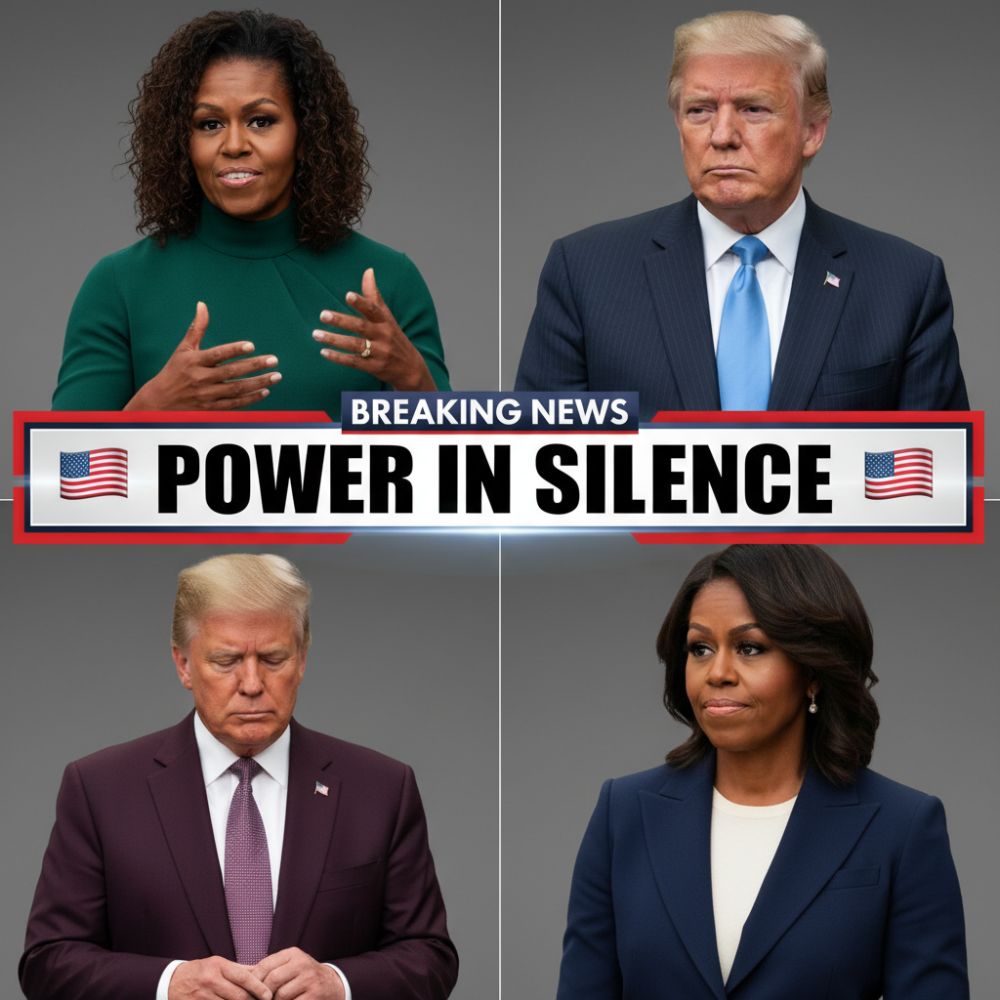
When Silence Carries More Weight Than Noise: Michelle Obama, Donald Trump, and the Power of Contrast
In contemporary American politics, conflict is rarely subtle. Disagreements are amplified, personalities clash in public, and attention is often secured through volume rather than substance. That is why the most striking political moment of the past week did not come from a rally, a press conference, or a late-night social media post. It came from restraint.
Michelle Obama did not attack Donald Trump directly. She did not issue a rebuttal, engage in name-calling, or respond in real time. And yet, her remarks — measured, deliberate, and grounded in lived experience — reverberated across the political and cultural landscape, provoking a reaction from a president known for thriving on confrontation.
The contrast was unmistakable. And it is precisely that contrast that has captured public attention.
A Reaction Without a Provocation
President Trump, speaking about critics he associates with past investigations and political opposition, dismissed one figure as “deranged,” insisting that claims about Russian influence were “false” and “the exact opposite” of reality. The comments followed a familiar pattern: personal grievance framed as political defense, delivered with intensity and repetition.
What made the moment notable was not the statement itself, but its timing. Trump’s remarks arrived in the wake of renewed public attention on Michelle Obama’s recent speeches and appearances — none of which mentioned him by name, yet all of which implicitly challenged the governing style he represents.
On social media platforms including X, Instagram, and YouTube, clips of Michelle Obama’s comments circulated alongside Trump’s reactions, often edited together to emphasize the imbalance. One did not provoke the other directly. Instead, one seemed to expose the other through contrast alone.
Authority Without Announcement
Michelle Obama’s influence has long rested on credibility rather than confrontation. A former first lady who has spoken openly about education, public health, racial justice, and women’s autonomy, she rarely engages in the daily churn of partisan combat. When she speaks, it is typically within a broader moral framework, not a tactical one.
In recent remarks, she addressed issues such as reproductive freedom, education policy, and the responsibilities of leadership. Her language was firm but calm. She did not dramatize her points. She did not personalize her criticism. She simply articulated consequences.
“The presidency,” she has said in various forms over the years, “does not change who you are. It reveals who you are.”
That idea — repeated across interviews, speeches, and her memoir Becoming — has resurfaced as a focal point of online discussion. Commentators across ideological lines noted that her delivery required no escalation. The authority came not from volume, but from consistency.
A President of Performance
Donald Trump’s political persona, by contrast, has always been rooted in spectacle. From rallies to social media posts, his style favors immediacy, emotional intensity, and personal dominance of the narrative. Supporters view this as authenticity; critics see it as volatility.
In recent weeks, Trump’s public appearances have followed a familiar arc: sweeping claims, personal grievances, and declarations of strength delivered with theatrical emphasis. Each new controversy is framed as a battle to be won rather than a problem to be managed.
Political analysts have increasingly described this approach as performative governance — a style in which attention becomes a proxy for authority. In such an environment, silence can be destabilizing. Without an adversary who responds in kind, performance loses its audience.
Michelle Obama did not engage on Trump’s terms. She did not respond to his comments. She did not attempt to “win” the exchange. And in doing so, she altered the dynamic entirely.
The Internet Notices the Gap
The public response unfolded largely online. Viral clips framed Michelle Obama’s calm delivery against Trump’s reactive statements. Commentary threads focused less on the content of individual remarks and more on what they represented.
One recurring observation appeared across platforms: Michelle Obama does not need to assert her credibility. It is assumed. Trump, by contrast, continually reinforces his authority through repetition, as if declaration alone can sustain it.
Media scholars have noted that such moments are rarely about persuasion. They are about recognition. Audiences recognize patterns. They recognize fatigue. And they recognize when one style begins to feel outdated.
The humor that followed was not cruel, but observational. Late-night commentary and social media satire framed the moment as an example of “quiet competence versus loud insistence.” The jokes landed not because they exaggerated reality, but because they reflected it.
Leadership as Endurance
Perhaps the most consequential aspect of the moment is what it reveals about changing expectations of leadership. For years, political strength has been associated with dominance — the ability to overwhelm opponents, command attention, and control the narrative.
Michelle Obama offers a different model. Her public presence suggests that leadership can also be expressed through discipline, patience, and preparation. She does not rush to respond. She trusts that substance accumulates over time.
Trump’s approach, by contrast, depends on constant motion. Each moment must escalate the last. Each silence must be filled. That strategy can be effective in short bursts, but it is difficult to sustain indefinitely.
Observers noted that Trump appeared unsettled not by an attack, but by irrelevance — by a conversation that moved forward without him at its center.
The Power of Being Unbothered
What ultimately resonated was not a single quote or viral clip, but the emotional tone. Michelle Obama appeared unbothered. Trump appeared reactive. In politics, perception matters as much as policy.
The former first lady did not claim victory. She did not frame the moment as a confrontation. She continued speaking about long-term challenges: education, equality, civic responsibility. In doing so, she shifted the frame from personality to purpose.
Trump’s response, focused on grievance and personal defense, only sharpened that contrast.
A Quiet Conclusion
There was no dramatic finale to the exchange. No decisive moment. Just distance.
Michelle Obama moved forward, her influence steady and cumulative. Donald Trump remained engaged in a cycle of reaction, louder with each turn, but no closer to regaining control of the narrative.
The lesson, for many observers, was subtle but clear: authority does not always announce itself. Sometimes it simply endures.
In a political culture saturated with noise, that endurance may prove more disruptive than any attack.