

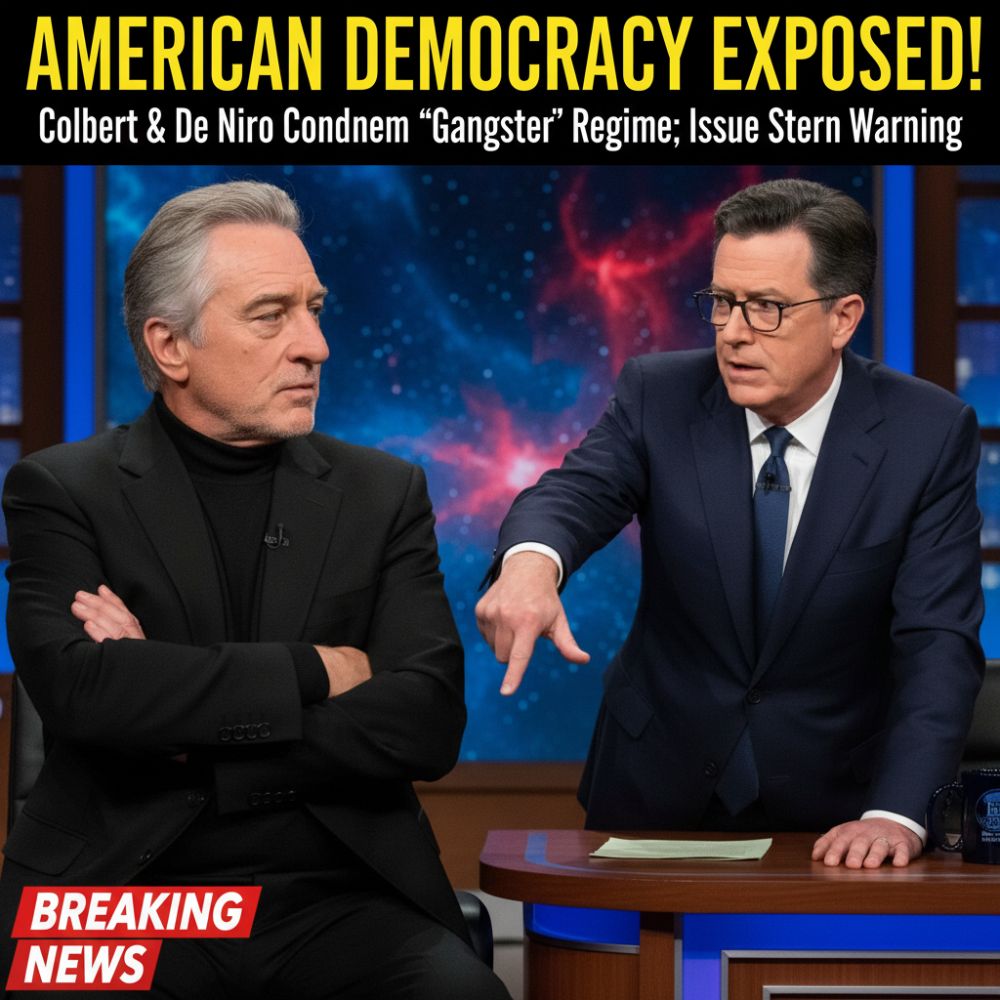
In the high-stakes theater of American politics and media, few moments carry the weight of genuine, unscripted truth. However, a series of recent events involving cinematic icon Robert De Niro and late-night veteran Stephen Colbert has done more than just provide entertainment; it has pulled back the veil on a systematic effort to reshape the American landscape through censorship, intimidation, and the rewriting of history. What began as a series of interviews on “The Late Show” has evolved into a cultural flashpoint, pitting two of the country’s most influential voices against an administration they describe as a “wannabe gangster” regime.
The most haunting moment of this saga occurred on February 19, 2025. Robert De Niro, a man who has spent over sixty years portraying some of cinema’s most notorious mob bosses, sat across from Colbert. The conversation took a sharp, somber turn when Colbert asked De Niro who his heroes were. After mentioning legends like Marlon Brando and Nelson Mandela, De Niro’s voice took on a gritty resolve as he named the Capitol Police officers who defended the building on January 6th. The audience erupted in applause, but it was the silence that followed that truly resonated.
Colbert looked directly at De Niro and the camera, asking the audience to imagine being those officers—watching as public figures and politicians attempt to deny their service and rewrite the events of that day. For several long, agonizing seconds, neither man spoke. This “haunting silence,” as it has been described, served as a powerful indictment of the political movement to pardon insurrectionists and label them “patriots.” For De Niro, the contrast is clear: real heroes are being cast aside to favor those who attacked the seat of democracy.
De Niro’s criticism of Donald Trump has been as relentless as it is legendary. Throughout 2024 and 2025, the Oscar winner has used every platform available—from the steps of Manhattan criminal trials to the prestigious stages of the Cannes Film Festival—to warn the public. At Cannes in May 2025, while accepting an honorary Palme d’Or, De Niro labeled the current leadership as “America’s Philistine,” arguing that 100% tariffs on foreign films were not just an economic policy, but a direct threat to the truth-seeking nature of art. “Art embraces diversity,” De Niro proclaimed, “and that is why we are a threat to autocrats and fascists.”
The conflict reached a boiling point in early 2026 when the battleground shifted to the very infrastructure of media itself. Stephen Colbert, typically known for his sharp wit and satire, delivered a bombshell monologue on February 17th that sent shockwaves through the industry. He revealed that CBS network lawyers had blocked a scheduled appearance by a Democratic Senate candidate, James Talarico. Even more chillingly, Colbert was told in “no uncertain terms” that he was not even allowed to mention that the candidate had been censored.
This revelation exposed a deepening vein of corporate surrender. Colbert pointed the finger directly at FCC Chairman Brendan Carr, a Trump appointee, whose “equal time” guidance has been perceived by many as a weaponized tool to intimidate networks and silence opposition. Colbert’s defiance was a rare act of televised rebellion. “I think you are motivated by partisan purposes yourself,” Colbert said of Carr, before bypassing his own network’s restrictions by posting the suppressed interview on YouTube. The video garnered millions of views, proving that while the traditional airwaves might be under siege, the digital frontier remains a space for resistance.
The response from the Trump administration has been a mixture of “demented late-night meltdowns” and aggressive policy shifts. Trump has reportedly celebrated the cancellation of Colbert’s show—a move that came shortly after the host labeled a Paramount-related settlement as a “big fat bribe.” Meanwhile, the administration’s rhetoric has turned toward international conflict, with threats of war with Iran and the imposition of heavy tariffs on allies like India. Critics argue these moves are designed to distract from domestic scandals, including the release of thousands of pages of Epstein-related documents in which Trump’s name reportedly appears over 1,600 times.
De Niro’s assessment of Trump as a “wannabe gangster” strikes a particular chord because of the actor’s history. Having played characters in “The Godfather Part II,” “Goodfellas,” and “Casino,” De Niro argues that even the most violent cinematic outlaws operate under a code. In his view, the current political leadership lacks any such code, operating instead on a foundation of ego, “grubby real estate hustling,” and a total lack of empathy.
As the United States finds itself on the brink of potential military escalations abroad and unprecedented media censorship at home, the collaboration between De Niro and Colbert serves as a stark reminder of the power of the individual voice. They have framed the current era not just as a political disagreement, but as a fundamental battle for the soul of the country. By refusing to be silenced by network lawyers or intimidated by MAGA protesters, they have set a precedent for how public figures can hold power to account.
The article concludes that the “silence” De Niro and Colbert shared on that February night was not just a pause in conversation—it was a call to action. It was a moment that demanded the audience look past the “AI-generated hockey videos” and “diaper-dropping tantrums” to see the very real erosion of democratic norms. As the 2026 election cycle looms, the question remains whether the American public will heed the warnings of the “wannabe gangster’s” most vocal critics, or if the “Philistine” era will continue to silence the voices of art and truth.