

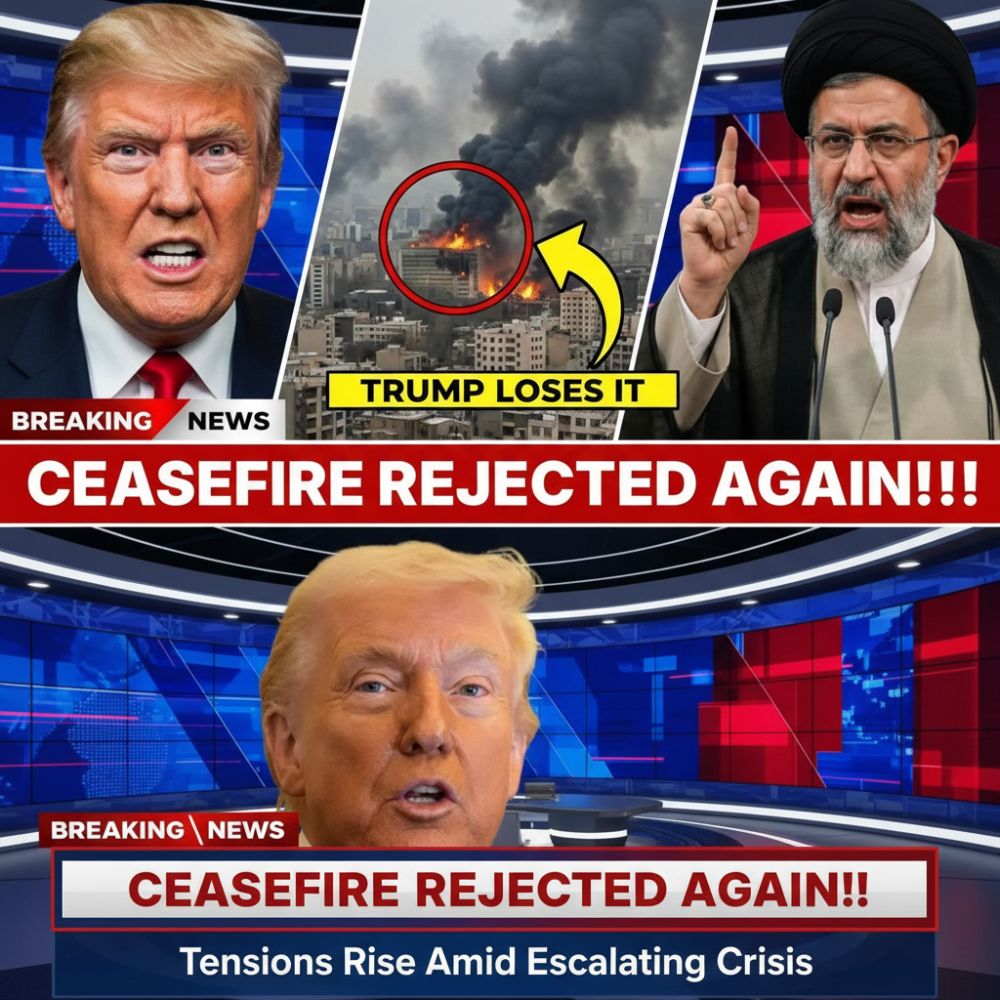
Trump LOSES IT Over Iran — Ceasefire REJECTED Again
The Merchants of Black Rain: How Delusion and Hubris Set the Middle East Ablaze
The sky over Tehran is no longer blue; it is a thick, oily shroud of soot and despair. Literal black rain is falling on nine million people, the direct result of American and Israeli strikes that converted Iran’s oil infrastructure into a series of unquenchable infernos. This is not a strategic surgical strike or a “contained” operation. It is a biblical catastrophe, yet the man in the Oval Office is treating a regional conflagration like a minor traffic delay on the way to a golf course.
When Donald Trump picked up the phone to call ABC News, he didn’t offer a somber assessment of the lives lost or the global economic precipice we now stand upon. Instead, he uttered words that should chill every person watching: “I am not worried about anything at all… It is a little glitch. We had to take this detour.”
A detour. That is the official White House branding for a conflict that has shuttered the Strait of Hormuz for the first time in eighty years, sent energy markets into a terminal tailspin, and brought ballistic missiles raining down on Tel Aviv and Bahrain. To call the systematic destruction of a region and the deaths of American service members a “glitch” is more than just a linguistic failure; it is a profound moral bankruptcy. It reveals a leadership that views geopolitical chess not with a sense of gravity, but with the casual indifference of a reality TV producer editing a difficult scene.
The Handshake That Broke the World
Washington’s entire playbook was predicated on a singular, arrogant assumption: that Iran would eventually fold. The belief was that if you hit them hard enough, they would crawl to the negotiating table, desperate for any scrap of a ceasefire. That calculation has been proven catastrophically wrong.
Iran’s Foreign Minister appeared on American television this morning to deliver a message that the administration clearly didn’t have a script for. He didn’t look like the leader of a regime on the verge of collapse. He looked like a man who had done the math. He pointed out the obvious hypocrisy of the West: Iran accepted a ceasefire before, exercised restraint, and framed their actions as self-defense. In response, the U.S. and Israel didn’t de-escalate; they rearmed and went after the jugular—hitting schools, hospitals, and desalination plants.
If you beat someone down, offer a handshake, and then strike them the moment they reach out, you shouldn’t be surprised when they eventually stop reaching. Iran has now said “no” to the ceasefire cycle. By targeting freshwater infrastructure, the U.S. moved beyond military objectives into the realm of existential warfare. In a region where purified water is more vital than crude oil, destroying desalination plants isn’t a tactic; it’s a death sentence for civilians. Iran is now mirroring these strikes, hitting plants in Bahrain and Kuwait, ensuring that the pain is felt by every American ally in the crossfire.
Extortion with a Merch Table
If the President’s “glitch” comment wasn’t enough to signal the lack of a coherent strategy, Senator Lindsey Graham’s recent media appearances filled in the blanks with terrifying clarity. Graham appeared on national television sporting “Make Iran Great” and “Free Cuba” hats—turning a bloody, active war into a late-night infomercial.
This isn’t diplomacy; it’s a war-themed gift shop. While American soldiers are being returned in flag-draped coffins, Graham is already pitching the “next war,” suggesting that after we “blow the hell out of” Iran, Cuba is next on the itinerary. He even went as far as to demand that Arab allies join the fight if they want to maintain treaties with the United States. It is a policy of pure extortion, delivered by a man who seems to think that wearing the right branded headwear is a substitute for a viable exit strategy.
The lack of dignity is perhaps most palpable in how the administration handles its own fallen. During the dignified transfer at Dover for six American heroes—Captain Cody Cork, Sergeant First Class Nicole Moore, Sergeant First Class Noah Tens, Sergeant Declan Cody, Major Jeffrey O’Brien, and Chief Warrant Officer 3 Robert Marzesen—the President saw fit to wear a $55 campaign hat. When Fox News tried to cover for this by airing old footage where he looked more “presidential,” they were caught in a blatant attempt to sanitize the optics of a Commander-in-Chief who views a funeral as a branding opportunity.
The Economic Aftershock
While the politicians play-act as conquerors, the rest of the world is about to pay the bill. The shutdown of the Strait of Hormuz, through which 20% of the world’s oil flows, is not something that “clears up” after a few weeks. Tanker traffic has dropped to zero. Iraqi oil output has plunged by 60%. Qatar has halted LNG production.
Analysts are already projecting that headline consumer price inflation will surge past 4% by late spring. This isn’t just about the price at the pump; it’s about the cost of the bread on your table and the stability of your retirement account. When supply chains are forced to reroute and companies restructure around permanent instability, those jobs and routes don’t just “come back” when the bombing stops. The economic damage is being baked into the foundation of the global market.
Three Roads to Nowhere
We are currently staring down three potential scenarios, and none of them offer a return to the world we knew a month ago.
The first is a “managed off-ramp” where back-channel pressure forces a ceasefire. Even in this “best-case” scenario, the trust is gone. Gulf States that watched their critical infrastructure burn will never again rely solely on the American security umbrella.
The second scenario is a regional realignment. We are already seeing this as the UAE furiously denies helping the U.S. strike Iran. Middle Eastern powers are beginning to hedge their bets, looking toward China and India for partnerships that don’t involve being collateral damage in a Washington “detour.” The American monopoly on strategic loyalty in the region hasn’t just been challenged; it has been fractured beyond repair.
The third scenario is the one Lindsey Graham is salivating over: full escalation. This means ground forces and special operations inside a nation of 90 million people. It is the “march through the world” doctrine brought to life—a generation-defining catastrophe that would see the global economy fragment and the Middle East dissolve into a permanent state of war.
The Illusion of Control
Donald Trump didn’t build an exit strategy; he built a merchandise line. He speaks of hand-picking the next Ayatollah as if he’s casting a lead for a sitcom, ignoring the reality of a sovereign nation that will never accept a leader chosen in Washington. It is delusion dressed up as strength, and it is being enabled by a political class that views war as a “win-loss” column in a domestic polling cycle.
The architecture that held the Middle East together for decades has been dismantled by a combination of Iranian defiance and American hubris. Whether Iran’s refusal to accept a ceasefire is a masterstroke of strategic patience or a desperate gamble remains to be seen. What is certain, however, is that the “glitch” is actually a systemic failure.
We are witnessing the end of an era where Washington could dictate the terms of peace through sheer intimidation. The black rain over Tehran is a grim reminder that when you destroy the infrastructure of life—water, power, and food—you lose the ability to negotiate. You aren’t “cleaning out the bad guys”; you are creating a vacuum that will be filled by whoever survives the fire.