

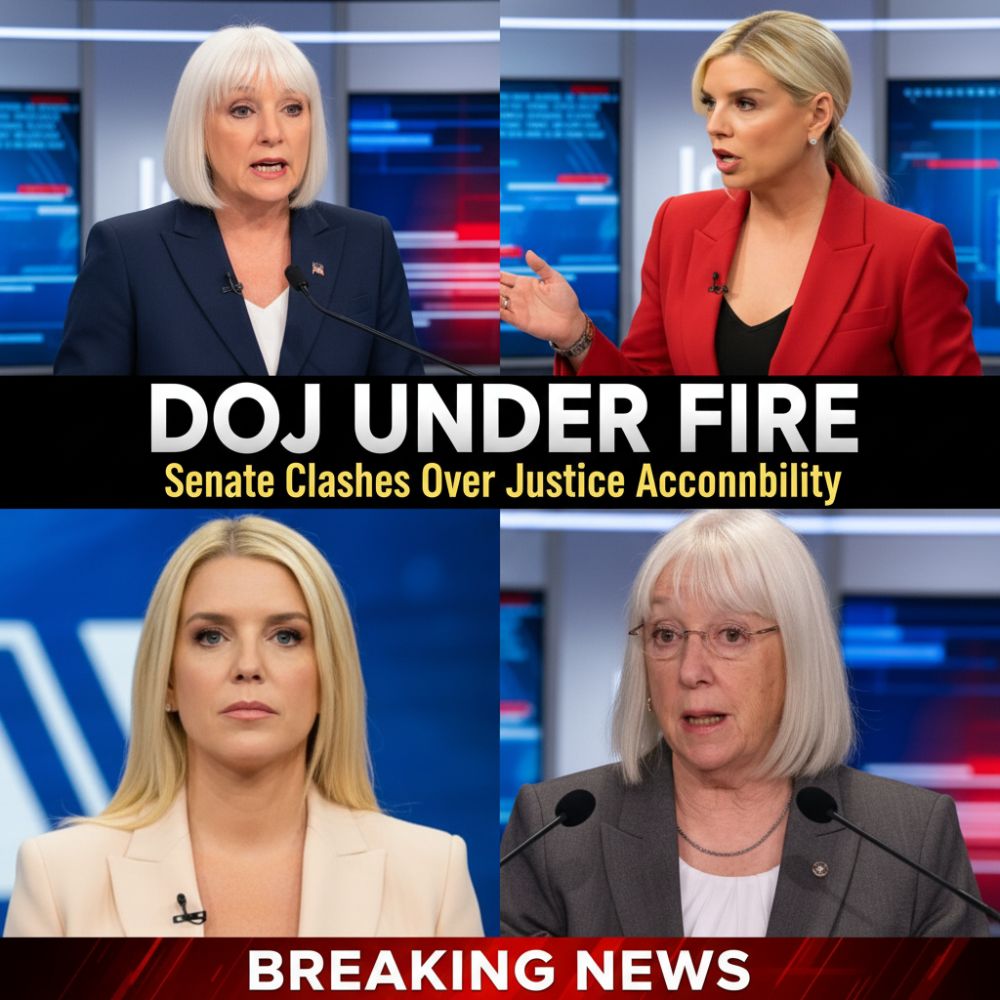
The hearing room fell into a rare silence when Senator Patty Murray leaned forward and asked a question that should have required only two words in response.
Yes or no.
Instead, Attorney General Pam Bondi paused, adjusted her microphone, and began an answer that immediately signaled the exchange was about to turn into something far bigger than routine oversight.
Within minutes, the confrontation would become one of the most talked-about political moments circulating across social media and news channels.
Because the question Murray asked touched on something that cuts to the heart of democracy itself.
Whether the Department of Justice is truly following the law.
Murray began by warning that she was deeply troubled by what she described as a disturbing pattern unfolding across government institutions.
She pointed to reports of detainees being moved overseas without due process, elected officials facing detention while conducting oversight, and political confrontations escalating into physical altercations.
“These are not the values I recognize,” she said, addressing colleagues from both parties.
But that statement was only the opening act.
The real confrontation began when Murray brought up a whistleblower complaint filed by a former Department of Justice attorney.
According to reports referenced during the hearing, the complaint accused senior DOJ leadership of defying court orders through deliberate delays, misleading statements, and what the filing described as disinformation.
The whistleblower also alleged retaliation after raising concerns about the department’s conduct in federal court proceedings.
Murray acknowledged the allegations had not yet been proven in court.
But she argued they were serious enough to demand immediate answers.
So she asked Bondi a simple question.
Would the Department of Justice follow court orders.
Bondi responded by saying the administration would follow court orders.
But then she added a comment that immediately caught the attention of everyone in the room.
She suggested the real issue might lie not within the Justice Department but with federal district courts across the country.
The remark landed like a spark in dry grass.
Murray quickly tried to redirect the conversation back to the central point.
She was not asking about district courts.
She was asking whether the DOJ would prevent the kind of conduct described in the whistleblower complaint.
Again she asked for a yes or no answer.
But Bondi refused to engage directly with the allegations.
Instead she defended two officials mentioned in the controversy, describing them as people she trusted and respected deeply.
“I would run through a wall for them,” she said.
For Murray, that response missed the point entirely.
She was not asking about personal loyalty.
She was asking about institutional accountability.
And the tension between the two women became unmistakable.
But the hearing was about to take another dramatic turn.
Because Murray shifted the conversation toward a decision that could affect hundreds of public safety programs across the United States.
According to information she presented during the hearing, the Justice Department had abruptly cancelled more than 300 federal grants.
These grants had already gone through a rigorous application process and had been approved through what Murray described as a fair and non-political review system.
The programs funded by those grants were not obscure bureaucratic initiatives.
They included efforts to investigate drug trafficking networks, support foster children who experienced abuse, expand violence prevention programs, and assist victims of crime.
Some grants funded community-based programs designed to reduce crime before it happens.
Others helped prosecutors build stronger cases against violent offenders.
But one cancellation raised particularly urgent concerns.
Funding for programs expanding access to forensic examinations for victims of sexual assault.
These examinations are often essential in criminal investigations.
They allow authorities to collect evidence that can later be used in court to prosecute perpetrators.
Without those services, many victims may struggle to pursue justice.
Murray asked Bondi directly whether she had known about the program when the funding was cut.
Bondi paused briefly before answering.
She said she was not familiar with that specific grant.
Instead, she offered to review the program personally if Murray’s office provided additional details.
To critics watching the exchange, that answer raised an uncomfortable question.
How could funding for critical victim services be cancelled if senior leadership was unaware of what those programs actually did?
Bondi defended the broader decision by explaining that the department had reviewed its grant programs and made adjustments representing only a small percentage of total funding.
She also emphasized that some grants had already been restored after organizations appealed the decision.
But Murray remained unconvinced.
Because the effects of the cuts were already being felt.
Organizations across the country had reportedly been forced to reduce staff, cancel services, or search urgently for new funding sources.
And that meant the consequences were not theoretical.
They were immediate.
But Murray still had one more issue to raise.
And it involved a law passed by Congress more than twenty years earlier.
She turned the conversation toward the Office on Violence Against Women.
This office was created to oversee programs established under the Violence Against Women Act.
In 2002, Congress made the office a permanent and independent entity within the Justice Department.
The goal was clear.
Ensure crimes involving violence against women receive dedicated attention, expertise, and resources.
But according to Murray, the Justice Department’s new budget proposal would change that structure dramatically.
The plan involved consolidating the office into the broader Office of Justice Programs.
Murray argued that such a move would weaken the office’s independence and reduce its ability to advocate for victims.
She also reminded Bondi that Congress had intentionally designed the office to remain separate.
Bondi acknowledged the proposal but defended it.
She argued that consolidating the offices would streamline operations and eliminate unnecessary bureaucracy.
According to her, the change would not reduce support for programs helping victims of violence.
But Murray strongly disagreed.
She pointed out that Congress had codified the office’s independence precisely to prevent it from being absorbed into larger bureaucratic structures.
In her view, the proposed consolidation directly contradicted the intent of the law.
The disagreement quickly became one of the most intense moments of the hearing.
And it revealed something deeper than a dispute over budgets or organizational charts.
It exposed a fundamental divide over how the Justice Department should operate.
One side argued that reforms were necessary to improve efficiency.
The other warned that those reforms could weaken critical protections for vulnerable communities.
As the hearing continued, it became clear that neither side was willing to retreat.
Supporters of Bondi argued that the department was making necessary adjustments while remaining committed to public safety.
Critics warned that those adjustments risked dismantling programs communities depend on.
Within hours, clips of the exchange began spreading across social media platforms.
Some viewers praised Murray for pressing tough questions about accountability inside the Justice Department.
Others accused her of turning a policy debate into a political spectacle.
But regardless of which side viewers supported, one fact remained undeniable.
The hearing had ignited a conversation far larger than the room where it took place.
Questions about whistleblower allegations, grant funding, and victim support programs were suddenly being debated across the country.
Legal experts, lawmakers, and ordinary citizens all began weighing in.
And that may be the most significant outcome of the entire confrontation.
Because congressional hearings rarely capture widespread public attention.
But when they do, it usually means something deeper has been exposed.
In this case, the debate centers on the role of the nation’s most powerful law enforcement institution.
How it makes decisions.
Who it protects.
And whether it remains accountable to the public it serves.
Those questions did not end when the hearing adjourned.
If anything, they are only beginning.
Because once a question about justice enters the national conversation, it rarely disappears quietly.