

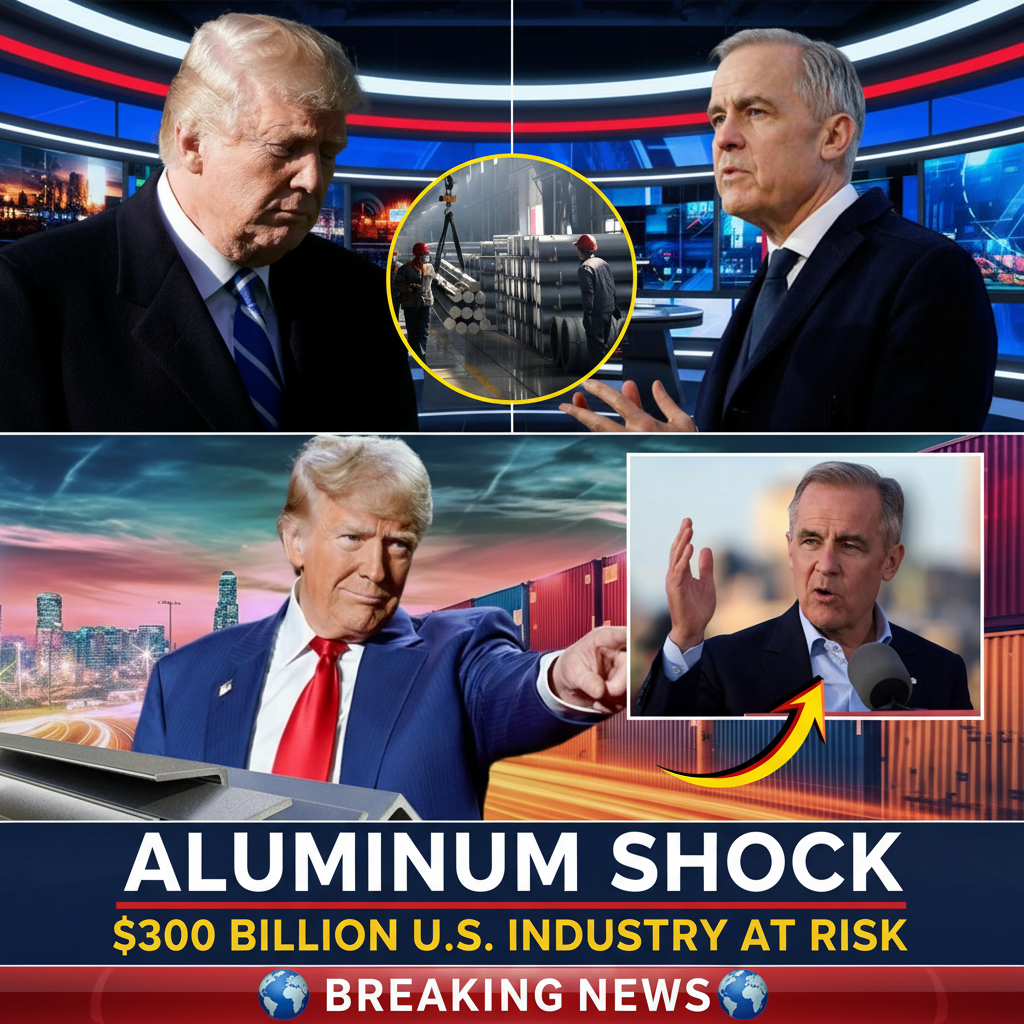
Aluminum Shock: $300 Billion at Risk as Supply Crisis Forces U.S. to Look North
WASHINGTON, D.C. — A silent but severe crisis is sending shockwaves through the backbone of American industry. A dramatic crunch in the U.S. aluminum supply chain now threatens nearly $300 billion in industrial activity, forcing manufacturers to scramble for resources and policymakers to urgently rethink their trade strategy. As domestic stockpiles dwindle to critical lows, all attention is turning north—to Canada.
The alarm was sounded this week as new data revealed that U.S. imports of unwrought aluminum plummeted by nearly 19% in February, landing at just 209,698 metric tons . For an economy that consumes vast quantities of the metal for everything from automobiles and construction to defense and beverage cans, this represents a dangerous shortfall. Industry experts warn that current inventories leave little margin for error, with stocks reported at under 200,000 tons .
“Aluminum is effectively out of metal,” warned a recent analysis from the CRU Group, noting that the import levels are inadequate to sustain normal consumption rates .
The timing could not be worse. The supply crisis is being exacerbated by two major global factors. First, the escalating conflict involving Iran has made the Strait of Hormuz, a critical artery for global metal shipments, increasingly perilous. Shipping from major suppliers like the United Arab Emirates and Bahrain—which accounted for 23% of U.S. unwrought aluminum imports in 2025—has slowed dramatically as tankers avoid the risk of missile and drone strikes . This has effectively “frozen” a key supply line just as North America needs it most .
Compounding the geopolitical turmoil is the lingering effect of the Trump administration’s own trade policy. Since June 2025, the U.S. has maintained a 50% tariff on Canadian aluminum under Section 232 of the Trade Expansion Act, justified on national security grounds . While intended to protect domestic smelters, the high levy had the unintended consequence of redirecting Canadian supply. Faced with the tariff, Canadian producers, including giants like Rio Tinto and Alcoa, began shipping more metal to European customers, where demand and prices were strong .
Data shows that Canadian shipments to the U.S. fell by 25.9% in 2025, dropping to 2 million tons from 2.7 million the previous year . In February 2026, Canada’s share of U.S. aluminum imports fell to just 58%, a steep drop from its historical role as the supplier of roughly two-thirds of American needs .
This perfect storm of reduced Canadian flows and frozen Middle Eastern supplies has created a dire situation. The U.S. Midwest premium, the price buyers pay on top of the global benchmark, is soaring as manufacturers compete for scarce metal .
Attention is now rapidly shifting back to Canada as the only viable short-term solution. “Canada remains the only short-term solution to replenish depleted domestic inventories,” noted the CRU Group, though they cautioned that Canadian producers have already committed much of their first-quarter output to European buyers and cannot simply reroute shipments overnight .
The crisis is reigniting a fierce debate over trade policy. While the Trump administration has used tariffs to pressure Canada, the reality is that the two economies are deeply intertwined. Canada is the world’s third-largest aluminum producer and the most logical source of supply for the U.S. market . The disruption threatens to ripple across the entire U.S. economy, hitting automakers, construction firms, and parts manufacturers who now face higher input costs and potential production delays .
Economists point out that while the tariffs may have provided a small boost to domestic smelters—of which there are only four operating in the U.S.—the broader manufacturing economy is suffering. The U.S. International Trade Commission previously found that the gains to metal producers are often offset by losses in downstream industries .
As the U.S. stares down a potential $300 billion industrial disruption, the path forward is fraught with difficult choices. Will the administration ease tariffs to encourage a flood of Canadian metal? Can Canadian producers break European contracts to help their southern neighbor? Or will American manufacturers be left to weather a storm of their own making, watching as the “shock” becomes a prolonged and painful crisis?