

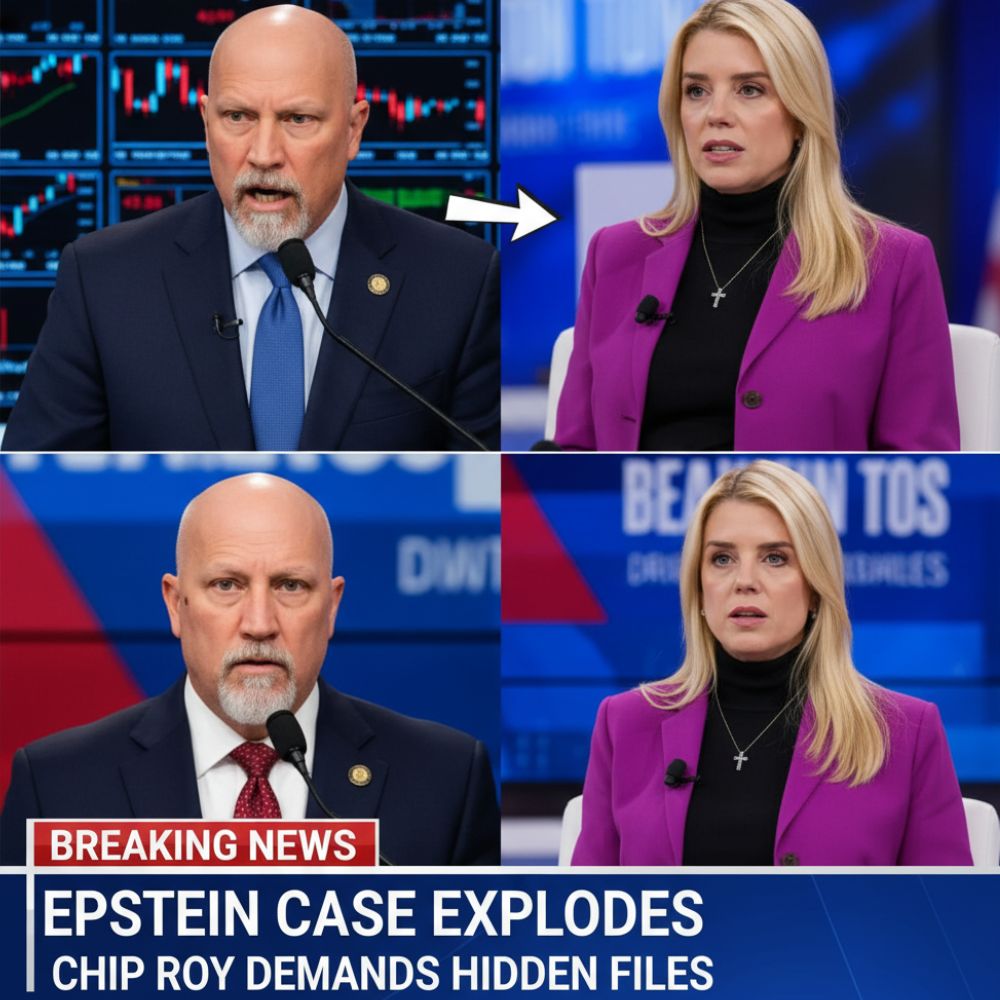
The hearing began like countless others in Washington, with lawmakers flipping through notes, staffers whispering quietly, and cameras waiting patiently for the next moment that might break through the routine.
Then Congressman Chip Roy leaned forward and asked a question that instantly changed the temperature of the room.
The question was simple on the surface but explosive in implication.
After Jeffrey Epstein and Ghislaine Maxwell were prosecuted, Roy asked, would anyone else ever face charges connected to the vast trafficking network investigators uncovered.
The room grew silent.
For years, that same question has echoed across the country, asked by survivors, journalists, legal experts, and ordinary citizens who believe the story of Epstein’s network remains unfinished.
Roy did not raise his voice.
But the seriousness in his tone made clear that the moment was no longer about routine testimony or procedural oversight.
Attorney General Pam Bondi sat before the House Judiciary Committee and answered carefully, choosing words that would soon dominate headlines across Washington.
She confirmed that Maxwell was properly convicted for trafficking minors and reiterated that Epstein himself had been charged years earlier.
But then Roy pressed further.
He asked directly whether anyone else connected to the evidence collected in the investigation would ever be indicted or prosecuted.
The tension inside the chamber became almost tangible.
For years the Epstein case has symbolized a deeper fear that wealth and influence can distort justice in ways the public rarely sees.
Bondi responded by saying there are still ongoing investigations connected to the case.
She did not name any individuals or provide additional details, but the statement alone was enough to ignite a new wave of debate.
If investigations are ongoing, the public wondered, what exactly are investigators still examining.
Roy’s line of questioning did not stop there.
He shifted toward the issue that has haunted the release of the Epstein files themselves, the claim that the government acted with complete transparency.
Bondi stated that more than three million pages of investigative records had already been released.
She described the effort as an extraordinary push for transparency and emphasized the enormous workload involved in reviewing millions of documents.
But critics in Congress immediately raised another number.
They argued that the Epstein Files Transparency Act required the release of roughly six million pages of records.
If that figure is accurate, they asked, why were only half of the documents released.
That question triggered one of the most contentious exchanges of the hearing.
Supporters of the Department of Justice argued that reviewing millions of pages for sensitive information is a massive task that cannot be completed overnight.
Critics countered that partial disclosure only fuels suspicion that powerful individuals might still be shielded from scrutiny.
The debate then moved to an issue even more emotionally charged.
Some lawmakers said that certain released documents may have included identifying details connected to victims who had previously been protected as Jane Does.
Those concerns struck deeply in the room because several survivors of Epstein’s trafficking operation were seated quietly in the audience.
When asked whether the Department of Justice had communicated directly with the survivors about the release process, the answers raised additional questions.
Some lawmakers claimed that many victims had never been consulted before documents containing sensitive information were made public.
The possibility that victims might have been exposed while powerful figures remained protected ignited intense reactions across the chamber.
For critics of the department’s approach, the issue symbolized a fundamental imbalance.
They argued that a justice system must protect the vulnerable first and foremost, especially in cases involving trafficking and exploitation.
Supporters of the department pushed back strongly.
They emphasized that the volume of material involved in the Epstein investigation is enormous, spanning decades of financial records, flight logs, emails, witness statements, and legal filings.
Reviewing such an archive requires careful legal scrutiny to avoid releasing information that could damage ongoing investigations.
Yet Roy’s questioning continued to return to the same central point.
If transparency is the goal, he argued, why does so much of the evidence remain hidden from public view.
The exchange soon moved beyond documents and into broader questions about how justice functions when powerful people are involved.
Some lawmakers cited references in investigative files to well-known business leaders and political figures who had connections to Epstein.
Others warned that simply appearing in records does not prove criminal wrongdoing and that speculation can easily outrun facts.
This tension between suspicion and proof lies at the heart of the Epstein controversy.
Investigators must meet strict evidentiary standards before bringing charges, while public opinion often demands immediate answers.
Bondi emphasized that prosecutors cannot act on rumors or online speculation.
She insisted that any future charges must be supported by evidence strong enough to withstand scrutiny in federal court.
Roy responded by noting that unresolved questions continue to damage public trust.
If the government claims transparency while withholding millions of pages of records, critics say the public will naturally assume something remains hidden.
The debate soon widened beyond Epstein himself.
Lawmakers began arguing about the broader role of the Department of Justice and whether political influence could shape investigative decisions.
Some members warned that accusing prosecutors of protecting elites without clear evidence could undermine faith in the rule of law.
Others insisted that accountability demands aggressive oversight whenever government power intersects with wealth and influence.
The confrontation revealed a deeper conflict inside American politics.
On one side are those who believe institutions must be trusted to follow legal procedures without interference from political pressure.
On the other side are those who believe institutions must be constantly challenged because history shows that power often protects itself.
The Epstein case sits precisely at the intersection of those two beliefs.
Its scale, secrecy, and the wealth of people involved created a perfect storm of suspicion that still echoes years after Epstein’s death.
Roy’s questioning forced the Department of Justice to address that storm directly.
Even without specific accusations, the demand for answers about the remaining documents struck a powerful chord with the public.
By the time the hearing moved to other topics, the political impact of the exchange was already clear.
Reporters rushed to file stories, analysts began debating the meaning of Bondi’s statement about ongoing investigations, and social media exploded with arguments about transparency.
Some observers praised Roy for pushing the issue back into the national spotlight.
Others criticized the confrontation as political theater that risks spreading speculation without proof.
But almost everyone agreed on one thing.
The Epstein case still holds enormous emotional power in American politics.
It represents not only a horrific trafficking scandal but also a symbol of unanswered questions about influence, wealth, and justice.
As long as millions of pages of records remain unreleased, those questions will not disappear.
They will continue resurfacing in hearings, courtrooms, and public debate across the country.
The confrontation between Roy and Bondi did not resolve the mystery surrounding the Epstein files.
Instead it reminded the nation that the story is still unfolding and that the demand for answers remains as strong as ever.
Whether future investigations lead to new charges or simply confirm what prosecutors already know remains uncertain.
What is certain is that the call for transparency has grown louder.
And after this explosive hearing, the pressure on the justice system to explain every remaining page of the Epstein record may be stronger than ever before.