


Jasmine Crockett’s Sharp Rebuttal During Tennessee Debate Goes Viral
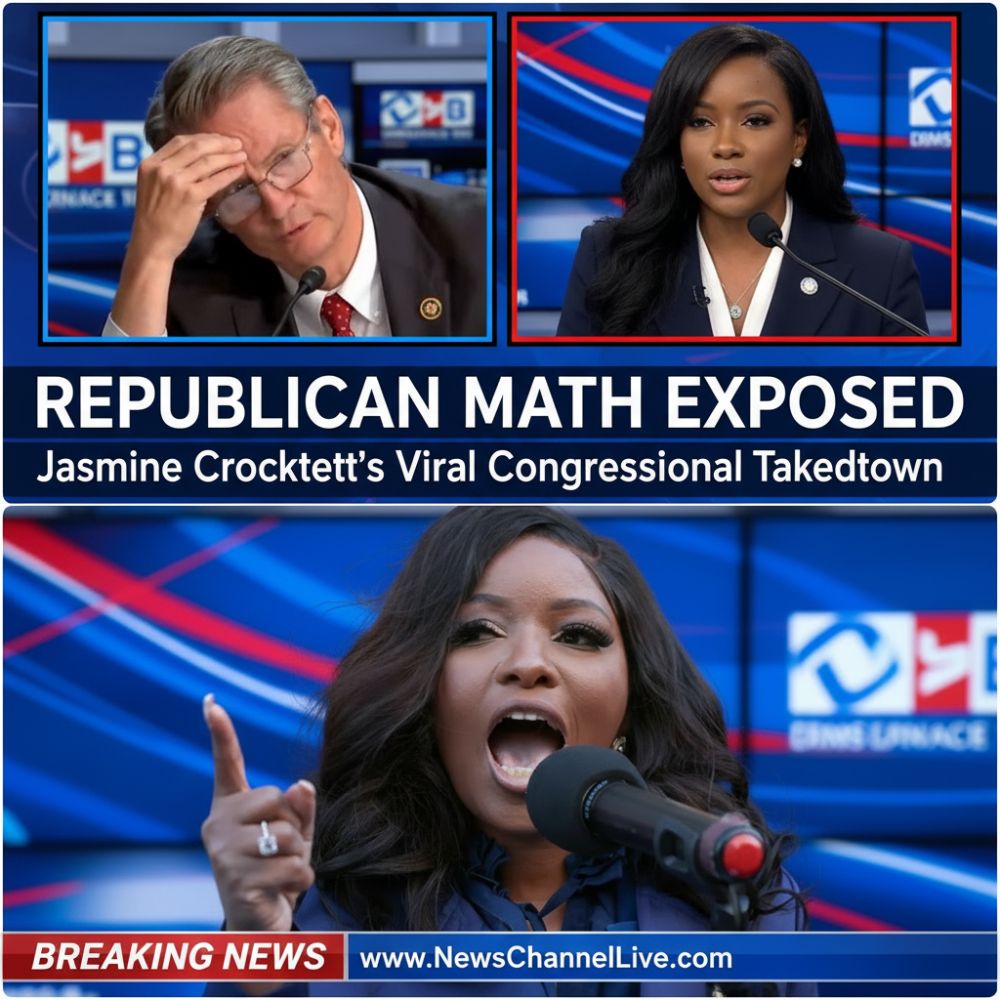
“Republican Math” Exposed: Jasmine Crockett’s Viral Takedown of Systemic Power Manipulation in Texas and Beyond
In a recent congressional hearing that has quickly transcended the halls of government to become a digital sensation, Representative Jasmine Crockett delivered a powerful and unapologetic critique of the current American political landscape. What was meant to be a discussion on the upcoming 2030 Census transformed into a deep dive into the mechanics of power, racial representation, and the systemic manipulation of population data. Crockett, known for her sharp wit and refusal to back down, didn’t just challenge the status quo; she dismantled the very foundation of how certain states allocate power at the expense of their most vulnerable citizens.
The core of the confrontation began with a discussion on the inclusion of a citizenship question in the census. While some argue this is a matter of administrative accuracy, Crockett framed it as a tactical weapon of intimidation. With an incoming administration promising mass deportations and “border czars” speaking of raids, Crockett argued that the federal government is effectively chilling the participation of residents. “If you start asking people are you a citizen or not… and somebody’s threatening to go in and raid homes… I would imagine that that may make people say, ‘Never mind, I’m not going to fill this out,’” she noted. This creates a selective undercount that skews funding and representation for years to come.
However, the most explosive part of her testimony focused on her home state of Texas. Crockett highlighted a statistical anomaly that she labeled “Republican math.” According to the 2020 Census, Texas added roughly four million people to its population. Of those four million, a staggering 95%—roughly 3.8 million people—were people of color. Only about 180,000 were Anglo. Based on this massive growth, Texas was awarded two new seats in Congress. One would logically assume that since the growth was driven by minority populations, the representation would reflect that. Instead, the redistricting process resulted in two new white Republican seats.
“They took those black and brown and Asian bodies and… somehow the way that they do their Republican math… that amounted to two new white Republican seats,” Crockett remarked with biting irony. This, she argued, is a clear example of how minority bodies are used to secure political apportionment for a power structure that actively works against their interests. It is a modern-day iteration of counting people for power while denying them a voice—a practice that strikes at the heart of democratic fairness.
Crockett didn’t stop at redistricting. She turned her focus to a less-discussed but equally insidious practice: prison gerrymandering. In Texas, a state that incarcerates more people than almost any other independent democratic nation, inmates are counted as residents of the rural areas where they are imprisoned rather than the urban centers they call home. This practice artificially inflates the population of rural districts—which are often losing residents—granting them more funding for roads, hospitals, and schools that the inmates don’t use and their children don’t attend. Meanwhile, the families of these inmates in cities like Dallas and Houston are left with diminished political clout and fewer resources.
“Rural Texas is getting better roads than they probably deserve because they’re counting those inmates that are not driving on those roads,” Crockett stated. By counting black and brown bodies in prison to bolster the power of white, rural districts, the system creates a parasitic relationship where the incarcerated are used as political capital for the very people who support the policies that led to their incarceration.
The emotional weight of Crockett’s speech reached its peak when she addressed the broader cultural context of these policies. She linked current political movements to a historical pattern of “countercultural” responses to progress. Just as the “welfare queen” trope was a reaction to the civil rights era, she argued that the modern MAGA movement is a reaction to the successes of women, the LGBTQ+ community, and people of color. She refused the popular narrative of “unity” that suggests critics should simply move on and “have a beer” with those perpetuating these systems.
“I’m really, really tired of having these ridiculous conversations about America’s inherent racism as if America’s history of land theft and free labor isn’t what it is,” she said. Her refusal to sugarcoat the reality of racial power dynamics in America is what makes her message so resonant—and so polarizing. She acknowledged that many people, particularly white Americans, are uncomfortable hearing these truths, but she insisted that silence is no longer an option when the data so clearly shows the disparity.
Crockett also touched on cultural flashpoints, from Colin Kaepernick to Caitlin Clark, illustrating how even in sports and entertainment, the push for equity is often met with fierce backlash. She praised Clark for acknowledging the black women who built the WNBA, noting that even such a simple act of recognition causes some to “lose their minds.”
In the end, Jasmine Crockett’s takedown was more than just a political moment; it was a demand for intellectual honesty. She challenged the country to look past the slogans and see the “nitty-gritty” of how power is hoarded. Whether through the census, redistricting, or the prison system, the message was clear: a democracy that uses its people for math but ignores them for representation is a democracy in crisis. As her words continue to circulate online, they serve as a rallying cry for those who believe that true representation requires more than just being counted—it requires being heard.