

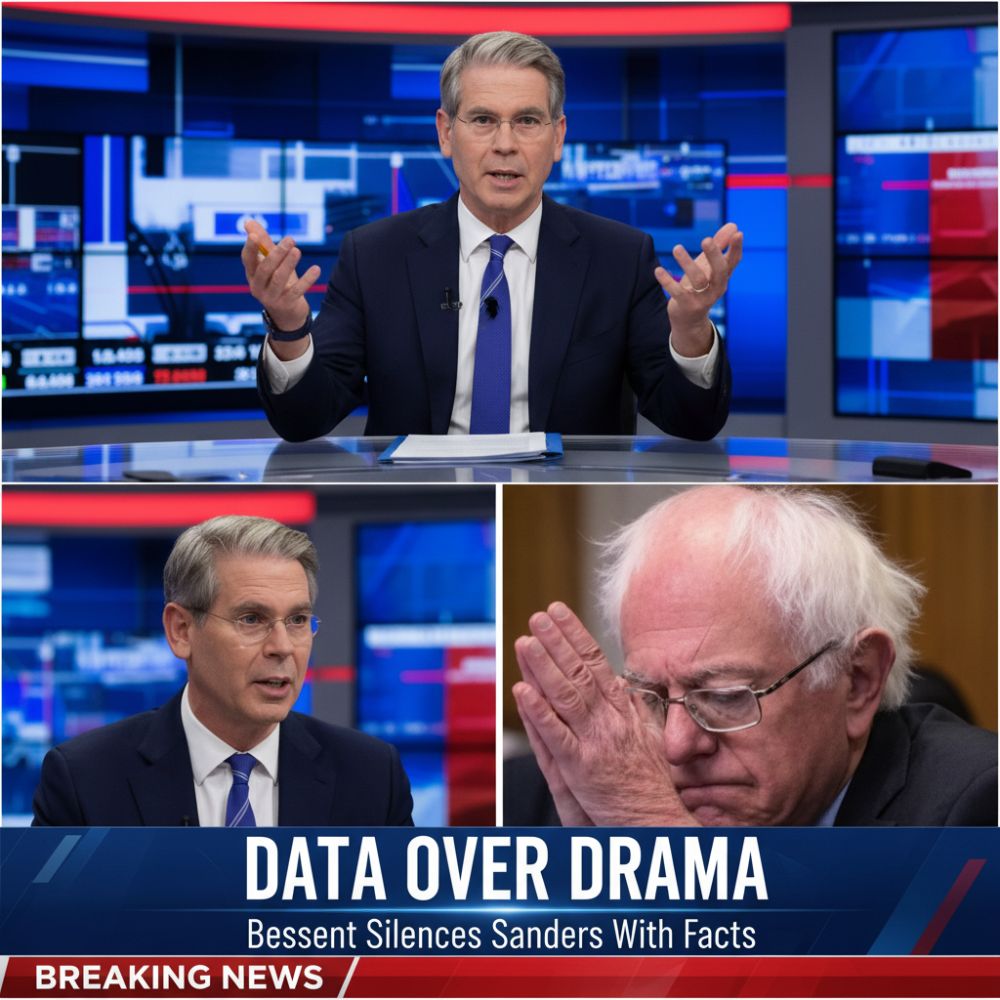
The Day the Script Died: How Scott Bessent’s Surgical Takedown of Bernie Sanders Exposed the Gap Between Ideology and Data
In the theater of American politics, few performers are as seasoned as Senator Bernie Sanders. For over three decades, the Senator from Vermont has refined a specific brand of populist rhetoric that has made him a household name and a hero to millions. His script is legendary: a high-decibel defense of the working class, a scathing indictment of the “billionaire class,” and a moral demand for radical systemic change. It is a performance that has rarely met a worthy adversary in the sterile environment of a Senate hearing room—until now. In a recent confrontation that has sent shockwaves through Washington and ignited a firestorm on social media, Treasury Secretary Scott Bessent did something few have managed to do: he didn’t just survive a Bernie Sanders “roasting”; he effectively dismantled it.
The setting was a standard oversight hearing, the kind of event that usually generates a few dry headlines and a handful of sleepy C-SPAN viewers. However, the atmosphere shifted the moment Senator Sanders took the microphone. He began with his customary zeal, framing the administration’s tax and healthcare policies not as matters of economic debate, but as moral catastrophes. He cited figures that were designed to evoke a visceral reaction—$235 billion in tax breaks for the top 0.2% of earners and a $700 billion cut to Medicaid that he claimed would result in 50,000 unnecessary deaths per year. For anyone who has followed Sanders’ career, it was a familiar opening act. The objective was clear: create a viral “gotcha” moment that would paint the Treasury Secretary as a cold-hearted protector of the ultra-wealthy.
But Scott Bessent is not your typical political appointee. A veteran of the financial world with a deep understanding of market dynamics and policy specifics, Bessent brought a different kind of weapon to the hearing: the truth of the data. When Sanders launched into his attack on the 2017 Tax Cuts and Jobs Act, implying it was a windfall for people exactly like Bessent, the Secretary hit back with a personal data point that completely derailed the Senator’s momentum. “Senator, I will tell you that when the 2017 tax cuts and jobs act passed, my tax rate went up,” Bessent stated calmly. It was a direct hit to the core of Sanders’ narrative. By revealing that he, a man of significant wealth, paid more under the law, Bessent exposed the reality that the tax code is far more complex than a simple “giveaway to the rich” slogan suggests.
The exchange only intensified from there. Sanders, visibly frustrated that his initial thrust had been parried, attempted to pivot to the estate tax. He characterized the provision as a “gift to billionaires” that does nothing for small businesses or the average American. This is where the difference between a rehearsed talking point and a deep understanding of policy became most apparent. Bessent refused to play on Sanders’ emotional turf. Instead, he forced the Senator to look at the legislative record. He pointed out that during the periods when Democrats held a “trifecta”—control of the House, the Senate, and the White House—they had ample opportunity to implement the very wealth taxes and billionaire levies Sanders was now demanding. “You chose not to,” Bessent reminded him. It was a stinging indictment of political hypocrisy that left the Senator with no answer but to retreat into his next talking point.
Perhaps the most dramatic moment of the hearing came when Sanders deployed what he likely considered his “kill shot.” He cited studies from Yale and the University of Pennsylvania to claim that the administration’s healthcare changes would throw 15 million people off insurance and lead to 50,000 deaths annually. It was a staggering accusation, intended to end the debate on moral grounds. But Bessent was ready with the fine print. He broke down the numbers with surgical precision, explaining that 5.1 million of the projected coverage losses were not actually attributed to the current bill, but rather to the expiration of Obamacare subsidies that Democrats themselves had failed to extend while they were in charge. He further noted that 1.4 million of those on Medicaid were illegal aliens and that the administration’s goal was to redirect resources toward mothers and children who actually needed the support.
The contrast between the two men was a study in modern political dynamics. Sanders represented the old guard of ideological purity—a man who has spent 30 years perfecting the art of the moral outrage. Bessent represented a new kind of technocratic resilience—a leader who understands that in the age of information, a well-placed fact is more powerful than a hundred slogans. Sanders’ attempt to paint the administration’s work requirements as a way of calling the unemployed “lazy” was met with a similarly firm shutdown. Bessent simply labeled the Senator’s framing as a “mischaracterization,” refusing to let the discussion descend into the kind of name-calling that fuels social media algorithms but does nothing to solve national problems.
The fallout from the hearing has been a fascinating look at the media landscape. While mainstream outlets attempted to edit the exchange into 15-second soundbites that preserved Sanders’ image as a champion of the people, the full, unedited footage tells a much different story. It shows a man who has relied on the same rhetorical crutches for decades finally encountering someone who knows the policy down to the decimal point. It shows that when ideology meets competence, competence has a distinct advantage. The reason the clip has gone viral is not because people enjoy seeing a veteran Senator struggle; it is because they are hungry for leaders who prioritize data over drama.
Scott Bessent walked out of that hearing with his dignity and his arguments fully intact. He didn’t need to yell, he didn’t need to get flustered, and he didn’t need to apologize for his success. He stood on the merit of the policies he was there to represent. Sanders, on the other hand, walked out with the same script he brought in, having learned nothing and gained no ground. The confrontation served as a vivid reminder that the world is changing. The old ways of political theater are being challenged by a new generation of leaders who are more interested in what works than in what sounds good in a campaign ad. In the end, the American people saw a rare thing: a man of the system being held accountable not by a protest, but by the very facts he claimed to represent.