


Starlink’s Setback: Canada Rejects U.S. Satellite Dominance as Europe Rushes to Fill Void
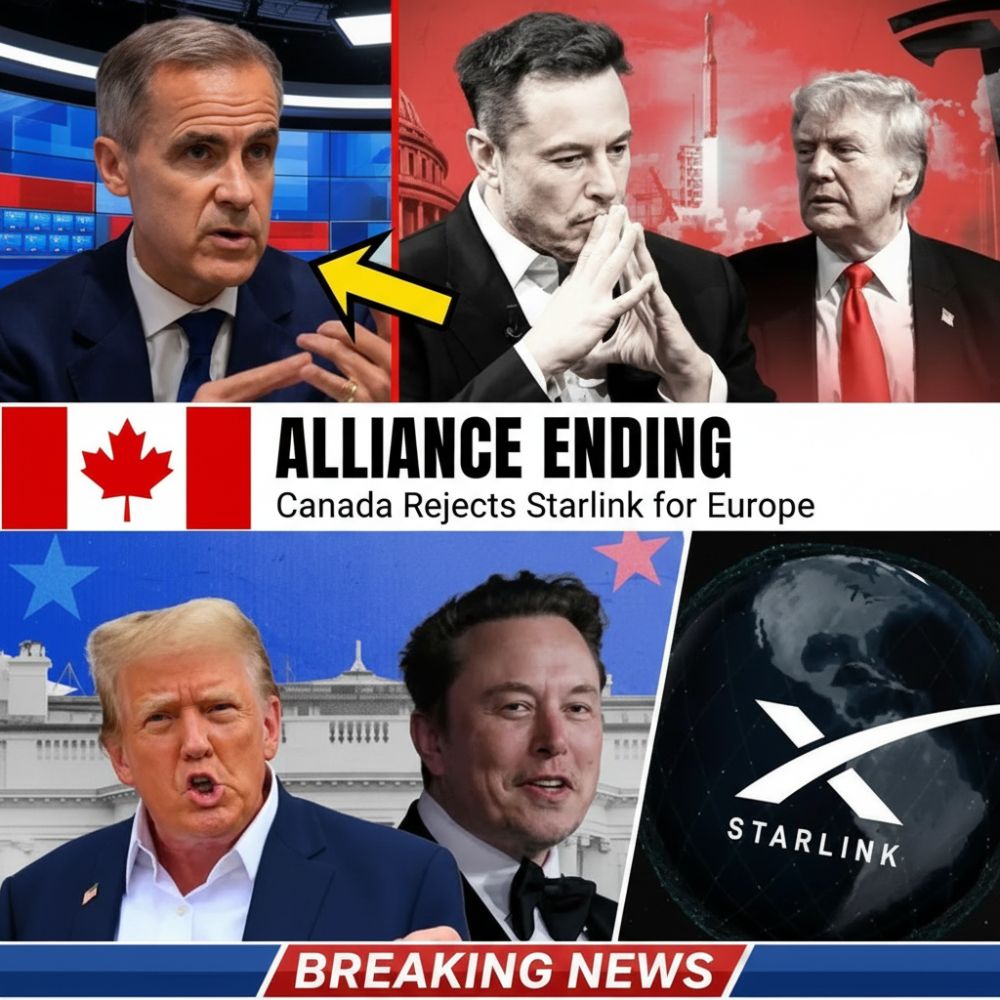
WASHINGTON — In what is rapidly becoming a pattern of diplomatic self-inflicted wounds, the Trump administration’s aggressive campaign to cement Starlink as the unassailable backbone of Western satellite communications has backfired spectacularly, triggering a transatlantic revolt that has handed Europe its most significant opening in the global space economy in decades.
Canada announced Tuesday that it would formally reject a multibillion-dollar framework agreement to integrate SpaceX’s Starlink constellation into its Arctic defense and rural broadband infrastructure, citing “unacceptable sovereign risks” associated with placing critical communications under the effective control of a single American company with deep ties to former president Donald J. Trump. Instead, Ottawa has signed preliminary contracts with a consortium of European satellite providers, including France’s Eutelsat and Luxembourg-based SES, effectively slamming the door on American dominance north of the border.
“The era of unthinking reliance on American technological infrastructure is over,” said François-Philippe Champagne, Canada’s minister of innovation, science and industry, in a statement that echoed the government’s recent confrontations with American automakers and agricultural policy. “We will not outsource our sovereignty to any nation, no matter how friendly. Critical infrastructure must be controlled by trusted partners, not leveraged as instruments of political pressure.”
The Canadian decision, which caught Washington off guard, represents the most concrete consequence yet of a broader European push to decouple from U.S.-dominated satellite networks. Hours after Ottawa’s announcement, European Commission President Ursula von der Leyen unveiled accelerated funding for IRIS², the bloc’s long-gestating sovereign satellite constellation, describing the initiative as “Europe’s answer to those who would use connectivity as a weapon.”
A Strategy That Backfired
For months, Trump and his surrogates had quietly pressured allies to adopt Starlink as the standard for next-generation communications, positioning the system—already the world’s largest satellite network—as the inevitable choice for military, commercial, and civilian infrastructure. What the administration presented as technological superiority, however, was widely perceived in allied capitals as an attempt to lock nations into permanent dependence on a system owned by Elon Musk, whose erratic management and political entanglements have become sources of deep unease.
“The message was clear: you can either be with us and on Starlink, or you can be irrelevant,” said a senior European diplomat who spoke on condition of anonymity to discuss internal deliberations. “What they failed to understand is that when you threaten allies with irrelevance, they will find another way. And now they have.”
The Canadian decision was particularly stinging because it followed months of negotiations in which Ottawa had appeared receptive to a partnership. But according to sources familiar with the talks, the tipping point came when representatives of the Trump administration reportedly suggested that Canada’s access to Starlink’s most advanced military-grade encryption could be contingent on Ottawa’s cooperation in broader trade disputes—a linkage that Canadian officials viewed as an unacceptable overreach.
“It was the final straw,” said a senior Canadian government official who was not authorized to speak publicly. “We were being asked to wire our entire national infrastructure into a system that could be turned off at someone else’s political whim. That is not partnership. That is subjugation.”
Europe Seizes the Moment
For European space officials, the Canadian pivot has been greeted with undisguised enthusiasm. The IRIS² constellation, which had been bogged down in budgetary disputes for years, now appears poised for rapid acceleration, with member states rushing to commit funding that had previously been withheld.
“What Washington intended as a power play has instead created the competitive urgency Europe needed to finally move,” said Tomas Hrozensky, a space policy analyst at the European Space Policy Institute. “The message is now clear: there is an alternative to Starlink, and it is European.”
The European consortium’s advantage, beyond political independence, lies in its multi-operator structure. Unlike Starlink, which is controlled entirely by SpaceX, the European approach combines geostationary satellites with low-Earth-orbit constellations operated by multiple companies, creating redundancy that officials say is essential for critical infrastructure.
“They gave us a gift,” said a French government official involved in space policy. “They showed the world what happens when you put all your trust in a single provider. We intend to show the world there is another way.”
The New Space Race
The reverberations were felt immediately in American boardrooms. SpaceX shares, privately traded, saw a sharp decline in secondary markets as investors absorbed the reality that the company’s political strategy may have permanently closed off key markets. Industry analysts estimate that the combined Canadian and European contracts, now lost, represented more than $15 billion in future revenue over the next decade.
“This is a strategic defeat of the first order,” said Carissa Christensen, chief executive of BryceTech, a space industry analytics firm. “Satellite communications is not just a commercial market—it is the infrastructure for everything from military operations to financial services to emergency response. Losing Canada and potentially Europe means the U.S. is no longer the uncontested center of gravity in this domain.”
In Washington, the administration struggled to contain the damage. A State Department spokesman described the Canadian decision as “disappointing” and insisted that “American technology remains the gold standard.” But privately, officials acknowledged that the administration’s confrontational approach had achieved the opposite of its intended effect.
For the European consortium, work has already begun. Engineers from Eutelsat and SES were scheduled to meet with Canadian defense officials in Ottawa next week to begin mapping the Arctic infrastructure that Washington had assumed would be its own.
“The Americans thought they had us,” the senior Canadian official said. “They thought we had no options. They were wrong. And now the world knows it.”