

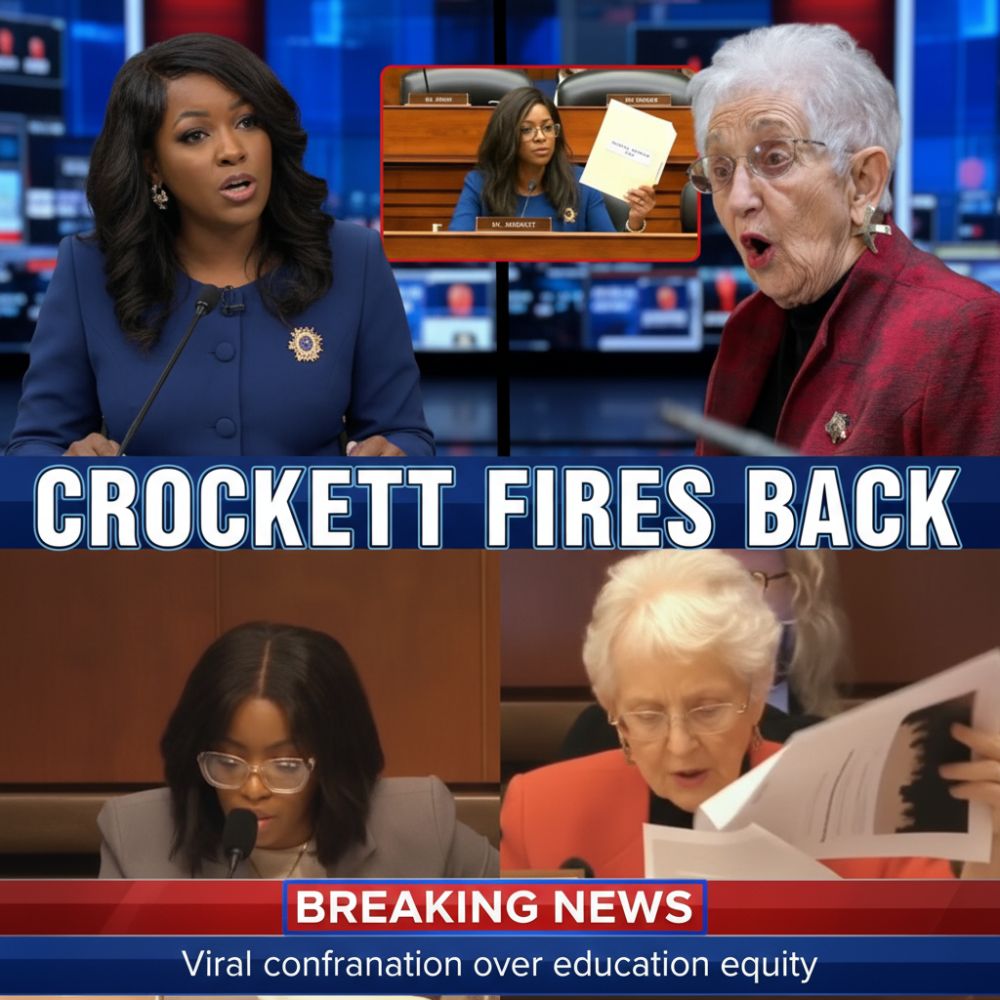
Jasmine Crockett DESTROYS Republican Who Tried to Interrupt – LIVE
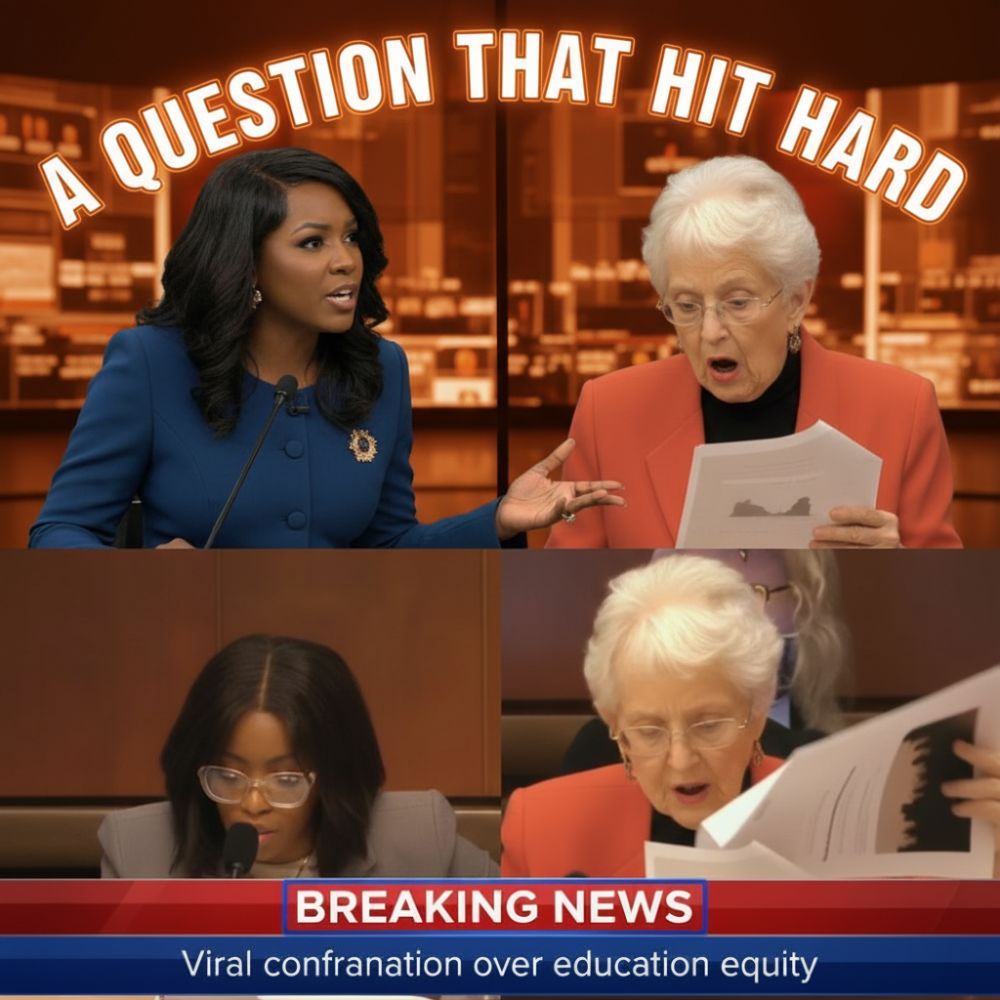
A Hearing That Didn’t Go as Planned
What began as a routine congressional debate over education policy quickly transformed into something far more revealing—a moment that exposed not just policy disagreements, but deeper tensions over credibility, priorities, and political narratives.
In a packed committee room on Capitol Hill, lawmakers gathered to discuss school voucher programs—an issue that has long divided Democrats and Republicans. The setting was familiar: prepared remarks, competing statistics, and sharply contrasting philosophies about the role of government in education.
But what unfolded was anything but routine.
At the center of it was Representative Jasmine Crockett, whose line of questioning shifted the entire tone of the hearing. What started as a policy critique evolved into a broader challenge—one that left her opponents visibly unprepared.
And in the end, it wasn’t a complex argument or technical detail that defined the moment.
It was a simple question:
“What else have y’all done for poor Black people in this country?”
The Policy Battleground: School Vouchers and Public Education
To understand the weight of that moment, it’s important to first understand the issue at hand.
School voucher programs allow families to use public funds to send their children to private schools instead of public ones. Supporters argue that vouchers provide opportunities for students trapped in underperforming schools. Critics contend that they divert resources from already struggling public education systems and lack sufficient oversight.
Republicans have increasingly championed vouchers as a solution to declining academic performance, particularly in urban districts with large minority populations. During the hearing, lawmakers pointed to troubling national statistics:
Significant percentages of high school seniors scoring below basic levels in math and reading
Declining engagement with reading among students
Persistent achievement gaps
For advocates of vouchers, these figures are evidence that the current system is failing—and that alternatives are necessary.
But for Crockett and other Democrats, the issue is not simply about outcomes. It’s about structure, accountability, and equity.
The Republican Argument: Choice as a Lifeline
Republican lawmakers framed vouchers as a lifeline for disadvantaged students—particularly in places like Washington, D.C., where public schools have long faced criticism.
Representative Virginia Foxx was among those leading that argument. She cited data suggesting declining academic performance and argued that students in low-performing schools—many of whom are minorities—deserve alternatives.
The message was clear:
Public schools are failing
Government oversight has not improved outcomes
Families should have the power to choose better options
Voucher programs, in this framing, are not just policy tools—they are moral imperatives.
They represent freedom, opportunity, and escape.
At least, that’s the argument.
Crockett’s Counter: A Question of Consistency
When Crockett began speaking, she did not immediately attack vouchers themselves.
Instead, she focused on something more fundamental: consistency.
She acknowledged the importance of accountability and data—points that Republicans had emphasized. Then she pivoted.
If accountability matters, she asked, why undermine the very institution responsible for enforcing it?
That institution is the United States Department of Education.
The Department of Education Debate
Crockett highlighted a key contradiction in the Republican position.
On one hand, lawmakers were demanding data, oversight, and evidence that voucher programs work. On the other hand, many of those same lawmakers have supported efforts to weaken—or even eliminate—the Department of Education.
This tension is not new. Conservative critics of the department have long argued that education should be controlled at the state and local level. Some have called for dramatically reducing the department’s role or abolishing it altogether.
Crockett brought that contradiction into sharp focus.
“You can’t claim you want oversight,” her argument implied, “while dismantling the agency responsible for providing it.”
She referenced the nomination of Linda McMahon—a controversial figure in education policy debates—highlighting concerns about leadership that may prioritize dismantling the department over strengthening it.
What the Department Actually Does
A significant portion of Crockett’s argument centered on clarifying a common misconception.
Contrary to popular belief, the Department of Education does not:
Set school curricula
Run classrooms
Directly manage most K-12 operations
Instead, its primary roles include:
Enforcing civil rights laws in education
Providing funding and support to disadvantaged students
Ensuring equal access regardless of race, disability, or income
This distinction is critical.
Because if the department’s role is not operational control but equity enforcement, then weakening it raises serious questions about who protects vulnerable students.
Civil Rights and Education
Crockett emphasized that one of the department’s most important functions is conducting civil rights investigations.
These investigations ensure that:
Students with disabilities receive appropriate accommodations
Schools do not discriminate based on race or background
Resources are distributed fairly
For many communities—particularly marginalized ones—these protections are essential.
Eliminating or weakening them, Crockett argued, would disproportionately harm the very students Republicans claim to be helping.
The Turning Point: A Broader Question
Up to this point, the debate had remained within the realm of education policy.
Then Crockett expanded the scope.
She paused, reframed the discussion, and challenged the underlying premise of the Republican argument.
If voucher programs are about helping poor Black students, she asked, what evidence exists that Republicans have prioritized those communities in other areas?
Her question was direct:
“What else have y’all done for poor Black people in this country?”
The Silence
What followed was not an immediate rebuttal.
There was no rapid exchange of statistics or legislative examples.
Instead, there was a pause.
Observers described it as a moment of visible discomfort—an interruption in the usual rhythm of debate.
Because the question required something different.
Not theory.
Not ideology.
But a track record.
Beyond Education: A Pattern Argument
Crockett’s argument did not stop at the absence of an answer.
She connected the education debate to a broader pattern of policies affecting Black communities, including:
Criminal justice policies
Policing practices
Voting rights legislation
Healthcare access
Social safety net programs
Her claim was not just that voucher programs are flawed.
It was that they exist within a larger policy framework that, in her view, has consistently disadvantaged the same communities they claim to help.
The Private School Question
Crockett also raised a critical issue often overlooked in voucher debates: admissions control.
Private schools, unlike public ones, are not required to accept all students.
They can:
Reject applicants based on academic performance
Decline students with disabilities
Set behavioral or cultural criteria
Public schools, by contrast, must serve everyone.
This creates a structural imbalance:
Private schools can select students
Public schools must educate all, including those with the greatest needs
When funding follows students to private institutions, Crockett argued, public schools may be left with fewer resources to serve more challenging populations.
Funding and Resource Allocation
This dynamic raises important questions about resource distribution:
If funding is diverted to private schools, how do public schools maintain services?
What happens to students who are not accepted by private institutions?
How are high-cost needs—such as special education—addressed?
These are not theoretical concerns.
They are central to the functioning of the education system.
Race, Policy, and Political Messaging
Crockett’s critique also touched on the intersection of race and policy messaging.
She referenced broader debates over diversity programs, race-conscious scholarships, and support for Historically Black Colleges and Universities (HBCUs).
These issues have become increasingly prominent in national politics, particularly during and after the presidency of Donald Trump.
Crockett argued that policies restricting such programs could undermine educational opportunities for minority students—contradicting claims that voucher programs are designed to help them.
Washington, D.C.: A Unique Case
The debate also highlighted the unique status of Washington, D.C.
Unlike states, D.C. does not have full congressional representation. Yet Congress has significant authority over its policies, including education.
Crockett pointed out the irony:
Lawmakers advocating for limited government were actively shaping local education policy in a jurisdiction without full democratic representation.
This added another layer to the debate—one involving governance, autonomy, and representation.
Competing Narratives
By the end of the hearing, two competing narratives had emerged.
The Republican Narrative:
Public schools are failing
Vouchers provide necessary alternatives
Choice empowers families
The Democratic Narrative (as articulated by Crockett):
Vouchers lack accountability
They weaken public education
They exist within a broader pattern of inequitable policies
Neither side conceded ground.
But the exchange shifted the conversation.
The Power of a Question
What made Crockett’s intervention so impactful was not just the content of her argument, but its structure.
She did not rely solely on counter-statistics or policy critiques.
She asked a question that reframed the debate entirely.
Instead of arguing about whether vouchers work, she asked whether the proponents of vouchers have demonstrated a broader commitment to the communities they claim to serve.
It was a move from policy to credibility.
Political Theater or Genuine Accountability?
Reactions to the exchange have been sharply divided.
Supporters of Crockett described it as a “masterclass” in holding opponents accountable—praising her ability to connect policy debates to real-world impacts.
Critics, however, argue that the moment was more rhetorical than substantive—suggesting that it oversimplified complex policy issues and ignored legitimate concerns about public school performance.
This divide reflects a broader tension in American politics:
Is the primary goal persuasion—or exposure?
The Role of Congressional Hearings
At their best, congressional hearings are designed to:
Clarify policy differences
Hold officials accountable
Inform the public
But they are also political arenas.
Lawmakers use them to:
Advance narratives
Highlight contradictions
Appeal to broader audiences beyond the room
In this case, the hearing did all of those things.
What Comes Next?
The debate over school vouchers is far from settled.
It continues to evolve at both the federal and state levels, with new programs, legal challenges, and policy proposals emerging regularly.
Key questions remain:
How should educational success be measured?
What balance should exist between public and private options?
How can equity be ensured across different systems?
These are complex issues without easy answers.
A Moment That Resonates
Regardless of where one stands on the policy, the exchange involving Jasmine Crockett has resonated far beyond the hearing room.
It has been shared, debated, and dissected—becoming part of a larger conversation about education, equity, and political accountability.
Because at its core, the moment was not just about vouchers.
It was about something deeper:
Who gets to claim they are helping—and how that claim is tested.
The Enduring Question
In the end, the most powerful moments in politics are often the simplest.
Not long speeches.
Not detailed reports.
But direct questions that demand clear answers.
“What else have y’all done?”
It is a question that does not fade easily.
And in this case, it is one that continues to echo—well beyond the walls of Congress.