

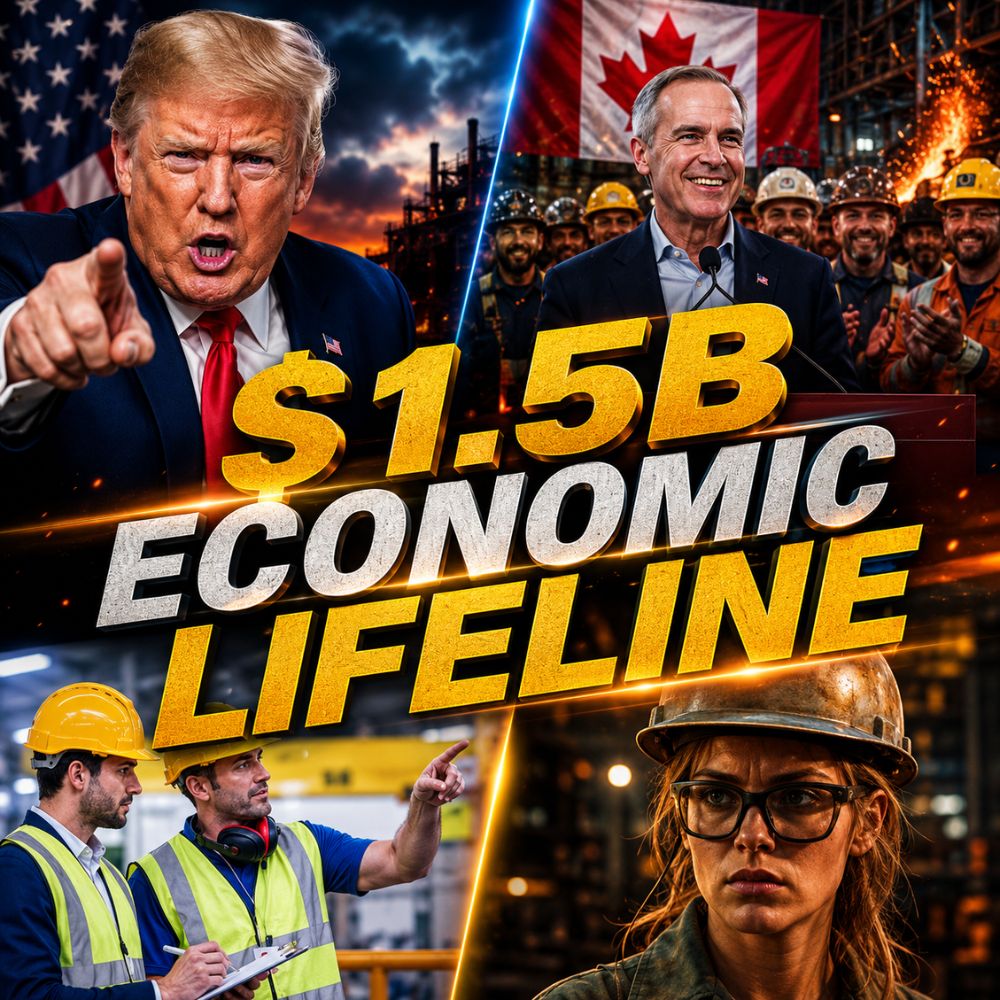
Canada’s $1.5 Billion Steel Gamble Signals a New Economic Era as Tariffs Reshape North America
The announcement came not from a polished Ottawa press room, but from the industrial heart of a steel plant in Vars, Ontario—where the scent of molten metal still lingers in the air.
There, against the backdrop of furnaces and uncertainty, Canada unveiled a $1.5 billion lifeline aimed at rescuing its embattled metals sector from the growing weight of U.S. tariffs.
Industry Minister Mélanie Joly’s message was as measured as it was consequential.
The funds—split between a $1 billion loan program and a $500 million transformation initiative—would be deployed through the Business Development Bank of Canada on favorable terms for at least three years.
That timeline, while technical on its surface, signals something deeper: Ottawa no longer sees this trade conflict as temporary.
For decades, Canada’s industrial strategy has been tethered closely to the United States. Steel, aluminum, and copper have flowed south in vast quantities, forming the backbone of a deeply integrated supply chain.
But recent policy moves out of Washington have shaken that foundation in ways not seen in generations.
At the center of the disruption are expanded tariffs under Section 232, a policy tool revived and broadened by former President Donald Trump.
Originally targeting raw steel and aluminum, the tariffs now extend to a wide array of downstream products—effectively tightening the economic vise on Canadian exports.
The consequences were immediate and severe. Manufacturers in Ontario, particularly in regions like Windsor, found themselves blindsided by steep new border costs.
Contracts that were profitable one week became untenable the next, forcing companies to reassess operations overnight.
Perhaps nowhere has the impact been more visible than in Sault Ste.
Marie, where Algoma Steel laid off roughly one-third of its workforce. The layoffs, numbering around 1,000 workers, serve as a stark indicator of how quickly trade policy can ripple through local economies.
Data from Statistics Canada underscores the scale of the downturn. Steel exports to the United States—historically Canada’s largest market—have fallen to roughly one-third of their previous value.
This is not a cyclical dip, but a structural shock with long-term implications.
Joly’s announcement, then, is less about short-term relief and more about recalibration. The $1 billion loan program is designed to stabilize companies facing immediate liquidity challenges, allowing them to maintain payroll and operations amid shrinking demand.
The second component—the $500 million transformation fund—reveals the broader strategy. Rather than simply preserving the status quo, Ottawa is actively encouraging companies to pivot away from dependence on the U.S. market.
This marks a significant departure from past policy. For the first time in modern memory, Canada is using public funds not to deepen integration with the United States, but to strategically reduce it.
Officials have been careful with their language. When pressed on whether the tariffs are expected to persist, Joly offered a diplomatic response: “You don’t know. I don’t know.” But the structure of the program suggests otherwise.
Three years of guaranteed support is not a stopgap measure—it is a planning horizon.
It gives companies the confidence to invest in new markets, retool supply chains, and rethink their place in the global economy.
The shift is also informed by signals from Washington. U.S. Trade Representative Jamieson Greer has made clear that the administration has no intention of returning to a tariff-free environment. The era of open access, it seems, has ended.
What makes this moment particularly complex is that the tariffs themselves have produced mixed results domestically in the United States.
While American steel production has seen modest gains, the broader economic impact tells a more complicated story.
According to industry data, U.S. steel output rose by just 3 percent in 2025—a figure that falls far short of the sweeping revival promised by tariff advocates.
Meanwhile, higher input costs have burdened downstream industries.
The U.S. Tax Foundation estimates that these tariffs have contributed to the loss of approximately 154,000 American jobs, largely in sectors that rely on affordable steel and aluminum.
The policy, in effect, has redistributed economic pain rather than eliminated it.
For Canada, this dual reality—domestic harm coupled with limited U.S. gains—creates both a challenge and an opportunity. If the American market becomes less accessible, alternative destinations must be found.
Europe is one such destination. With increased defense spending and infrastructure investment, demand for steel is rising. Canadian producers, known for quality and reliability, are well-positioned to compete.
The Indo-Pacific region offers another avenue. Countries like Japan, South Korea, and Australia are expanding their industrial bases, creating new demand for raw materials and finished products alike.
Domestically, Canada is also looking inward. Federal projects in the Arctic, including icebreakers, ports, and defense installations, represent a growing source of demand that could help absorb excess capacity.
This multi-pronged approach reflects a broader philosophical shift. Rather than reacting to external pressures, Canada is attempting to proactively shape its economic future.
The use of the Business Development Bank of Canada as the delivery mechanism is a key part of this strategy. Unlike traditional funding channels, BDC can deploy capital بسرعة, allowing for quicker responses to market changes.
This agility is crucial in a landscape where conditions can shift rapidly.
By bypassing slower parliamentary processes, Ottawa has effectively equipped itself with a more responsive economic toolkit.
The steel package also complements other initiatives, including a $5 billion strategic response fund and targeted tariffs on Chinese imports.
Together, these measures form a coordinated industrial policy not seen since the post-war era.
Critics may question whether such intervention risks distorting markets or picking winners and losers.
But proponents argue that in an era of global competition and protectionism, inaction carries its own risks.
For companies on the ground, the focus remains pragmatic. Survival in the short term, adaptation in the medium term, and competitiveness in the long term.
The coming months will be critical. The effectiveness of the funding programs, the ability of firms to access new markets, and the evolution of U.S. policy will all shape the outcome.
What is clear, however, is that Canada is no longer waiting. The days of assuming stable, open trade with its southern neighbor are over.
In their place is a more complex, less predictable environment—one that demands flexibility, resilience, and strategic foresight.
The $1.5 billion package is not a silver bullet. It will not immediately restore lost jobs or reverse export declines. But it does represent a decisive step in a new direction.
A direction defined not by dependence, but by diversification. Not by reaction, but by intention.
As the furnaces in Vars continue to burn, they now do so under a different kind of pressure—one that is reshaping not just an industry, but a nation’s economic identity.BREAKING: Carney Drops $1.5 Billion Steel Lifeline as Trump’s Tariffs Cripple American