

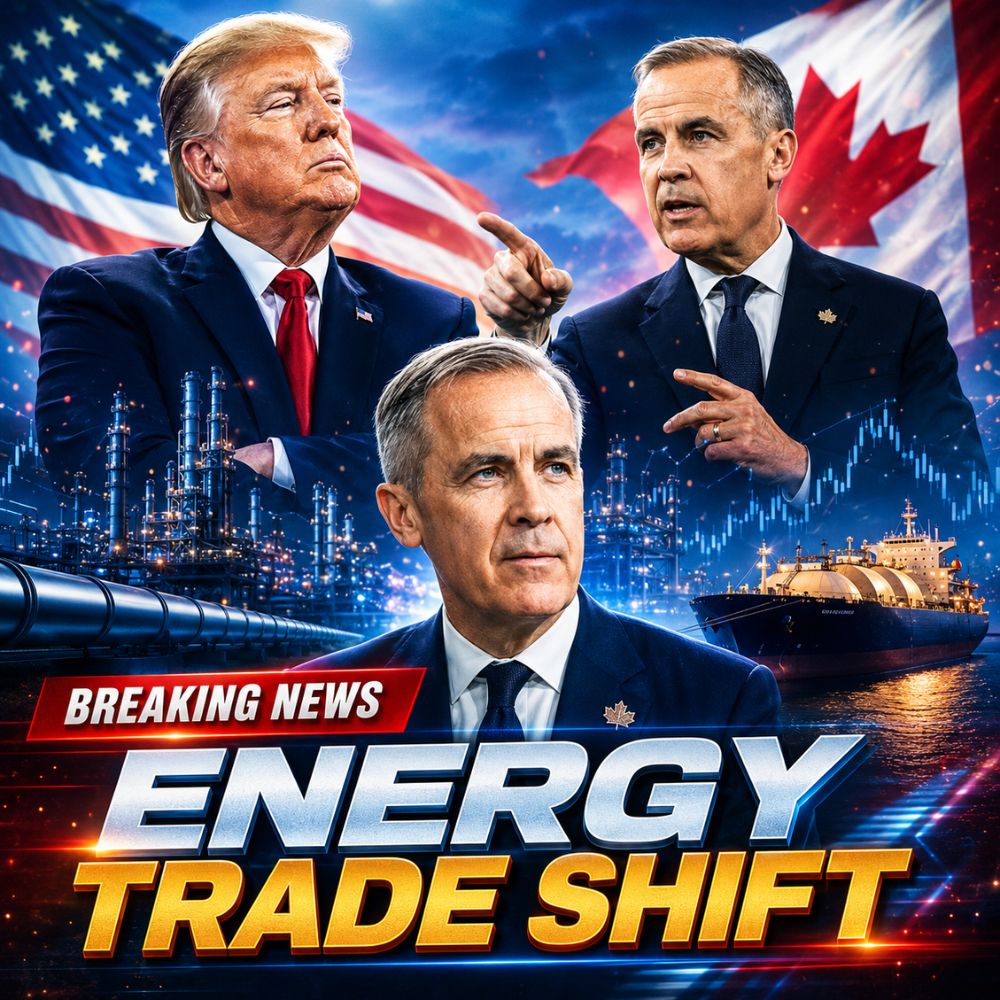
A major transformation is unfolding across global energy markets as Canada gains growing leverage to sell crude oil directly into Asian markets at more competitive global prices — a shift that analysts say could gradually pressure long-standing advantages historically enjoyed by United States refineries.

Despite dramatic online claims suggesting an immediate collapse of American competitiveness, energy experts emphasize the reality is more strategic and gradual.
This is not a sudden destruction of U.S. refining capacity.
Nor is it an overnight geopolitical shock.
Instead, it represents something potentially more important over the long term:
A structural shift in leverage, pricing flexibility, and export diversification.
For decades, much of Canada’s oil industry depended heavily on pipeline access into the United States, where American refiners often benefited from discounted Canadian crude due to limited alternative export routes.
Now, that dynamic is beginning to evolve.
The change is being driven largely by expanded export infrastructure and improved access to Pacific markets.
With greater ability to reach Asian buyers directly, Canadian producers are no longer as dependent on a single customer base.
That matters enormously in energy markets.
Because the more options a producer has, the stronger its negotiating position becomes.
Analysts often describe this principle as “market optionality” — the ability to choose where resources are sold depending on pricing, demand, and geopolitical conditions.
Historically, the United States benefited from Canada’s limited alternatives.
Now Canada increasingly has those alternatives.
Energy experts note that Canadian crude has often traded below broader international benchmark prices because transportation bottlenecks restricted access to overseas markets.
American refiners, particularly in regions optimized for heavy crude processing, gained substantial economic advantages from those discounts.
But expanded export capacity toward the Pacific changes the equation.
If Asian buyers are willing to pay closer to global benchmark pricing, Canadian producers gain leverage to negotiate stronger terms overall.
That does not mean American refiners suddenly become unprofitable.
But it could narrow certain profit margins over time.
The geopolitical implications are also attracting attention.
Canada’s increasing ability to diversify energy exports strengthens its strategic flexibility internationally.
Rather than relying overwhelmingly on U.S. demand and infrastructure, Ottawa and Canadian energy companies can potentially balance relationships across multiple global markets.
Some analysts believe this reflects a broader global trend where countries seek to reduce excessive dependence on single trade partners and build more resilient export networks.
That strategy became especially important after years of geopolitical instability, sanctions battles, supply chain disruptions, and shifting energy alliances.
Supporters of Canada’s diversification efforts argue the move was inevitable.
As one of the world’s largest energy producers, Canada long faced criticism for lacking sufficient export flexibility compared to other major oil-producing nations.
Greater Pacific access allows Canadian resources to compete more directly in rapidly growing Asian markets where energy demand remains enormous.
Countries across Asia continue seeking stable long-term energy supplies, making Canadian crude increasingly attractive.
Critics of overly dramatic interpretations caution against portraying the situation as a catastrophic defeat for the United States.
The American refining system remains one of the most sophisticated and powerful in the world.
The U.S. and Canadian energy sectors also remain deeply interconnected through pipelines, trade agreements, infrastructure networks, and continental supply chains.
Many American refineries will continue processing large volumes of Canadian crude for years to come.
However, the balance of leverage may slowly shift.
And in global energy politics, leverage often matters just as much as production itself.
Several market observers describe the development as part of a wider geopolitical transformation already reshaping international trade patterns.
Around the world, nations increasingly seek flexibility rather than dependence.
Energy exporters want multiple buyers.
Importers want multiple suppliers.
And governments want strategic resilience against political or economic disruptions.
Canada’s growing access to Asian markets fits directly into that global realignment.
For the United States, the shift raises important long-term questions.
Can American refiners maintain the same cost advantages if Canadian crude pricing gradually moves closer to global benchmarks?
Will North American energy integration remain dominant, or will Canadian exports become increasingly globalized?
And how will Washington respond if allies continue diversifying strategic economic relationships beyond traditional American-centered systems?
These questions are becoming more relevant as global energy competition intensifies.
The political symbolism of the moment also matters.
For years, North American energy dynamics operated within a relatively predictable framework dominated by geography and infrastructure dependency.
Now, that framework appears more fluid.
Canada is gaining more freedom to choose where its energy flows.
And with that freedom comes greater pricing power and geopolitical influence.
No dramatic overnight collapse has occurred.
No final geopolitical victory has been declared.
But quietly, steadily, the balance inside North American energy markets is evolving.
And as Canada expands its reach beyond traditional dependence on the United States, many analysts believe the real story is not about one country defeating another.
It is about a changing global system where flexibility, diversification, and strategic options increasingly define economic power.