

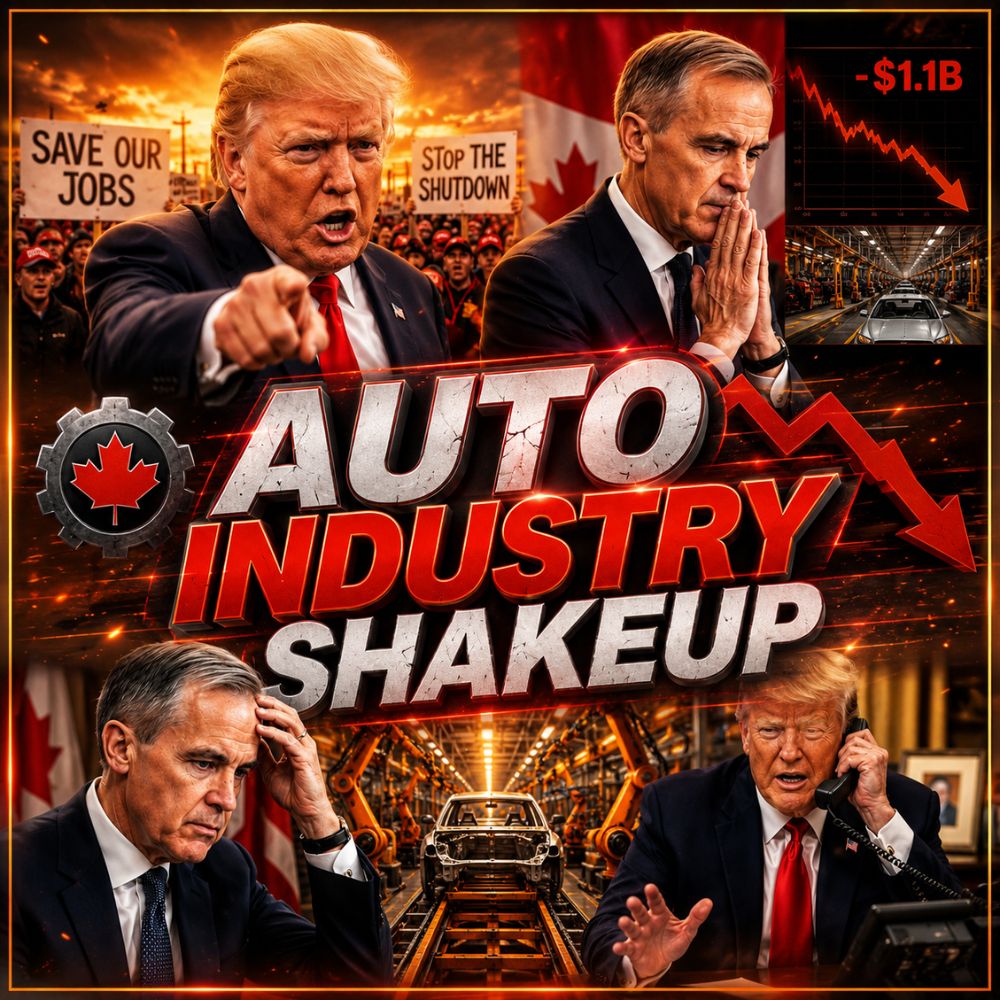
The dispute surrounding automotive tariffs between Canada and the United States has entered a sensitive new phase as Ottawa seeks to recover hundreds of millions of dollars in public subsidies granted to major automakers after several production commitments in Canada were not maintained. At the centre of the controversy are General Motors and Stellantis.
Against this backdrop, the Canadian government had previously allocated more than US$1 billion in public support to encourage domestic manufacturing and preserve jobs in the automotive sector. However, multiple facilities are now experiencing downsizing or production shifts to the United States, raising questions about the true effectiveness of the trade war launched under former U.S. President Donald Trump with the stated goal of protecting American manufacturing.
According to figures cited in the transcript, GM reported a US$1.1 billion loss in the second quarter alone due to tariffs. The company also projected that tariff-related losses for 2025 could reach between US$4 billion and US$5 billion. Meanwhile, Stellantis recorded losses of approximately US$477 million during the first half of 2025.
One of the most notable developments has been the financial market’s reaction to rising costs tied to trade policy. GM shares reportedly declined sharply not because of weak consumer demand or product issues, but because tariff policies significantly increased operating costs throughout the North American supply chain.
GM is said to have shifted roughly one-third of its Canadian production to U.S. facilities in response to tariff pressures. However, the move also disrupted a deeply integrated cross-border supply network that had taken decades to establish between Canada and the United States.
North America’s automotive manufacturing system relies heavily on integrated supply chains. A single component may cross the Canada–U.S. border multiple times during assembly. Under the current tariff structure, every border crossing can become a taxable event, causing costs to accumulate far beyond the nominal 25 per cent tariff rate.
The impact has not been limited to large corporations. Stellantis reportedly halted plans to manufacture the Jeep Compass at its Brampton, Ontario plant, putting approximately 3,000 jobs at risk. Production of the model was later transferred to Illinois.
GM also ended production of its BrightDrop electric vans at the Ingersoll, Ontario facility, which currently remains without a replacement product announcement. In addition, the company cancelled a third shift at its Oshawa operation, intensifying concerns over the long-term future of Canada’s auto sector workforce.
Previously, the Canadian government had provided more than US$470 million in federal support to Stellantis for the retooling of the Brampton facility. GM also received approximately US$190 million in assistance for manufacturing upgrades at Canadian plants, including Ingersoll.
Ottawa is now reportedly considering legal measures to recover part of those subsidies. Industry Minister Melanie Joly confirmed that the federal government would pursue repayment if production commitments were not fulfilled.
The transcript argues that the underlying reason automakers withdrew from their Canadian commitments stems from a tariff environment that dramatically increased operational costs, even with public financial assistance in place.
Analysts referenced in the discussion contend that the trade war is inflicting significant damage on America’s industrial heartland, particularly states such as Michigan, Ohio, Indiana, and Kentucky — regions that were originally presented as primary beneficiaries of protectionist policies.
Another major development involves Prime Minister Mark Carney’s economic outreach to China in early 2026. According to the transcript, Canada reduced tariffs on Chinese electric vehicles from 100 per cent to 6.1 per cent under an initial quota of 49,000 vehicles annually.
In exchange, China reduced tariffs on Canadian canola oil from 84 per cent to roughly 15 per cent. However, the agreement is portrayed as more than a simple trade arrangement, representing an opening for Chinese electric vehicle and battery manufacturers to establish a foothold in Canada.
Under the reported terms of the agreement, Chinese firms would be required to create joint ventures for vehicle or battery production within Canada within three years. The arrangement has fuelled concerns in the United States about the possibility of Chinese manufacturing operations emerging directly along America’s northern border.
A Democratic congresswoman from Michigan reportedly described the agreement as a direct threat to American manufacturers and workers. Meanwhile, the head of the American EV Jobs Alliance argued that Washington’s unpredictable trade policies created the conditions for such developments.
The debate has also extended into national security concerns. A U.S. senator from Michigan warned that Chinese-made electric vehicles could present risks involving data collection and surveillance technologies.
However, the transcript notes that if a Chinese-backed joint venture manufactures vehicles in Windsor using Canadian labour and Canadian-made components, defining those vehicles as “Chinese cars” under existing legislation may become significantly more complicated.
At the same time, uncertainty surrounding the future of the KUSMA trade agreement — the successor to NAFTA — continues to weigh heavily on North American investment decisions. According to the discussion, no formal renewal framework has yet been established despite the approaching July 1, 2026 deadline.
Many companies are reportedly delaying investment and expansion plans because of long-term uncertainty surrounding trade policy. Planned factory expansions have been frozen, hiring has slowed, and supply chain contracts are increasingly shifting toward more stable markets.
Although Canada is also experiencing significant economic strain, the transcript argues that Ottawa now holds several strategic advantages, including reaching NATO defence spending targets earlier than expected and controlling critical minerals essential to the U.S. defence industry.
Ultimately, the discussion concludes that many of the economic consequences may not be easily reversed, even if a new trade agreement is eventually reached. The Ingersoll facility remains empty, Jeep Compass production has already moved to Illinois, and thousands of Ontario jobs have yet to return.
The ongoing negotiations between Ottawa and Washington therefore continue to leave major questions unresolved regarding the future of North America’s automotive supply chain, the effectiveness of tariff-driven industrial policy, and the ability of Canada and the United States to establish a more stable long-term trade framework.