

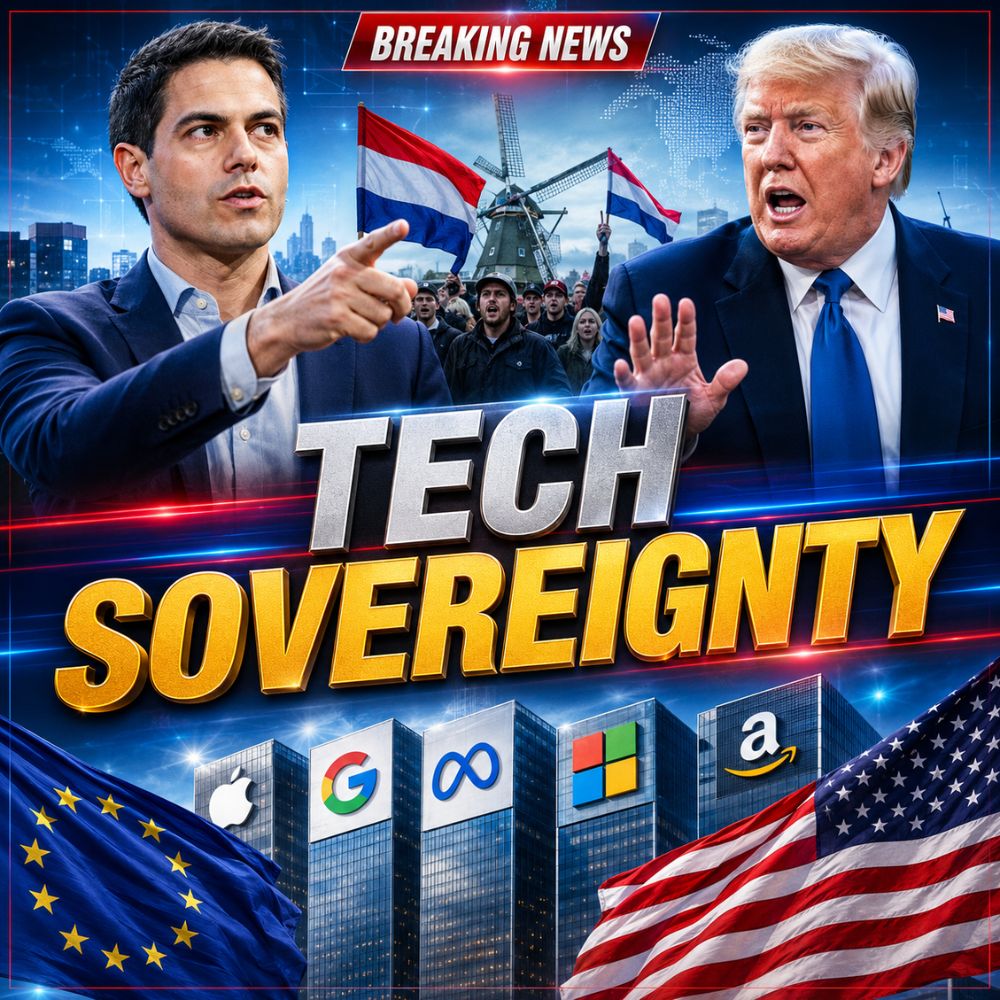
Europe’s Quiet Tech Revolt Is No Longer Quiet
For years, Europe’s anxieties about American technology dominance lived mostly in white papers, parliamentary hearings and policy conferences in Brussels. Officials spoke in abstract terms about “strategic autonomy,” “data sovereignty,” and “digital resilience,” while citizens continued to use American cloud services, American operating systems and American AI models for nearly every aspect of daily life.
Now the debate has escaped the conference room.
It is moving into courtrooms, procurement offices, national identity systems and the infrastructure beneath modern government itself.
The latest signal came not from a state ministry but from a search engine.
Ecosia, the Berlin-based search company known for planting trees with its advertising revenue, announced this week that it had shifted nearly its entire AI stack to a European provider. The company did not trumpet the move with a political campaign or nationalist rhetoric. It arrived quietly, in the form of a blog post and a product update. (The Ecosia Blog)
But the implications were difficult to miss.
“Partnering with European companies supports our mission for independent European tech that’s not subject to political whims,” the company wrote. (The Ecosia Blog)
That sentence captured a sentiment now spreading rapidly across Europe: the belief that dependence on American digital infrastructure has become a strategic vulnerability.
Ecosia’s argument was not merely ideological. The company emphasized three practical points. Its new system consumes less energy. User queries are not stored by third parties, even temporarily. And all interactions fall under European Union privacy protections, among the strictest data regulations in the world. (The Ecosia Blog)
The company serves more than 20 million users globally and remains structured around a not-for-profit climate mission. (Reddit)
The provider itself was not officially named. Yet online discussions and updated privacy disclosures strongly suggest the company has shifted toward French AI firm Mistral AI. (Better in Europe)
On the surface, this may appear to be a niche technical decision by a mid-sized European search engine.
In reality, it is part of a much larger continental movement.
Across Europe, governments, universities, cloud providers and ordinary citizens are increasingly asking the same question: Who ultimately controls the systems modern societies depend on?
That question has become particularly urgent in the Netherlands.
Nearly every adult resident of the Netherlands uses DigiD, the country’s national digital identity platform.
DigiD is not a peripheral service. It functions as the authentication backbone of Dutch civic life. Citizens use it to file taxes, access health records, apply for benefits, interact with municipalities and verify their identity across government systems.
In practical terms, DigiD is part passport, part public utility and part digital nervous system.
And that system has become the center of a sovereignty battle.
The infrastructure platform supporting DigiD is supplied by the Dutch cloud company Solvinity. That company is currently the target of a proposed acquisition by Kyndryl, the American IT services company spun out of IBM.
If the takeover proceeds, critics argue, a core component of Dutch national digital infrastructure could ultimately fall under American legal jurisdiction.
The fear revolves around the U.S. CLOUD Act, legislation allowing American authorities to compel U.S.-based companies to provide access to data under certain legal circumstances, even when that data is stored abroad.
Dutch lawmakers, privacy advocates and cybersecurity experts have warned that such exposure creates risks that extend beyond ordinary data privacy concerns. (DutchNews.nl)
For many Europeans, the issue is not simply whether American authorities would access data. It is whether European governments should depend on foreign-controlled systems for critical national infrastructure at all.
The public backlash in the Netherlands has been unusually intense.
Privacy First, a Dutch civil liberties foundation, initiated legal proceedings challenging the arrangement. Citizens filed lawsuits demanding the government halt contract renewals connected to the acquisition. Members of Parliament from nearly every political party backed motions calling for the Dutch government to refuse future renewals if Solvinity becomes American-owned. (DutchNews.nl)
In a fragmented parliamentary system famous for coalition politics, that degree of consensus is rare.
The Dutch government has acknowledged the concerns while simultaneously arguing that an immediate transition would be risky.
Officials extended the Solvinity contract through 2028, stating that replacing the infrastructure before August 2026 could threaten service continuity. (digid.nl)
The courts largely agreed with that narrow argument.
Judges ruled that maintaining continuity of a critical government service did not constitute unlawful conduct. But notably, they did not dismiss the broader sovereignty concerns themselves. (DutchNews.nl)
That distinction matters.
The legal battle may have failed in the short term, but politically, the campaign succeeded in changing the trajectory of the debate.
The Dutch Parliament has effectively placed a deadline on the problem.
By the next contract cycle, the expectation is that the Netherlands must either develop or secure a European-controlled alternative.
That process is already underway.
Dutch institutions have begun migrating workloads toward European cloud providers. Universities are coordinating efforts to reduce dependency on American platforms. Telecommunications firms and defense contractors are collaborating on sovereign military cloud infrastructure. (DutchNews.nl)
In isolation, each move might appear technical or bureaucratic.
Together, they resemble something larger: a slow-motion decoupling from American digital dependence.
This shift is being driven by several forces simultaneously.
One is geopolitics.
Europeans increasingly worry that digital infrastructure has become a tool of state leverage. The same cloud systems that provide efficiency and scale also create dependencies that can become strategic pressure points during diplomatic or economic conflict.
Another force is legal asymmetry.
European privacy law, especially under the GDPR framework, is built around strict limitations on data collection and transfer. American law, by contrast, often prioritizes national security access and intelligence powers. Those two systems coexist uneasily.
The result is a growing belief among European policymakers that jurisdiction matters as much as technology itself.
Where a server sits is no longer the only important question.
Who owns the company operating it may matter even more.
The Ecosia story illustrates one side of this transformation.
Private companies with flexible infrastructure can pivot quickly. They can migrate providers, rewrite contracts and restructure systems within months.
Government systems are different.
They move slowly because they are deeply embedded into public administration, healthcare, taxation and identity verification. Replacing them involves procurement rules, continuity guarantees and massive technical complexity.
That is why the DigiD fight has become symbolically important across Europe.
It demonstrates how sovereignty debates are no longer abstract discussions about future regulation. They are now battles over existing systems that millions of people already rely upon every day.
And increasingly, citizens themselves are driving those battles.
This is perhaps the most significant development of all.
For much of the past decade, digital sovereignty was primarily a project of elites — regulators, ministers and EU commissioners.
Now ordinary citizens are participating directly.
They are filing lawsuits. Lobbying legislators. Organizing public campaigns. Demanding procurement transparency. Challenging acquisitions.
In the Netherlands, the political pressure became so intense that even maintaining the status quo required extraordinary public justification.
The deeper issue underneath all of this is trust.
Europe spent decades integrating itself into an American-centered digital ecosystem because the arrangement appeared efficient, stable and politically safe.
But stability is now precisely what many Europeans believe has eroded.
The return of aggressive geopolitical competition, disputes over surveillance powers, growing distrust of foreign tech monopolies and concerns over political volatility in Washington have all accelerated the reassessment.
In response, Europe is attempting something extraordinarily difficult: rebuilding layers of digital infrastructure that it allowed foreign firms to dominate for nearly two decades.
That process will not happen quickly.
American cloud providers remain deeply embedded throughout Europe. American AI companies still dominate much of the global market. The economics of scale remain overwhelmingly favorable to U.S. firms.
Yet momentum is shifting.
What once sounded like protectionist rhetoric increasingly resembles long-term industrial strategy.
And unlike previous European technology ambitions, this movement is no longer confined to governments.
Companies are participating.
Universities are participating.
Courts are participating.
Citizens are participating.
Ecosia’s transition and the Dutch DigiD battle may seem like separate stories. One concerns an environmentally focused search engine. The other concerns a national identity platform.
But both are responses to the same underlying realization.
Control over digital infrastructure is no longer viewed merely as a commercial issue.
It is increasingly viewed as a question of political sovereignty itself.
And across Europe, that realization is beginning to reshape the architecture of the internet.