


Colbert’s Stinging On-Air Monologue About Trump Ignites a Fresh Cultural and Political Storm
In a late-night segment that blended comedy, political critique and pointed personal commentary, Stephen Colbert on Monday delivered one of his sharpest monologues of the past year, prompting a wave of digital reaction and immediate political scrutiny. The bit — in which the Late Show host dissected former President Donald J. Trump’s recent public claims, mocked his rhetorical habits and unveiled what he called a “live, point-by-point reality check” — quickly circulated across social platforms, drawing millions of views by morning.
The routine began with Colbert’s response to a weekend speech in which Mr. Trump accused his critics of “failing America,” a line the late-night host described as “a familiar refrain in a very familiar loop.” From there, the monologue accelerated into what would become an extended satirical takedown, complete with edited clips, visual gags and on-screen graphics designed to scrutinize — and lampoon — Trump’s words.
“Whenever he says he’s winning,” Colbert told his audience, “that’s the moment to check the scoreboard.” The line drew extended applause, and from that point forward, the segment unfolded with a pace and intensity that suggested Colbert had been preparing it for some time.
A Segment That Escalated On Air
Midway through the monologue, Colbert introduced what he described as a “live-fact overlay,” a comedic device in which graphics compared Mr. Trump’s claims to publicly available data. Although the material was explicitly framed as satire, it carried a sharper tone than usual, reflecting what media analysts described as the “increasingly confrontational posture” of late-night hosts toward political figures.
Colbert’s staff played a sequence of clips in which Mr. Trump repeated several familiar talking points — about the economy, the media, and his political opponents — and paired them with tongue-in-cheek commentary. But it was the segment’s final act, in which Colbert evaluated Trump’s comments about “loyalty” and “respect,” that sparked the strongest reaction.
“If respect matters so much,” Colbert said, “why does he spend so much time demanding it and so little time earning it?” The audience erupted, and online reactions followed almost immediately.
Reaction Inside Mar-a-Lago
By the time the broadcast ended, advisers close to Mr. Trump were expressing frustration, according to two individuals familiar with private conversations at Mar-a-Lago who spoke on condition of anonymity. One adviser described Mr. Trump as “visibly angry,” saying he viewed the segment as “a coordinated Hollywood attack.”
A second person familiar with the former president’s reaction said he asked his team whether “anything could be done” about what he described as “character assassination,” echoing earlier moments in which Mr. Trump clashed publicly with late-night hosts.
A spokesperson for Mr. Trump declined to comment.
A Flashpoint in the Politics–Entertainment Divide
Experts in media and political communication said the episode underscored a recurring dynamic: the role of late-night comedy as both entertainment and cultural commentary in a deeply polarized political environment.
“Late-night shows have evolved into a major platform for political conversation,” said Dr. Maya Compton, a professor of media studies at Northwestern University. “Colbert’s segment wasn’t just a joke — it was a referendum on political narratives, and viewers treat it that way.”
Since 2016, late-night hosts have increasingly adopted explicit political stances, responding to — and reshaping — the national conversation through satire. Whether viewers embrace or reject this shift often mirrors broader partisan divides.
A Digital Aftershock
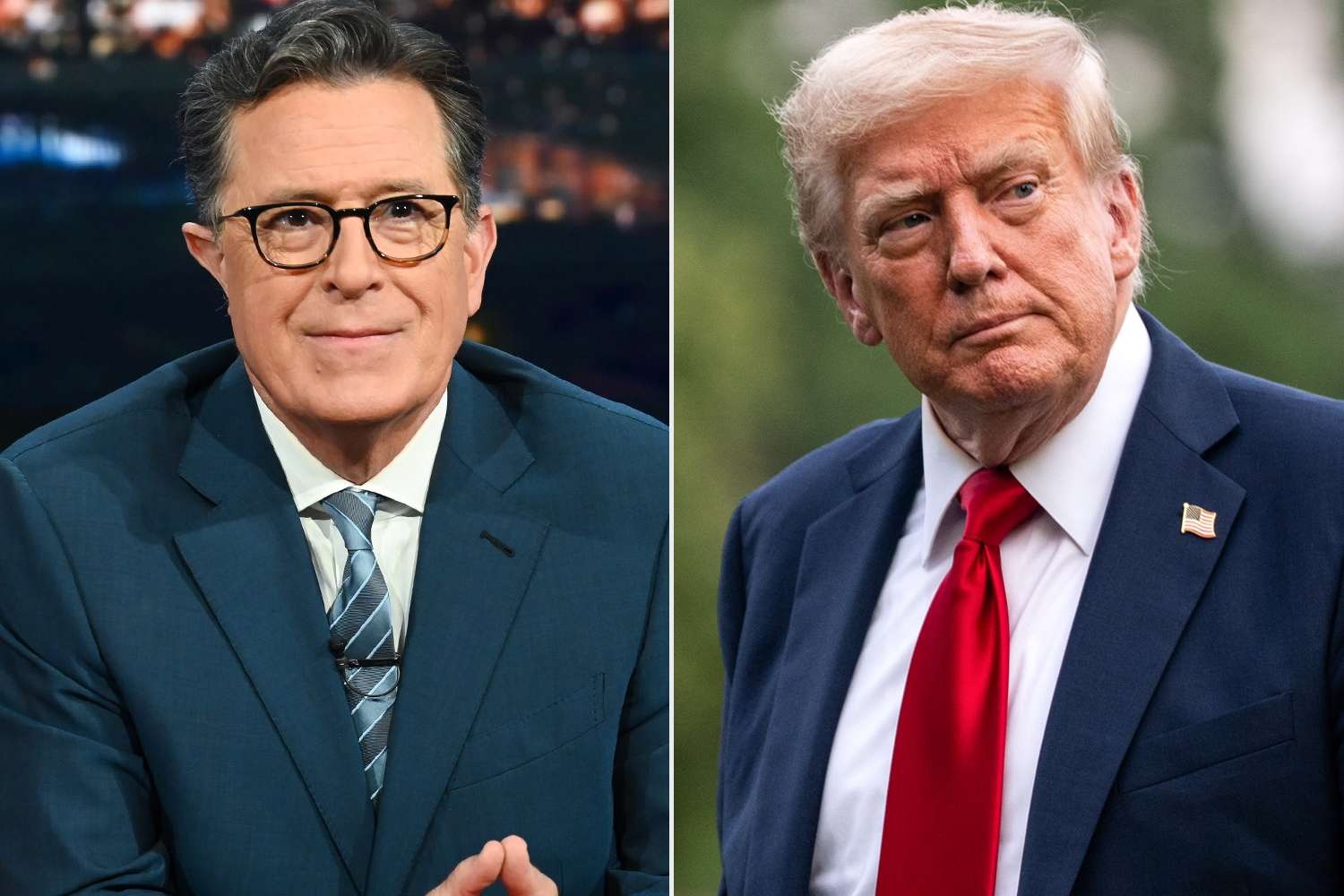
By early Tuesday, the segment had become one of the most shared political clips of the week. The hashtag #ColbertDestroysTrump trended across major platforms. Supporters of Mr. Trump criticized the monologue as “mean-spirited,” while critics of the former president praised it as “long overdue.”
Media analysts noted that the reaction was amplified by Colbert’s use of visual elements — particularly the exaggerated on-screen charts and “reality overlay” graphics — which lent themselves to rapid online circulation independent of the full broadcast.
“Clips like these now function as standalone cultural artifacts,” said Samuel Jiménez, a digital culture researcher at MIT. “They travel faster than the show itself and accumulate interpretations along the way.”
Political Repercussions in Washington
On Capitol Hill, lawmakers and aides reacted cautiously but acknowledged the cultural impact. While few addressed the segment directly, several congressional staffers noted that viral late-night moments often influence public perceptions in subtle but persistent ways.
One Democratic aide described the segment as “a reminder that political storytelling now happens outside traditional institutions.” A Republican aide called it “political theater masquerading as comedy,” but acknowledged that such moments often “shape a news cycle whether we want them to or not.”
An Increasingly Blurred Line
The Colbert segment reflects a broader trend in American media: the erosion of a once-clear boundary between political journalism and entertainment. Analysts say this dynamic places political figures — and late-night hosts — at the center of a cultural arena where every joke, claim or critique is scrutinized far beyond its original context.
“It’s part of the ongoing redefinition of public discourse,” Dr. Compton said. “Comedy isn’t just comedy anymore.”
Whether the exchange leads to a direct response from Mr. Trump remains uncertain. But as one media strategist put it, “In this environment, a seven-minute monologue can have a week-long afterlife.”