

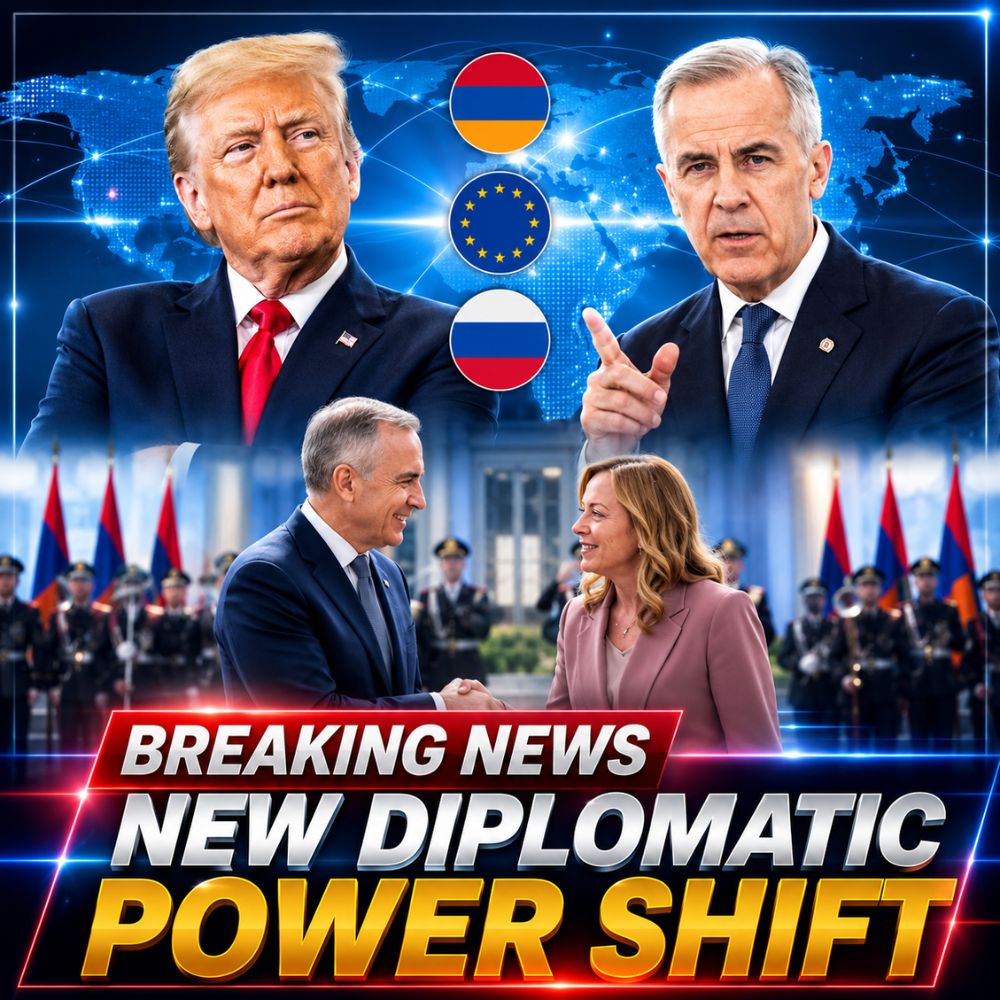
Prime Minister Mark Carney’s touchdown at Zvartnots International Airport this week marks more than a diplomatic visit; it signifies a bold remapping of Canadian influence. With a brief 20-hour window to engage Armenia’s leadership before the eighth European Political Community (EPC) summit begins, Canada is planting its flag in a region traditionally dominated by Moscow, signaling its evolution into a truly global operational power.

The significance of this moment cannot be overstated. Carney is the first non-European leader ever invited to the EPC, a forum born in the shadow of the Ukraine invasion. This invitation confirms that the European Union no longer views Ottawa as a mere “Atlantic partner” for G7 photo ops, but as an indispensable security stakeholder on Europe’s eastern frontier.
The Pivot Toward Yerevan
For decades, Armenia was the Kremlin’s most reliable client state in the Caucasus. However, after Moscow remained silent during the devastating 2020 and 2023 conflicts with Azerbaijan, Armenia’s trust in its old patron evaporated. Under Prime Minister Nikol Pashinyan, Yerevan has accelerated a “Westward pivot,” and Canada has stepped into the vacuum with surprising speed.
2023: Ottawa opened its first full embassy in Yerevan.
Presence: Canada became the first non-EU nation to join the EU monitoring mission along the volatile Armenian-Azerbaijani border.
Geography: Positioning itself in a nation bordering Iran and sitting atop vital energy corridors, Canada is securing strategic leverage in one of the world’s most contested “neighborhoods.”
Defense and Doctrine: A Long-Term Bet
Beyond trade and diplomacy, the next frontier for Canada-Armenia relations is defense. Experts suggest that Canada is positioned to become a primary partner in modernizing the Armenian military. By embedding Canadian institutional models within Armenia’s military education, Ottawa is helping to steer the country away from Russian tactical doctrines.
“This is influence measured in decades, not summits,” notes analyst Alan Whitehorn. It is a slow, deliberate process of integrating a former Soviet state into the Western security architecture.
Navigating Complications
Canada’s rise in the region is not without friction. The 2020 “drone scandal”—where Canadian-made optical sensors ended up in Azerbaijani drones via Turkey—left a scar on relations that the
Carney government is working hard to heal through direct engagement. Furthermore, Canada finds itself entangled in domestic Armenian politics, notably with the arrest of dual citizen Archbishop Bagrat Galstanyan, highlighting the “immediate and sensitive” nature of this new foreign policy.
A Global Power, Not a Regional Player
As 48 European heads of state converge on Yerevan, the presence of a Canadian Prime Minister sends an unmistakable message to Vladimir Putin: the era of unchallenged Russian dominance in the Caucasus is over. Canada is no longer content to operate as a junior partner whose ambitions stop at the Atlantic coast.
This is the Canada of 2026—a “connective middle power” that opens embassies in contested capitals, monitors borders on the edge of Iran, and writes its own script on the global stage. 20 hours in Yerevan may seem like a brief stop, but it is a loud declaration that Canada has finally claimed its full operational reach.