

THE IVORY TOWER UNDER SIEGE: Inside the Legal and Financial War on the Trump Dynasty
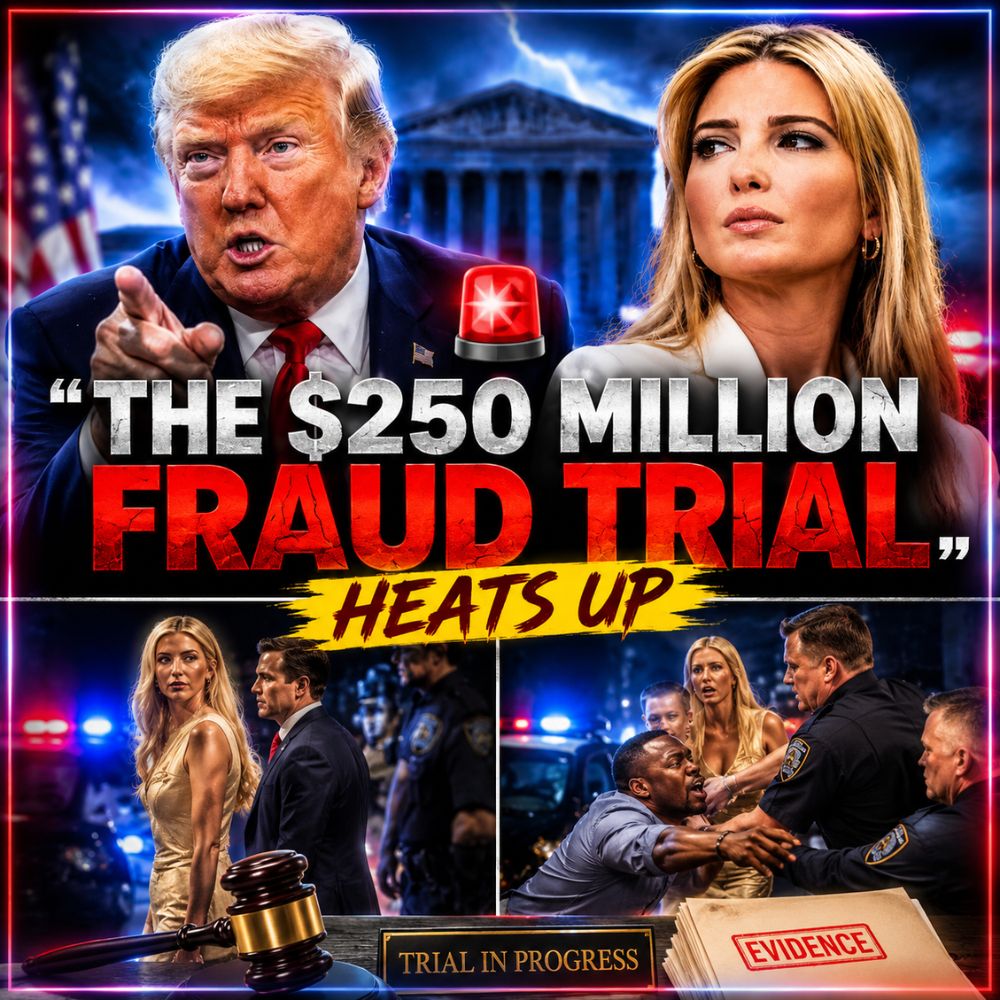
WASHINGTON, D.C. — In the hushed, high-stakes atmosphere of a Manhattan courtroom, a decades-old business empire is being dissected, brick by brick. The setting is the $250 million civil fraud trial against the Trump Organization—a case that has transformed from a mere legal dispute into a sweeping historical audit of one of America’s most famous families.
This week, the prosecution called its final and perhaps most anticipated witness: the former President’s eldest daughter, Ivanka. Her presence on the stand marks the culmination of a family-wide judicial gauntlet, following the sworn testimony of her brothers, Donald Jr. and Eric, and their father.
But while the headlines focus on the courtroom drama, a much larger, more ominous narrative is resurfacing in the background. As the family answers questions about loan documents and net-worth statements, a tidal wave of investigative journalism is reviving thirty years of allegations regarding a “shadow economy” of international money—specifically from Russia—that critics claim has long been the invisible foundation of the skyline’s most famous properties.
PART I: THE DAUGHTER ON THE STAND
Ivanka Trump’s appearance in court was a study in poise and “memory management.” No longer a co-defendant in the case, she stood before the judge not as a target, but as a primary source of institutional knowledge. As a former executive vice president for the Trump Organization, Ivanka was central to the acquisition of key properties and the securing of massive loans that are now the subject of intense scrutiny.
However, for those looking for a “smoking gun” in her testimony, the result was a masterclass in executive deflection. Repeatedly, when confronted with emails, loan discussions, and financial spreadsheets, Ivanka offered a consistent refrain: “I do not recall.”
The Memory Gap
In high-profile financial litigation, the “I don’t recall” defense is a double-edged sword. While it protects the witness from potential perjury, it creates a vacuum that investigators are eager to fill with documentary evidence.
The prosecution’s strategy has been to present a “paper trail” that speaks when the witness will not. They have introduced emails where Ivanka was a direct recipient of discussions regarding “net worth” requirements for loans from Deutsche Bank. The stakes are immense: if the prosecution can prove that the Trump family knowingly inflated their asset values to get better loan rates, the $250 million penalty is just the beginning. The very “Trump” brand, built on the image of billions, could be legally rebranded as a fiction.
PART II: THE THREE-DECADE TRAIL OF RUSSIAN RUBLES
While the civil trial focuses on the math of the last decade, a secondary, more global investigation is unfolding in the court of public opinion. A “fascinating new piece of journalism” has tracked three decades of Russian money connected to Trump properties, suggesting that the current fraud trial is merely the tip of a much larger, international iceberg.
For years, the former President has downplayed his business ties to Russia, famously stating, “I have nothing to do with Russia.” But the history of the Trump Tower and other flagship properties tells a different, more complicated story.
The Russian Immigré and the Tower
Investigators are revisiting the case of David Bogatin, a Russian émigré who, in 1984, walked into Trump Tower and purchased five apartments for $6 million. At the time, Bogatin was allegedly tied to powerful organized crime figures in the Soviet Union.
This single transaction is being highlighted as an “early warning sign.” Critics argue that Trump Tower, in its early days, was inadvertently—or perhaps intentionally—structured as a perfect vehicle for money laundering. The use of “anonymous shell companies” to purchase luxury real estate allowed individuals to move vast sums of cash into the American financial system with minimal oversight.
The Oligarch’s Channel
The report identifies at least ten high-profile businessmen with links to the former President and his companies who were allegedly connected to organized crime or corrupt oligarchies from former Soviet republics. These were not just simple real estate deals; they were high-value transactions that occurred when the Trump Organization was struggling to find financing from traditional American banks.
The narrative emerging from these reports is that of a “symbiotic relationship”:
The Trump Organization needed liquidity and high-status buyers.
Wealthy Russians and Oligarchs needed a way to legitimize their wealth and a safe place to park money outside the volatile post-Soviet landscape.
PART III: THE DUE DILIGENCE DEBATE
The most politically sensitive aspect of these revelations is the question of Due Diligence. In the American business world, a company is expected to vet its partners, especially when dealing with massive international sums.
The allegations resurfacing today claim that Trump properties were attractive to questionable actors for purposes far beyond “ordinary real estate investment.” Critics argue that the Trump business model—which often involved “licensing” the name to other developers—created a layer of plausible deniability that allowed suspicious money to flow through the brand without direct oversight from the headquarters.
The Role of Anonymous Ownership
The controversy intensifies around claims that anonymous property ownership structures created ideal conditions for money laundering. Historically, the U.S. real estate market had significantly fewer reporting requirements than the banking sector. This loophole allowed “all-cash” buyers to hide their true identities behind layers of legal entities.
By the time federal prosecutors and journalists began asking “What is it about Trump and the Russians?”, the financial trail had grown cold, buried under decades of sophisticated corporate structuring.
PART IV: THE PROSECUTOR’S PERSPECTIVE
Adding weight to these charges is the involvement of former federal prosecutors who are now lending their voices to the scrutiny. They describe the Trump growth strategy not just as a push for real estate holdings, but as an “intersection with questionable international money networks.”
A former prosecutor, interviewed for the report, called the accumulation of these allegations a “weighty charge.” They suggest that the current civil fraud trial in New York is providing the “connective tissue” that helps explain how the organization could sustain itself through numerous bankruptcies and financial crises.
The Pattern Over the Episode
The commentary is shifting from discussing “isolated episodes”—like a single apartment sale or a missed loan payment—to identifying a “broader long-term pattern.”
The 1980s: The influx of émigré cash.
The 2000s: The licensing deals in the former Soviet states.
The 2010s: The massive loans secured through inflated net-worth statements.
When viewed as a single, forty-year timeline, the “business credibility” of the Trump Organization looks vastly different than the “stable genius” narrative presented to the voters.
PART V: THE SYMBOLIC WEIGHT OF THE FAMILY
The reason Ivanka Trump’s testimony is so consequential is not necessarily the specific facts she reveals—which, given her memory lapses, may be few—but the symbolic weight she carries.
As the “polished face” of the Trump brand, her presence in a courtroom, answering questions under the threat of perjury, signifies a fundamental shift in the American power dynamic. For the first time, the private “Black Box” of the family business has been forced open.
While her brothers, Don Jr. and Eric, have often adopted a more combative tone, Ivanka’s more reserved testimony creates a different kind of pressure. It forces observers to look at the documents. If she “cannot recall,” then the emails from Deutsche Bank and the spreadsheets from the accountants become the primary witnesses.
PART VI: THE BROADER NARRATIVE
The contrast between the limited answers provided in court and the explosive allegations being revived by investigative journalists is creating a “credibility gap” that may be impossible to close.
On one side, the Trump family maintains that these are “politically motivated attacks” designed to derail a presidential campaign. They argue that their business practices were “standard for the industry” and that no bank ever lost money on their loans.
On the other side, critics see a growing body of troubling questions. They see:
A Lack of Transparency: Decades of hidden tax returns and anonymous buyers.
Ethical Vulnerabilities: A willingness to do business with anyone, regardless of their background, as long as the check cleared.
Systemic Deception: The alleged “inflation” of assets to manipulate the financial system.
CONCLUSION: THE TRIAL OF THE CENTURY
As the civil fraud trial moves toward its conclusion, the “biggest unanswered question” is no longer whether the Trump Organization committed fraud. It is a question of Depth.
How deep does the financial trail go? Is the New York fraud case just the prologue to a much larger story involving international crime, money laundering, and the manipulation of American power?
The uncertainty itself has become part of the American story. Every “I don’t recall” in the courtroom and every new report of “Russian Rubles” in the skyline keeps the reputational risk alive. For the Trump family, the ivory tower is no longer a sanctuary; it is a crime scene being examined by the world.
Whether the result is a $250 million fine or a total “business execution,” the era of the Trump Organization operating in the shadows is over. The curtain has been pulled back, and what remains to be seen is whether the empire is made of steel and glass, or merely paper and mirrors.