

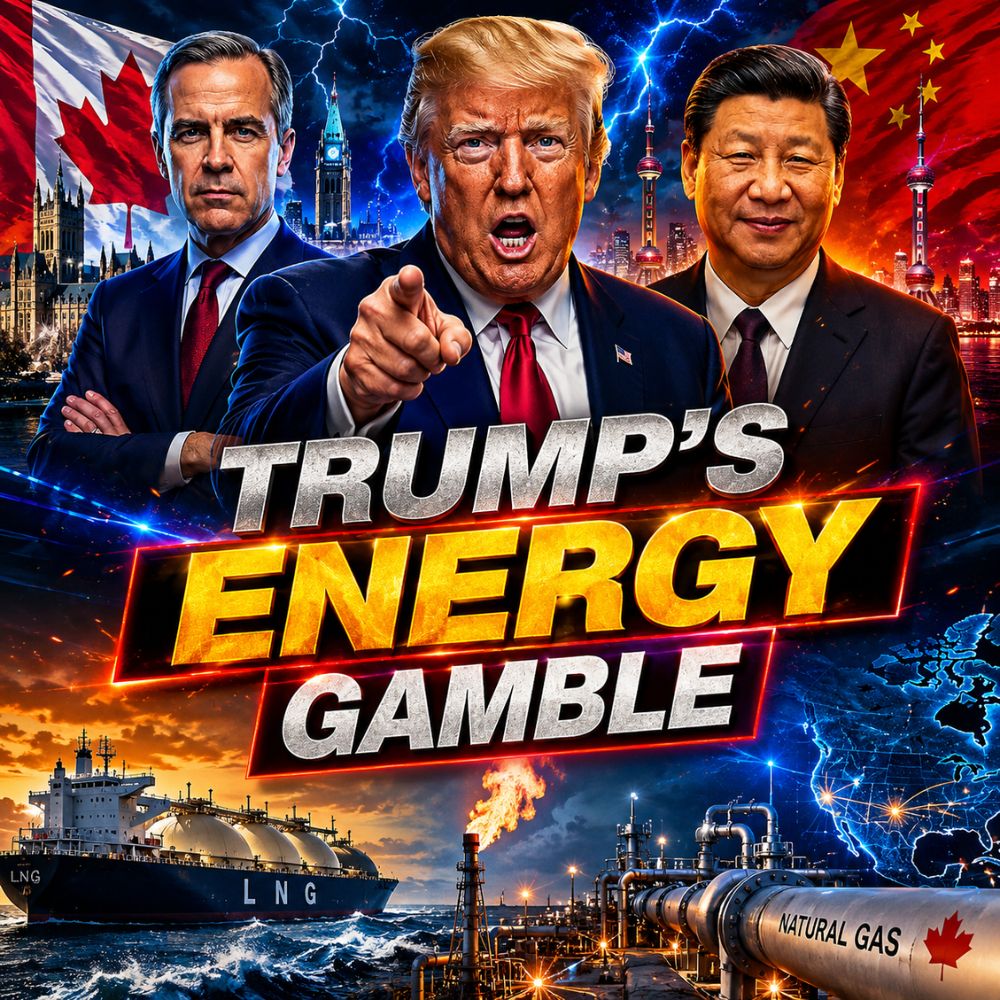
The Pacific Pivot: How Trump’s Trade War Built a Chinese Energy Lifeline in Canada
For a decade, the energy relationship between Canada and China was a rounding error in the global ledger. Between 2013 and 2023, China purchased a consistent, modest 7,000 barrels of Canadian oil per day. At $75 a barrel, that amounted to roughly $525,000—a figure so small it barely registered in the energy calculations of either nation. Canada was, for all intents and purposes, a captive supplier to the United States, sending 96% of its export oil south to American refineries.
Then came the return of Donald Trump and the declaration of an economic “national emergency” at the northern border. By February 2025, Trump had imposed a 10% tariff on Canadian energy. He intended to use Canada’s total dependency on American pipelines and refineries as a weapon of compliance.
He ended up doing the opposite.
Within twelve months of those tariffs hitting, China was buying 207,000 barrels of Canadian oil every single day—a staggering 30-fold increase. Simultaneously, the first Chinese-owned vessels began arriving at a brand-new Canadian terminal to collect liquefied natural gas (LNG). Trump wanted to squeeze Ottawa; instead, he provided the final catalyst for Canada to open its “exit door” to the Pacific, permanently re-engineering the geometry of global power.
The Alberta Bottleneck: A Century of Captivity
To understand the magnitude of this shift, one must understand the geological irony of Alberta. The province sits atop one of the largest petroleum deposits on Earth—the Athabasca oil sands. With an estimated 165 billion barrels of recoverable bitumen, Canada’s reserves are roughly 62% of Saudi Arabia’s total proven reserves.
Despite this wealth, Alberta is landlocked. For half a century, the physics of Canadian energy were dictated by a southward pull. Pipelines like the Enbridge Mainline and the Keystone system were engineered specifically to feed heavy crude into the American Midwest and the Gulf Coast.
This structural dependency gave Washington immense leverage. Because Canada had no other way to get its oil to the global “waterborne” market, it had to accept “Western Canadian Select” (WCS) prices, which often traded at a significant discount to the global benchmark. Canada was an energy superpower with only one customer—a customer that eventually decided to treat it as an adversary.
TMX: The $34 Billion Exit Door
The turning point was not a political speech, but a pipe. On May 1, 2024, the Trans Mountain Expansion (TMX) project officially came online.
It was a project born of desperation. After years of legal battles, environmental protests, and a government buyout, the TMX tripled the capacity of the original line from 300,000 to 890,000 barrels per day. More importantly, it ended at the Westridge Marine Terminal in Burnaby, British Columbia.
For the first time in history, Canadian oil could be loaded onto Aframax tankers and shipped west across the Pacific. Canada spent $34 billion (CAD) to build this door. Critics called it a “stranded asset” in a greening world. But when Donald Trump’s tariffs hit in early 2025, that “stranded asset” became Canada’s primary strategic defense.
The Trade War Catalyst
When Trump signed the executive order imposing tariffs in February 2025, he gambled that Canada would have to “eat” the cost because it had nowhere else to go. He miscalculated the speed of the Pacific pivot.
The 10% tariff on energy served as a flare in the night for Chinese energy buyers. China’s state-owned refineries had been searching for a way to diversify away from Russian oil (exposed to sanctions) and Middle Eastern oil (exposed to the Strait of Hormuz). They saw in Canada a stable, democratic, and high-quality producer that was suddenly being shoved away by its primary partner.
By May 2025, the data from energy analytics firm Kpler revealed a shock: China had become the top buyer of Canadian oil from the TMX pipeline, surpassing the United States. Between May 2024 and September 2025, Canada generated over $13 billion (CAD) in Asian energy sales—revenue that simply did not exist a year prior.
LNG: The “Clean” Energy Bridge
While oil was moving through Burnaby, a second energy revolution was finishing construction further north in Kitimat, B.C.
LNG Canada, a massive joint venture led by Shell and including PetroChina (with a 15% stake), represents the largest private infrastructure project in Canadian history. Its goal: to take natural gas from the Montney formation in northeastern B.C., liquefy it at -160°C, and ship it to Asia.
In July 2025, the Hong Kong-flagged carrier Wu Dang arrived in Kitimat to collect “Cargo Number Five.” This wasn’t just any gas; because the facility is powered by B.C.’s hydroelectric grid, it produces the lowest carbon-intensity LNG in the world.
For Chinese buyers facing increasing domestic
Shutterstock and international pressure to reduce emissions, Canadian LNG provided a competitive advantage. It was a “clean” bridge fuel that arrived on a Chinese-owned vessel from a terminal where a Chinese state company was a part-owner. PetroChina isn’t just a customer; it owns 15% of the infrastructure. They have “skin in the game.”
Value-Based Realism: Carney’s Beijing Visit
In January 2026, Prime Minister Mark Carney flew to Beijing, signaling the end of a seven-year diplomatic freeze. The visit resulted in a Memorandum of Understanding (MOU) on energy that effectively formalized the new supply chain.
Canadian Energy Minister Tim Hodgson was blunt about the motivation. He told reporters in Beijing that China was looking for “trading partners that don’t use energy for coercion.”
The irony was unmistakable. For decades, Western leaders had accused Russia and China of using energy as a weapon. Now, a G7 nation was using that exact same language to describe its relationship with the United States. Canada was no longer asking for permission to export; it was signing deals that traded energy security for tariff relief on other goods, like Canadian canola and seafood.
The New Geometry of Power
The numbers tell the final story of this transition:
Decade Average (2013-2023): 7,000 barrels/day to China.
The Trump Era (2025): 207,000 barrels/day to China.
Revenue: Nearly $7 billion (CAD) in annual run-rate revenue from Asian oil sales alone.
Utilization: The TMX is projected to reach 92% utilization by 2027, with almost all incremental growth flowing west, not south.
In March 2026, Fortune magazine ran a headline that captured the shift: “Asia’s energy crisis: The answer lies across the Pacific in Canada.”
By attempting to force Canada into submission through economic pressure, the Trump administration inadvertently broke the “captive supplier” model. They forced a G7 nation to build the very infrastructure—and the very diplomatic bridges—required to feed the world’s second-largest economy.
The pipelines that once only pointed toward Illinois and Texas now have a powerful western branch. The tankers loading at Kitimat and Burnaby are physical proof that when a superpower uses energy as a weapon against its friends, it doesn’t just lose a partner—it builds an empire for its rivals.
The Pacific pivot is no longer a plan; it is a multi-billion dollar reality. The pipeline runs west now, and it isn’t coming back.