

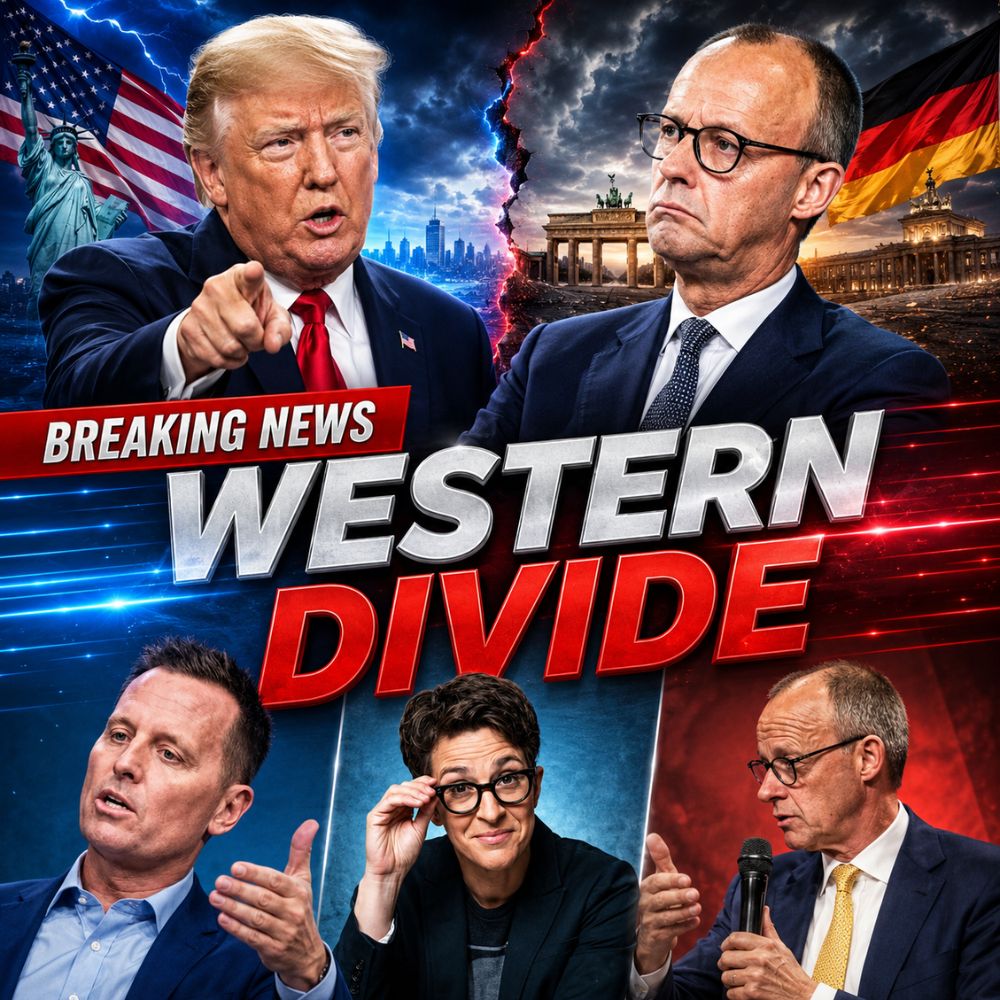
For decades, the alliance between Germany and the United States was considered one of the pillars of the Western world. From Cold War cooperation to economic integration, generations of German leaders openly promoted the American dream as a model of opportunity, stability, and innovation.
That is why the latest comments from German Chancellor candidate Friedrich Merz have sent shockwaves through political circles across Europe and beyond.
What began as a discussion with young Catholics in the Bavarian city of Würzburg has suddenly evolved into a much larger debate about the future of the transatlantic relationship — and whether faith in America itself is beginning to erode among European elites.
According to reports circulating across European media and social platforms, Merz made a statement that many observers described as extraordinary coming from a traditionally pro-American German conservative leader.
Speaking candidly to the audience, Merz reportedly admitted that he would no longer automatically encourage young Germans — including even his own children — to study, work, or build their future in the United States.
The reason, he suggested, was not hostility toward America itself.
Instead, he pointed toward what he described as a rapidly shifting and increasingly unstable social climate inside the country.
The room reportedly reacted with nervous laughter and applause, a moment that many political analysts now view as deeply symbolic.
For decades, audiences across Europe would likely have reacted with disbelief to such comments from a mainstream German politician. But the response suggested something very different: many people in the room appeared to already share the concern.
And that may be the most important part of the entire story.
The remarks come at a moment when relations between Europe and the United States are already under growing strain over issues ranging from trade and defense spending to technology regulation, energy policy, and global security priorities.
Across Europe, leaders have quietly begun debating a question that once seemed almost unthinkable:
Can Europe continue relying on the United States as the unquestioned center of the Western alliance?
That conversation has accelerated dramatically in recent years.
The return of political polarization in Washington, uncertainty surrounding future American elections, rising cultural tensions, and disputes over NATO strategy have all contributed to growing anxiety among European policymakers.
For Germany in particular, the issue carries enormous historical significance.
Since the end of World War II, the German-American partnership has shaped not only European security but also Germany’s own political identity. American universities, corporations, and cultural institutions long represented aspiration and prestige for many young Europeans.
Now, some analysts believe that image may be changing faster than many expected.
Supporters of Merz argue that his comments reflected legitimate concerns shared by many families across Europe.
They point to rising political division in the United States, concerns about public safety in some major cities, heated cultural conflicts, and uncertainty about immigration, education, and social stability.
Some also argue that Europe itself is changing.
Instead of automatically looking westward toward America for leadership, many European countries are increasingly attempting to strengthen their own institutions, economies, and geopolitical independence.
Critics, however, say the remarks risk damaging one of the world’s most important alliances at a dangerous moment for global stability.
Some commentators accused Merz of contributing to anti-American sentiment and exaggerating the problems facing the United States.
Others warned that public criticism from senior European figures could deepen divisions inside NATO at a time when Western unity remains crucial regarding conflicts involving Russia, China, and the Middle East.
Still, the controversy has continued growing because the comments appear to reflect a broader emotional shift already underway across parts of Europe.
In online discussions, many Europeans openly described feeling less attracted to the United States than previous generations were.
Some cited concerns over political extremism and social polarization.
Others argued that Europe increasingly offers stronger healthcare systems, more social protections, and greater long-term stability for younger generations.
The symbolism surrounding Merz himself makes the story even more dramatic.
Unlike anti-establishment populists who often criticize Washington, Merz has historically been viewed as strongly pro-transatlantic and economically conservative.
That is why many analysts believe his comments carry far greater weight than similar statements from fringe political figures would.
If even traditionally Atlanticist leaders are beginning to publicly question America’s social direction, some fear the psychological foundations of the Western alliance could be entering a new phase.
The timing is also politically sensitive inside Germany itself.
The country is currently facing enormous debates over immigration, economic competitiveness, military spending, energy transition policies, and Europe’s role in an increasingly fragmented world order.
German voters are becoming more skeptical of traditional political assumptions that dominated the post-Cold War era.
That skepticism now extends not only toward Brussels, but increasingly toward Washington as well.
Meanwhile, younger Europeans appear more divided than ever regarding their perceptions of America.
While many still admire American innovation, entertainment, universities, and entrepreneurial culture, others increasingly see the United States as politically chaotic and socially unpredictable.
That perception matters enormously.
Soft power has always been one of America’s greatest global strengths.
For generations, the idea of studying in New York, working in Silicon Valley, or building a future in the United States carried emotional and cultural prestige worldwide.
If that attraction weakens significantly, the geopolitical consequences could extend far beyond education or tourism.
Some experts believe Europe is now experiencing what could become a broader “strategic emotional decoupling” from the United States.
Not necessarily a formal break.
Not necessarily hostility.
But a gradual psychological distancing driven by uncertainty about America’s long-term direction.
And if that trend continues, it could reshape global alliances for decades.
Inside Washington, officials are reportedly paying close attention to these evolving attitudes among European elites and younger populations.
American policymakers have long viewed Europe not only as a military ally but also as a cultural and ideological partner.
Any erosion of that bond creates risks that extend far beyond diplomacy.
It affects trade.
Defense cooperation.
Technology partnerships.
Academic exchange.
And ultimately, public trust between societies.
Some observers argue the situation reflects a deeper transformation occurring across the entire Western world.
Traditional political consensus is weakening.
Public trust in institutions is declining.
National identity debates are intensifying.
And younger generations increasingly question assumptions that older political leaders once treated as permanent truths.
Within that environment, even a single remark from a senior European politician can suddenly resonate far beyond the room where it was spoken.
That is exactly what happened in Würzburg.
What may have initially sounded like an off-the-cuff personal reflection rapidly evolved into a symbol of something much larger: uncertainty about the future of the Western alliance itself.
Whether Merz intended it or not, his words opened a conversation many leaders had previously avoided saying aloud.
And the reaction suggests millions of people may already have been thinking the same thing privately for years.
Now the debate is no longer happening quietly behind diplomatic doors.
It is happening openly, emotionally, and publicly across Europe.
The deeper question now facing both Europe and the United States may not simply be about politics.
It may be about trust.
Can the transatlantic alliance still inspire the same confidence it once did?
Or is the Western world entering a new era where even its closest partners increasingly begin looking inward instead of toward each other?
That uncertainty is precisely why Friedrich Merz’s comments are now echoing far beyond Germany.
Because for many observers, this was not just a controversial statement.
It felt like a warning sign that something fundamental may already be changing beneath the surface of the Western alliance.