

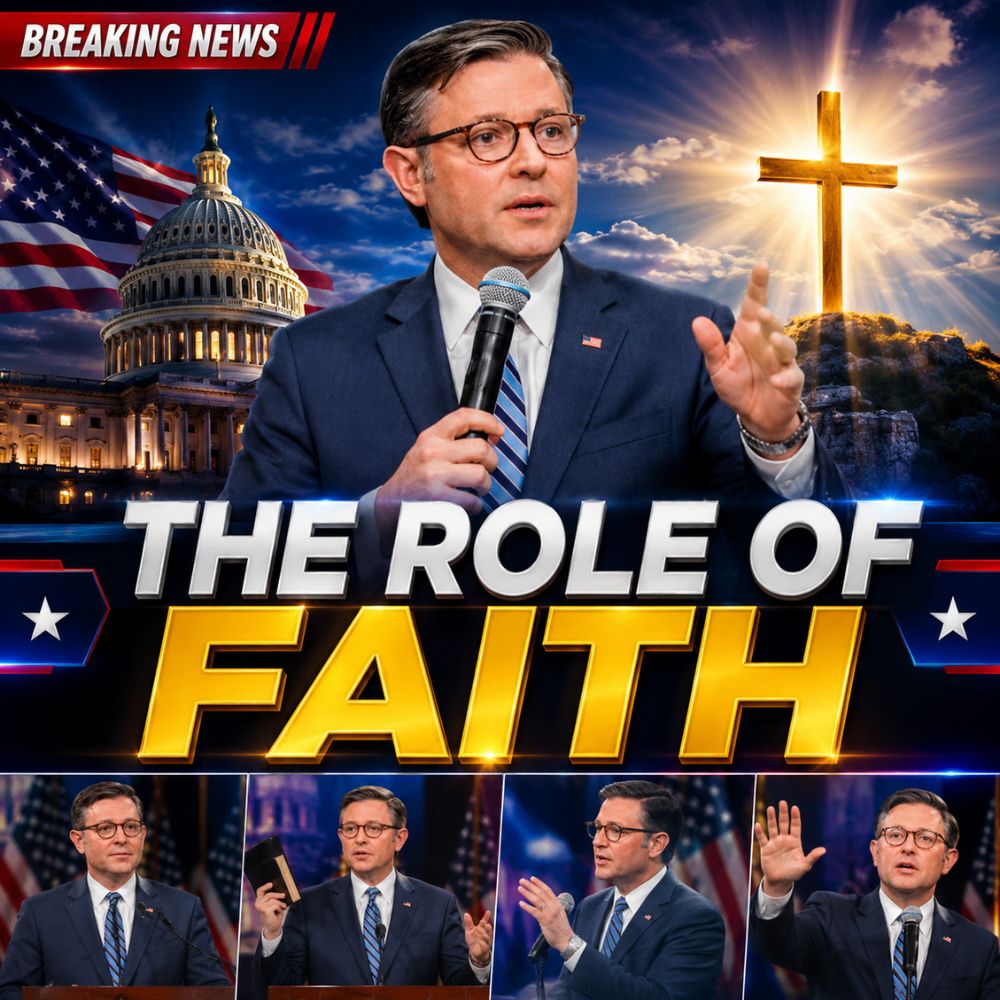
House Speaker Mike Johnson is pushing back on what he believes is a widespread misunderstanding of one of America’s most debated phrases, urging Americans to reconsider the true meaning of “separation of church and state” and the role of faith in public life.
Speaking at the 2026 National Catholic Prayer Breakfast in Washington, D.C., Johnson reflected on the nation’s spiritual foundations as the United States approaches the 250th anniversary of the Declaration of Independence. His message was clear: faith has always been central to America’s identity—and it still matters today.
“It is from the very birth of our nation that America has always been sustained by prayer and been reliant upon our foundation of religion and morality,” Johnson said. “It’s in the DNA of our nation and who we are.”
A former constitutional lawyer and professor, Johnson described religion in public life as one of the most misunderstood issues in modern society. He acknowledged that he is often criticized for speaking openly about his faith but argued that such expressions are deeply rooted in American history.
“I’m often criticized for invoking my faith,” he said. “That’s not some innovative thing.”
Johnson pointed to the origins of the phrase “separation of church and state,” noting that it does not appear in the Constitution itself but rather in a letter by Thomas Jefferson to the Danbury Baptist Association. In that letter, Jefferson described a “wall of separation” intended to protect religious freedom—not to remove faith from public life.
“Jefferson clearly did not mean that wall to keep religion from influencing our government and public life,” Johnson explained. “To the contrary, the Founders wanted to protect the church and the religious practice of citizens from an encroaching state, not the other way around.”
He expressed concern that modern interpretations of the phrase have flipped its original intent, often being used to argue that faith should be excluded from the public square altogether. According to Johnson, that perspective overlooks the role religious values have historically played in shaping a free and healthy society.
“Our Founders understood that a free society and a healthy republic depend upon religious and moral virtue,” he said, adding that these values help prevent the abuse of power and preserve liberty.
Johnson highlighted virtues such as personal responsibility, self-sacrifice, civility, strong families, and respect for human dignity—principles he believes are strengthened through faith. Without them, he warned, the nation risks losing the very foundation that has sustained it.
“Without those virtues indispensably supported by religion and morality, no nation can endure,” he said.
As he concluded his remarks, Johnson issued a call not just for reflection, but for action. He encouraged Americans to return to prayer and to recommit themselves to the principles that guided the nation’s founding.
“We have to rededicate ourselves to the cause of our Founders and turn toward prayer again, just as they did,” he said.
Describing the challenges facing the country as more than political or cultural, Johnson framed them in spiritual terms. “You and I know it’s a spiritual battle,” he added.
In a time of growing division and debate over the role of faith in public life, Johnson’s remarks serve as a reminder of a long-standing tension in American history—one that continues to shape conversations about freedom, belief, and the nation’s future.