

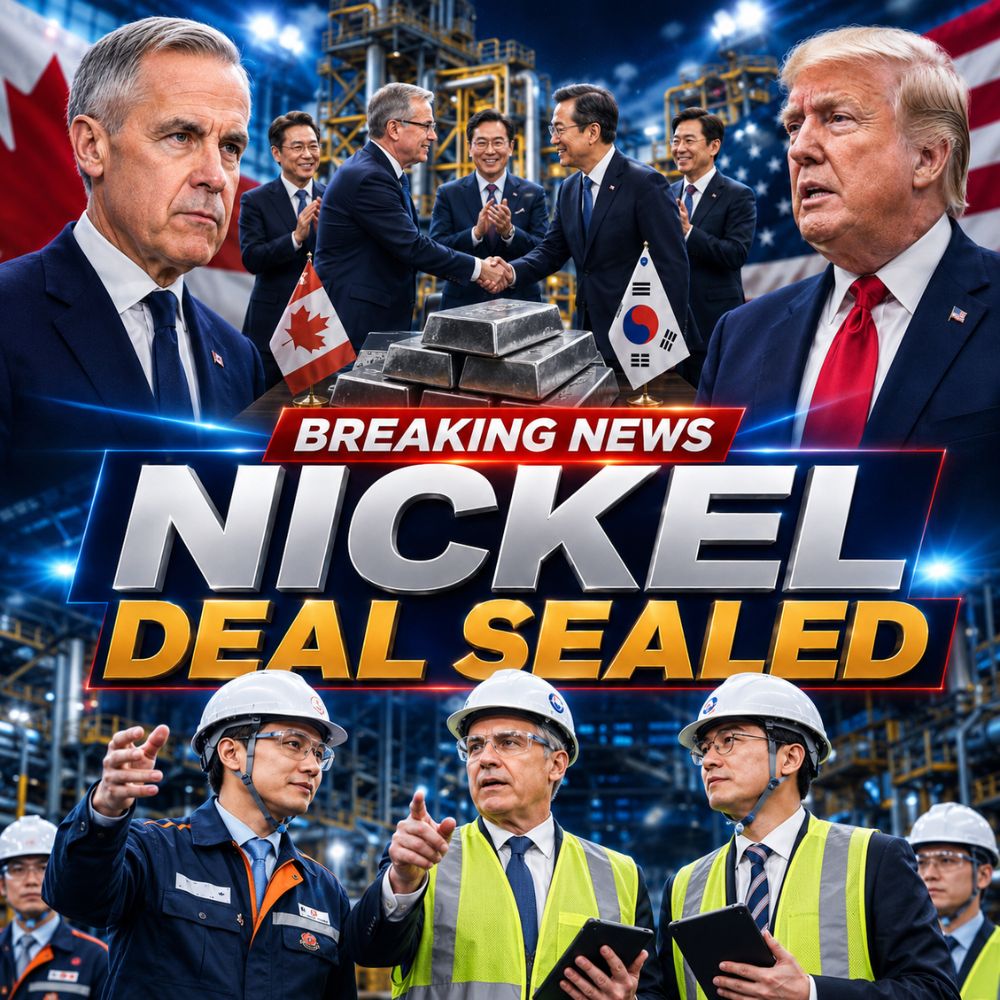
Korea Locks In Canadian NICKEL — Trump’s EV Battery Plants Just Lost the Supply Chain Four days ago, Canada and South Korea signed a major critical minerals agreement that could reshape the global EV battery supply chain.
The deal includes joint stockpiling of key minerals, deeper supply chain integration, and long-term cooperation on nickel production. While it received little attention in U.S. media, its implications are significant.
South Korea’s battery giants—LG Energy Solution, Samsung SDI, and SK On—depend heavily on imported battery materials. At the same time, Canada offers something increasingly valuable: stable, high-purity, battery-grade nickel produced outside China’s processing network.
For years, North America’s EV strategy relied on Canadian minerals feeding Korean-operated battery plants in the United States. But policy changes, including the removal of EV incentives and weakening demand growth, have altered that equation.
As a result, Canada and South Korea are strengthening direct ties, securing mineral supplies and building long-term industrial partnerships. The nickel that was expected to support American EV expansion may increasingly serve global battery and energy-storage markets instead.
This isn’t just a trade story. It’s a supply-chain story. And the countries securing critical minerals today could hold a major advantage in the industries of tomorrow.