


Republican House Speaker Mike Johnson has addressed accusations that his party plans to cut Social Security and other federal programs.
Following Johnson’s appearance on the Moon Griffon Show on June 8, Democrats accused him of planning cuts to entitlement and benefit programs, while Johnson said Republican efforts are focused on strengthening oversight and addressing what he described as “autopilot” spending.
The Trump administration is intensifying its focus on reducing federal spending and rooting out what it describes as widespread waste, fraud and abuse across government benefit programs.
What Johnson Said
In a clip from the interview posted on X, formerly Twitter, Johnson said: “The largest spending items, the reason we’re in trouble is because over 74 percent of federal spending is on autopilot—mandatory spending, that is your entitlement programs like Medicare, Medicaid, and things like Social Security—they have to be adjusted and fixed.
“We have a plan to do that next year, and it’s critical, because we’re at $40 trillion plus in debt. At some point you get into a hole so deep you can’t climb out of it, so desperate times call for desperate measures.”
The comments quickly drew criticism from Democrats, who argued Johnson was signaling future reductions to major entitlement programs.
Democrats Accuse GOP of Targeting Benefits
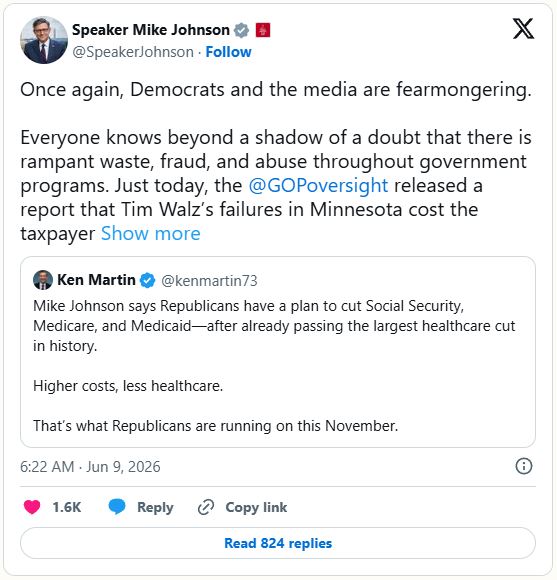
Responding to the clip, Ken Martin, chair of the Democratic National Committee, wrote on X: “Mike Johnson says Republicans have a plan to cut Social Security, Medicare, and Medicaid—after already passing the largest healthcare cut in history.
“Higher costs, less healthcare. That’s what Republicans are running on this November.”
The exchange reflects a longstanding political divide over entitlement spending, with Democrats warning that Republican reforms could reduce benefits while Republicans argue changes are needed to improve efficiency and strengthen program finances.
Johnson’s Response
The Republican rejected the criticism and accused Democrats and news organizations of misrepresenting his remarks.
“Once again, Democrats and the media are fearmongering,” Johnson wrote in a post on X.
“Everyone knows beyond a shadow of a doubt that there is rampant waste, fraud, and abuse throughout government programs. Just today, the @GOPoversight released a report that Tim Walz’s failures in Minnesota cost the taxpayer potentially $9 billion in Medicaid-related funds and roughly $300 million in federal child nutrition funds.”
Johnson added: “During this Congress, the House has already passed substantive legislation to clean up this waste, fraud, and abuse, and Democrats have voted against nearly every piece of legislation we’ve passed.
“We will continue to do so in this Congress and in future Congresses so that these important programs can be preserved for the American citizens that need them. Democrats love to say that ‘everybody is against fraud,’ and they are right—this is a 90/10 issue.
“Republicans are the ones with the courage to actually do anything about it.”
Why Spending Cuts Are Back in Focus
Reducing government spending has become a central priority for President Donald Trump and congressional Republicans, particularly in Social Security, Medicare, Medicaid, food assistance and other benefit programs.
In March, Trump signed an executive order creating a government-wide Task Force to Eliminate Fraud. The administration said the initiative was designed to strengthen oversight and recover taxpayer dollars lost through improper payments and fraudulent claims.
Trump has repeatedly argued that eliminating fraud could generate substantial savings without reducing benefits for eligible recipients.
How Much Money Is Lost to Improper Payments?
Federal agencies estimated roughly $186 billion in improper payments across 64 government programs during fiscal year 2025, according to the Government Accountability Office (GAO).
The figure was approximately $24 billion higher than the previous year.
The GAO said about $153 billion—or 82 percent of the total—consisted of overpayments. Nineteen reporting programs recorded improper payment rates of at least 10 percent, while six exceeded 25 percent.
Some of the largest estimated totals included:
- Federal-State Unemployment Insurance: $5.6 billion
- Medicaid: $37.4 billion
- Medicare Fee-for-Service: $28.8 billion
- Medicare Advantage: $23.7 billion
- Earned Income Tax Credit: $21.1 billion
- SNAP: $10.2 billion
- Shuttered Venue Operators Grant Program: $10.1 billion
- Supplemental Security Income: $7.3 billion

The GAO cautioned that improper payments are not necessarily fraudulent.
The category includes payments that should not have been made, were made in the wrong amount, or resulted from paperwork mistakes, eligibility errors or administrative problems. Fraud, by contrast, involves deliberate deception intended to obtain government funds illegally.
“Improper payments—those that should not have been made or were made in incorrect amounts—have consistently been a government-wide issue,” the GAO said in a summary of its findings.