

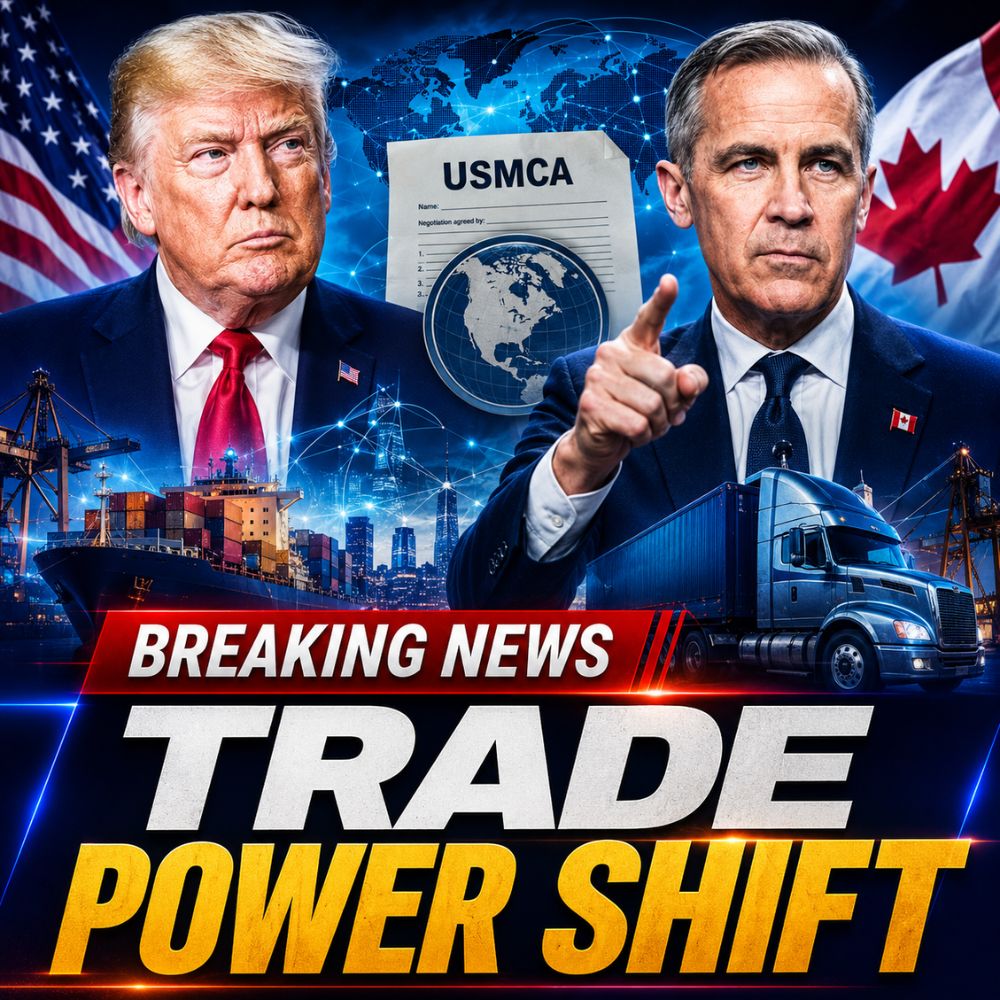
Trump Said He’d Rather Have No Usmca — Carney’s Six Words Changed The Entire Conversation
What if one of the most consequential moments in the Canada–United States trade dispute did not come from a tariff announcement, a presidential threat, or a high-stakes negotiation session?
What if it came from six quiet words spoken by a Canadian prime minister who understood that the most effective response to a bluff is not a bigger bluff—but a reminder of reality?
That is precisely why a seemingly routine exchange this week has attracted so much attention among economists, political strategists, and business leaders across North America. At first glance, the story appeared to be another chapter in the familiar drama surrounding the future of the United States-Mexico-Canada Agreement, known as USMCA in the United States and CUSMA in Canada.
Donald Trump once again adopted a confrontational position, suggesting that the United States might be better off without the trade agreement altogether. The comment immediately generated headlines and renewed concerns about the future of North American trade integration. For many observers, the message seemed straightforward: Washington was reminding Canada that America remained the dominant economic power in the relationship.
But beneath the headlines, something far more interesting was unfolding.
Rather than responding with outrage or escalating the rhetoric, Prime Minister Mark Carney chose a very different path. His response was brief, measured, and remarkably strategic. Instead of arguing about who needed whom more, Carney redirected attention toward a question that many political discussions conveniently ignore: who would actually bear the immediate cost if the agreement collapsed?
That subtle shift transformed the conversation.
For years, much of the debate surrounding Canada-U.S. trade disputes has been built around a familiar assumption. Canada exports roughly three-quarters of its goods to the United States. Therefore, the argument goes, Canada has more to lose in any confrontation. The implication is that Washington possesses overwhelming leverage while Ottawa has limited room to maneuver.
There is truth in that assessment. The United States remains Canada’s largest trading partner by an enormous margin. No serious analyst disputes that reality. Canadian prosperity remains deeply connected to access to the American market.
Yet economic relationships are rarely as simple as headline statistics suggest.
The dependency narrative often overlooks a crucial fact: integration works in both directions.
Canada is not merely a seller of optional goods. It supplies products and resources that are deeply embedded within the American economy. Canadian oil helps fuel U.S. refineries. Canadian electricity powers homes and businesses in several northern states. Canadian potash supports American agriculture. Canadian uranium contributes to energy production. Canadian aluminum, steel, timber, and critical minerals play important roles in industrial supply chains.
These are not products that can be easily replaced overnight.
The same reality applies to manufacturing. Modern North American supply chains have become extraordinarily interconnected over the past three decades. Components frequently cross the border multiple times before becoming finished products. An automobile assembled in North America may contain parts that moved back and forth between Canada and the United States several times during production.
A disruption to that system would not simply create problems in Ontario or Quebec. It would also affect factories in Michigan, Ohio, Pennsylvania, and other states that depend on integrated continental production networks.
This is where the significance of Carney’s response becomes clearer.
Rather than engaging in a political contest over national pride, he focused attention on economic consequences. The underlying message was simple: if USMCA collapses, the costs do not begin and end in Canada. They immediately affect American businesses, consumers, manufacturers, and workers as well.
That message matters because it challenges the core assumption underlying many pressure tactics.
Trade threats are effective when one side believes it has no alternatives and significantly more to lose. But if both sides face substantial costs, the dynamic changes. The negotiation becomes less about dominance and more about mutual dependence.
Carney’s approach reflects a broader philosophy that has increasingly shaped Canada’s economic strategy.
Unlike many politicians, Carney comes from a background rooted in central banking and financial markets. He led the Bank of Canada during the global financial crisis and later guided the Bank of England through the uncertainty surrounding Brexit. Throughout those experiences, he developed a reputation for focusing on data, structural realities, and long-term risks rather than political theatrics.
That background may help explain why he avoided taking Trump’s bait.
A more traditional political response would have involved counter-threats, fiery speeches, and declarations that Canada would never be pushed around. Such statements might have generated positive headlines at home, but they would also have elevated the conflict and potentially strengthened Trump’s preferred negotiating environment.
Instead, Carney did something more subtle.
He reduced the emotional temperature of the dispute and redirected attention toward economic facts.
The timing of this exchange is particularly important because it comes amid growing uncertainty regarding the future structure of North American trade.
Businesses across the continent have spent decades operating under assumptions of relative stability. Factories, transportation networks, investment decisions, and employment strategies have all been built around the expectation that goods can move efficiently between Canada, the United States, and Mexico.
Any serious disruption would create consequences extending far beyond government negotiating rooms.
This helps explain why many American business groups have consistently supported preserving a stable continental trade framework. While political leaders may occasionally view trade agreements as leverage, businesses tend to view them as infrastructure. They provide predictability, planning certainty, and investment confidence.
The longer uncertainty persists, the greater the economic costs become.
Ironically, this may be one of Canada’s strongest advantages moving forward.
The more frequently the possibility of disruption is raised, the more pressure is placed not only on Canadian policymakers but also on American companies that rely on integrated supply chains. Over time, those businesses can become powerful advocates for stability within Washington itself.
In that sense, threats intended to increase leverage can sometimes produce the opposite effect.
Every discussion about abandoning or weakening USMCA encourages companies to evaluate alternatives, diversify operations, and lobby for greater certainty. The result is that pressure designed to strengthen one side’s negotiating position may gradually erode it.
At the same time, Canada has not been standing still.
While headlines focus on tariff disputes and political rhetoric, Ottawa has been pursuing a broader strategy aimed at reducing vulnerability. Trade missions, international investment initiatives, critical mineral partnerships, energy agreements, and deeper relationships with allies have become increasingly prominent components of Canada’s economic agenda.
These efforts are not intended to replace the United States.
That would be unrealistic.
Instead, they are designed to reduce dependence on any single market and increase Canada’s strategic flexibility.
This distinction is critical.
Diversification does not require abandoning existing partnerships. It simply means ensuring that future economic growth is supported by multiple pathways rather than a single one.
Over time, that approach can alter negotiating dynamics.
A country with alternatives tends to negotiate differently from a country that believes it has none.
This brings us to the central question raised by this week’s exchange: did Carney’s six-word response reveal that Canada’s position is stronger than many people assume?
Based on the broader economic and strategic context, the answer appears to be yes—though with important qualifications.
Canada remains deeply tied to the United States. Geography, infrastructure, investment patterns, and decades of integration ensure that reality will not change anytime soon. The American market will remain essential to Canadian prosperity for the foreseeable future.
However, strength in negotiations is not determined solely by size. It is also determined by resilience, alternatives, credibility, and the ability to absorb pressure without appearing desperate.
That is where Carney’s response may have been particularly effective.
Rather than arguing that Canada would emerge unscathed from a trade confrontation, he highlighted an equally important reality: the United States would not emerge unscathed either. The costs would be shared, and in some cases they could arrive faster than many political leaders would prefer.
That observation does not eliminate risks. It does not guarantee success. And it certainly does not mean future trade disputes will be easy.
But it does suggest that the old assumption—that Canada automatically folds whenever Washington applies pressure—is becoming increasingly difficult to sustain.
So when Trump suggested that America might be better off without USMCA, the real significance of Carney’s response was not the words themselves. It was what those words revealed.
They revealed a Canada that appears increasingly confident in its ability to withstand pressure, increasingly committed to diversification, and increasingly willing to challenge assumptions that have shaped North American trade debates for years.
Whether that strategy ultimately succeeds remains to be seen. Diversification is a long-term project, and significant challenges remain ahead.
But one thing is becoming increasingly clear: this week’s story was not simply about a trade agreement. It was about a changing balance of confidence. And for perhaps the first time in a long time, Canada no longer appears to be negotiating from a position of fear. Instead, it is negotiating from a position built on patience, preparation, and the growing belief that it has more options than its critics assume.
And if that perception continues to gain credibility, the consequences could extend far beyond the future of USMCA itself, shaping the economic and strategic relationship between Canada and the United States for years to come.