

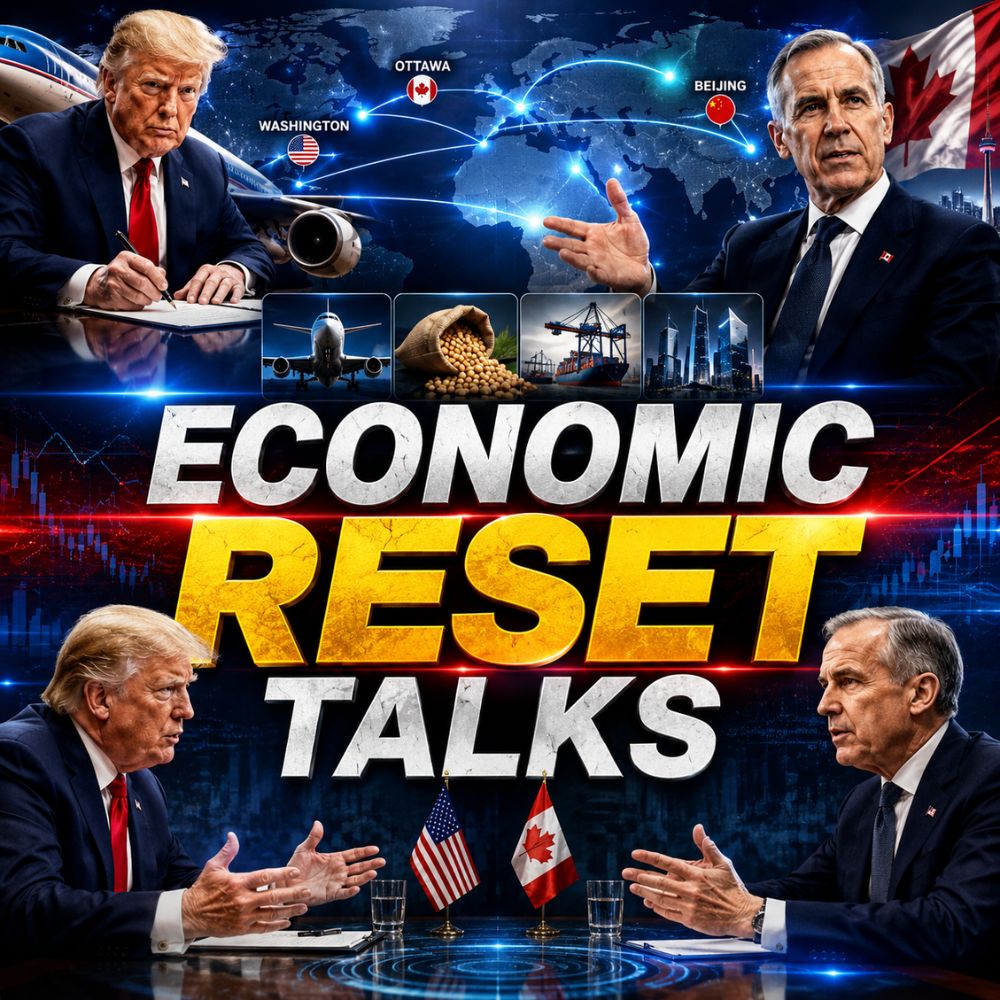
Trump Goes to China for Help After Threatening Canada — Carney Was Already There…
The image itself carried enormous symbolism.
Donald Trump stepped off his aircraft in Beijing surrounded by some of the most powerful corporate executives in the world: Elon Musk, Tim Cook, Jensen Huang, senior representatives from BlackRock, Boeing, and Goldman Sachs.
Officially, the trip was described as a high-level economic mission designed to stabilize relations between the United States and China after months of escalating global tensions.
But behind the carefully managed photographs and diplomatic handshakes, another story was impossible to ignore.
Canada had already arrived months earlier.
And that may be the detail now making Washington deeply uncomfortable.
Earlier this year, Canadian Prime Minister Mark Carney quietly traveled to Beijing at a moment when global attention remained focused almost entirely on American politics, Middle East instability, and rising trade conflicts across the Pacific.
At the time, few observers fully understood what Ottawa was attempting to do.
Carney’s government avoided dramatic headlines.
There were no triumphalist speeches.
No public confrontation with Washington.
No theatrical declarations about reshaping the global order.
Instead, Canada approached China with a narrower and far more pragmatic objective: stabilize trade flows, secure export markets, and reduce economic vulnerability.
That strategy now appears increasingly significant.
During Carney’s visit, Canadian officials reportedly focused heavily on agricultural exports, energy cooperation, and long-term market access.
Among the most important developments was renewed Chinese demand for Canadian canola products after months of uncertainty in global commodity markets.
For Canada, the timing mattered enormously.
American tariff pressure, unpredictable trade disputes, and growing concerns about overdependence on the U.S. market had already pushed Ottawa toward a broader diversification strategy involving Europe, Asia, and emerging Pacific partnerships.
China represented one piece of that larger calculation.
And Carney moved early.
What makes the situation politically explosive today is the contrast between Trump’s earlier rhetoric and his current position.
Only months ago, Trump sharply criticized Canada for increasing economic engagement with Beijing.
At campaign rallies and press conferences, he warned that countries cooperating too closely with China could face economic consequences.
Canada, according to Trump’s narrative at the time, was supposedly making a dangerous strategic mistake by expanding ties with Beijing while Washington was attempting to apply pressure on Chinese trade policies.
But now the optics have completely reversed.
The president who condemned Canada for negotiating with China has arrived in Beijing himself seeking economic cooperation on multiple fronts simultaneously.
And global observers immediately noticed the contradiction.
The list of issues now confronting Washington is enormous.
American industries remain deeply dependent on Chinese manufacturing capacity, rare earth mineral processing, battery supply chains, and critical technology components.
Meanwhile, tensions linked to the Iran crisis, energy instability, semiconductor competition, and slowing global growth have increased pressure on the White House to reduce economic uncertainty wherever possible.
That reality explains why Trump’s Beijing delegation included leaders from some of America’s largest corporations.
These companies are not visiting China for symbolism.
They are there because the economic relationship remains too large to ignore.
For executives inside the delegation, the stakes are exceptionally high.
Tesla continues relying heavily on Chinese production capacity and battery supply networks.
Apple still depends extensively on Chinese manufacturing ecosystems despite years of diversification efforts.
NVIDIA faces enormous pressure surrounding advanced AI chips and export restrictions.
And companies like Boeing remain eager to recover access to one of the world’s largest aviation markets.
The message from corporate America is becoming increasingly clear: full economic separation from China is far more complicated than political slogans suggest.
That is precisely why Carney’s earlier approach now appears strategically important.
Unlike Washington, Ottawa did not frame engagement with Beijing as ideological surrender or geopolitical confrontation.
Canada approached the relationship as a middle power attempting to protect national economic interests in an increasingly fragmented world economy.
That distinction matters.
Carney avoided inflammatory rhetoric.
He focused on exports.
He pursued sector-specific agreements.
And he deliberately positioned Canada as flexible, stable, and commercially pragmatic.
Months later, the United States now appears to be pursuing many of the same objectives—only under far greater political pressure.
The deeper geopolitical story extends far beyond Canada and the United States.
Beijing itself is changing role inside the global system.
For decades, Washington operated as the undisputed center of global economic gravity.
Most countries structured diplomacy, finance, and strategic planning around American power.
But the images emerging from Beijing this week tell a more complicated story.
China is increasingly positioning itself as a parallel diplomatic center where governments, multinational corporations, and competing global blocs all seek influence simultaneously.
Russia negotiates there.
European leaders travel there.
Middle powers coordinate there.
And now even Washington arrives seeking stabilization.
That shift alone represents a major transformation in global politics.
For Canada, the implications are potentially enormous.
Ottawa has spent years attempting to balance its overwhelming economic dependence on the United States with the realities of a changing international system.
Nearly every Canadian government understood the structural risk of relying too heavily on a single trading partner.
But political caution often limited how aggressively Canada diversified.
Under Carney, that caution appears to be fading.
The current strategy increasingly emphasizes multiple trade corridors:
Europe through expanded EU cooperation.
Asia through energy and agricultural exports.
And broader middle-power partnerships designed to reduce vulnerability to sudden American policy shifts.
China is not replacing the United States in that framework.
But Beijing is clearly becoming part of Canada’s long-term diversification strategy.
That evolution is happening during one of the most unstable periods in recent global economic history.
Energy prices remain volatile.
Supply chains continue shifting.
Military tensions affect shipping routes.
Artificial intelligence is reshaping industrial competition.
And governments across the world are becoming more aggressive about securing strategic resources and manufacturing capacity.
In that environment, flexibility becomes power.
Countries able to maintain relationships across multiple economic centers gain leverage.
Countries trapped inside narrow dependency structures become vulnerable.
Canada appears increasingly determined to move into the first category.
Trump’s Beijing visit therefore carries two completely different narratives at once.
Supporters will present the trip as proof of strong American leadership and pragmatic diplomacy.
Critics will argue it exposes the limits of Washington’s confrontational trade strategy after years of tariff threats and escalating rhetoric.
But internationally, many governments may focus on a third interpretation entirely:
The realization that middle powers like Canada are beginning to adapt to the new global order faster than some larger powers expected.
The symbolism surrounding timing is especially striking.
Carney entered Beijing months earlier while Washington was still focused heavily on confrontation.
Canada secured agricultural relief, stabilized key export sectors, and quietly expanded dialogue.
Now the United States arrives later, carrying visible pressure from global instability, energy concerns, corporate lobbying, and domestic economic anxieties.
Whether intentional or not, the sequence creates a powerful perception internationally:
Ottawa recognized the Pacific shift early.
Washington is now responding to it.
And in diplomacy, perception often matters almost as much as reality itself.
There is also a larger psychological shift underway among America’s allies.
For decades, many Western governments automatically aligned their economic strategies with Washington’s geopolitical priorities.
Today, that alignment is becoming more conditional.
Countries increasingly pursue what analysts call “multi-vector diplomacy” — maintaining relationships with several major powers simultaneously in order to reduce exposure to political shocks from any single capital.
Canada’s recent actions fit directly into that model.
So do similar moves emerging from Europe, Southeast Asia, and parts of the Middle East.
None of this means American influence is disappearing.
The United States remains the world’s largest military power, one of its largest economies, and the central player in global finance and technology.
But influence is no longer as automatic as it once was.
And the Beijing optics this week highlighted that reality with unusual clarity.
The president of the United States arrived seeking cooperation from the same country his administration previously criticized allies for engaging with.
Meanwhile, Canada had already built part of that relationship quietly in advance.
For Trump, the immediate political objective is straightforward: return home with agreements, stability, and evidence that Washington still controls the direction of global economic negotiations.
For Carney, the objective appears different.
Canada is attempting to position itself as adaptable, globally connected, and less dependent on any single superpower relationship.
Those are not identical strategies.
And over the next decade, the difference between them may matter far more than many people currently realize.
Because the most important takeaway from this week may not be about China at all.
It may be about the changing structure of global power itself.
The old world operated around one unquestioned center.
The new world increasingly looks multipolar, fragmented, and strategically fluid.
And in that environment, countries that move early, diversify carefully, and avoid ideological rigidity may gain advantages larger powers struggle to recognize until much later.
Canada appears to understand that.
The United States is now trying to catch up.