

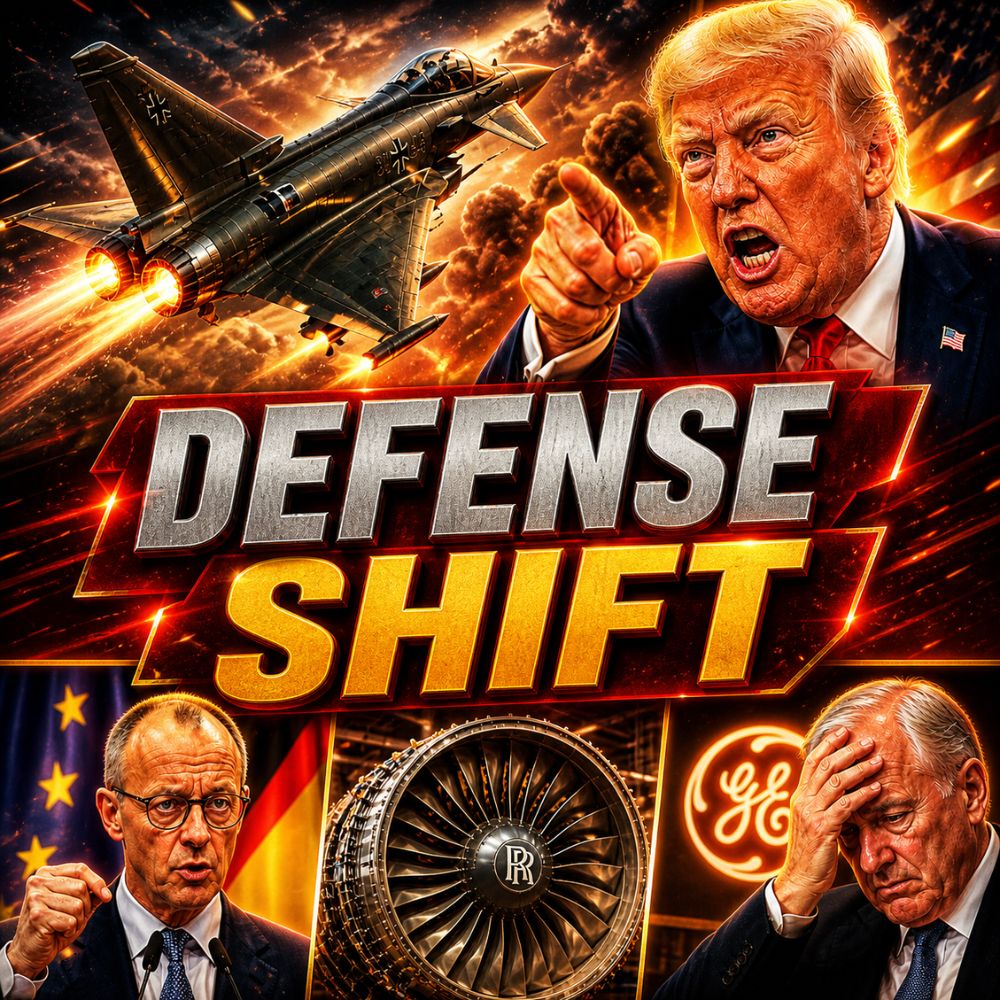
BERLIN — It began as a technical procurement discussion within Europe’s next-generation defense planning framework. But the narrative quickly expanded into a broader strategic conversation about technological autonomy and transatlantic defense alignment. What was initially viewed as a routine engine selection debate has now evolved into a development closely watched by defense analysts, policymakers, and aerospace industry stakeholders worldwide.

According to sources familiar with early-stage deliberations, German officials have increasingly emphasized long-term industrial resilience and supply chain independence when assessing future sixth-generation fighter components. The preference for Britain’s Rolls-Royce over America’s General Electric represents not merely an engineering choice but a deliberate strategic signal.
While no abrupt policy shift has been formally confirmed, behind-the-scenes consultations are said to have focused on balancing performance requirements with strategic diversification of defense technology partnerships. Germany, along with France and Spain, is moving forward with the Future Combat Air System (FCAS) — a program designed to produce the world’s first fully operational sixth-generation fighter by 2040 .
Advisers within European defense circles are reportedly reviewing multiple technical pathways, weighing interoperability standards, lifecycle costs, and the geopolitical implications of engine integration choices. Analysts note that next-generation fighter programs inherently involve complex collaboration structures, where technological decisions often reflect broader strategic priorities rather than purely engineering considerations .
The engine decision is particularly significant. European developers have confirmed that FCAS will employ an adaptive or variable cycle engine — a technological path distinct from American and British projects . Germany’s MTU Aero Engines, working with France’s Safran and Spain’s ITP Aero, is pushing for what one program official called “a true cutting-edge product, not an improved M88 or EJ200” .
Industry observers and aerospace manufacturers are now monitoring the situation closely. Potential shifts in supplier alignment could influence research funding flows, joint development frameworks, and long-term defense industrial cooperation across NATO partners. Experts suggest that even incremental procurement signals can reshape expectations across the global defense market.
The broader context cannot be ignored. Germany is in the midst of a historic defense transformation. Chancellor Friedrich Merz has pledged to spend more than 1 trillion euros over the next 12 years on infrastructure and defense, with roughly half earmarked for military spending . Berlin plans to transform the Bundeswehr into Europe’s strongest conventional army .
This rearmament drive is driven by a growing realization that the United States can no longer be relied upon as a guaranteed security partner. Under former President Donald Trump, Washington has questioned European defense capabilities, imposed tariffs, and signaled a reduced commitment to NATO . The result is a Europe that feels it must build its own strategic capacity.
“Those who scale and deploy the right technologies can better protect themselves against aggressors,” wrote Thomas Enders and Moritz Schularick of the German Council on Foreign Relations in a recent analysis. “Germany must now implement this in its defense policy” .
The FCAS program, estimated to cost more than 100 billion euros, is not without internal tensions. France’s Dassault Aviation has pushed for greater decision-making authority, while Germany and Spain insist on maintaining balanced industrial workshare agreements . But despite these frictions, the program’s strategic importance has only grown.
European leaders have also emphasized the need to reduce dependence on non-European suppliers for critical technologies. Germany’s first-ever space security strategy, released in November 2025, explicitly calls for reducing reliance on “non-European actors” for intelligence, surveillance, reconnaissance, and launch capabilities .
The engine decision fits this pattern. By choosing a European-led propulsion pathway — even one that involves British rather than German firms — Berlin signals that transatlantic technological dependence is no longer acceptable. This is not anti-Americanism. It is strategic realism.
Online discussions intensified as commentators debated whether the move represents a strategic recalibration or simply a program-specific engineering preference. Supporters frame it as a step toward technological sovereignty, while critics caution that divergence in core systems could introduce new coordination challenges in multinational defense initiatives.
Yet the momentum toward European autonomy appears irreversible. Germany has announced it will invest €35 billion over the next five years on space security alone . It is developing independent satellite reconnaissance capabilities. It is exploring orbital defense systems. And it is building a fighter jet engine without American involvement.
As consultations and evaluations continue, one question remains at the center of the debate: Is this a singular technical decision within a complex fighter program — or an early indicator of a broader shift in how Europe approaches defense technology partnerships in an increasingly multipolar security landscape?
The answer, increasingly, seems to be both. Europe is not abandoning the United States. But it is no longer waiting for Washington to lead. The Rolls-Royce decision is a small but unmistakable signal that the era of automatic transatlantic technological alignment is ending.
For American defense contractors like General Electric, the message is clear: European markets will no longer be treated as captive. For European policymakers, the message is equally clear: the future of defense is sovereign, collaborative within Europe, and strategically independent.
The sixth-generation fighter that eventually enters service in 2040 will be European in ways that its predecessors were not. And the engine that powers it will be a symbol of a continent that has finally decided to build its own destiny.